Tether–Bitfinex Class Action: What It Means for Stablecoin Trust and Market Structure
Summary
Executive summary
The U.S. federal court’s decision to let the Tether–Bitfinex dispute proceed as a class action is more than a litigation technicality — it’s a governance and market-structure event. Plaintiffs allege that large-scale minting of USDT in 2017 helped prop up crypto asset prices and constituted market manipulation; the court’s move, reported by CoinPedia, formally opens the door to consolidated damages claims on behalf of broad market participants. This piece unpacks the allegations, legal timelines and remedies, the liquidity and contagion risks for USDT, and concrete steps compliance officers and treasury teams should take to reassess stablecoin counterparty exposure.
Background: the 2017 allegations in plain language
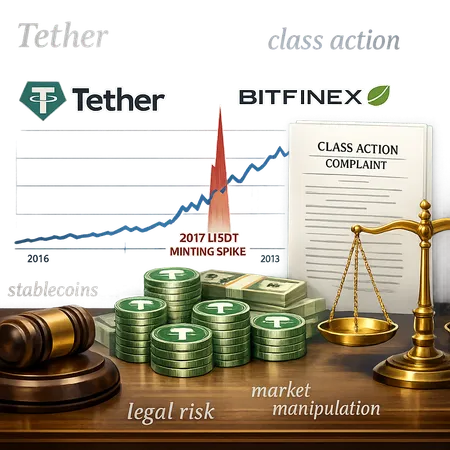
At the core of the class-action complaint are two connected allegations: first, that USDT was minted in response to demand engineered to push crypto prices upward; second, that those issuances were coordinated with Bitfinex trading to distort market prices during the 2017 bull run. Plaintiffs argue these actions amplified price moves and caused losses to retail and institutional traders who traded at distorted prices. The recent court decision allowing the suit to proceed as a class action is summarized in this report: U.S. court approves class action in Tether–Bitfinex case.
These are allegations — not yet adjudicated facts. Still, simply having a class action can change market behavior: it concentrates many small claims into a single vehicle, increases potential damages exposure, and makes discovery more intrusive (forcing disclosure of internal minting and custody records). For treasury managers, that prospect alone changes counterparty calculus.
Legal timeline, possible remedies, and what to watch for
Class certification is the gateway; discovery and motions follow. Timelines in complex financial class actions often span years. Key milestones to monitor:
- Pleadings and motions to dismiss — defendants can attack legal sufficiency early. If complaints survive, the case proceeds to discovery.
- Discovery phase — may force production of internal documents, bank records, and testimony that explain minting policies and custodial arrangements.
- Summary judgment motions and trial — eventual rulings may limit or expand remedies.
Potential remedies available in class actions of this kind can include monetary damages, disgorgement of profits, and in limited cases injunctions or operational restraints (for example, court-ordered transparency or oversight measures). Plaintiffs may also seek industry-wide reforms or disclosures as part of settlement negotiations. Any remedy that affects how USDT is issued, redeemed, or disclosed would ripple through trading venues and trusts that use USDT as a liquidity rail.
Why this matters now: market sensitivity and amplification
Markets are more finely tuned to trust events than they were in 2017. Recent liquidations and sensitivity to narratives show how quickly shocks can cascade: a market roundup highlighting sharp liquidations and rapid price drops illustrates how legal or trust events can exacerbate selling pressure across BTC, ETH and other tokens (market roundup and liquidations). Likewise, on-chain analytics show how whale flows and exchange movements can precede broader sell-offs — the kind of dynamics that make allegations about coordinated minting particularly meaningful for risk managers (whale flows and exchange movements).
In short: when confidence in a dominant liquidity token wavers, price dislocations happen fast. That fragility is especially pronounced because USDT remains one of the largest stablecoins by market cap and liquidity, and it acts as the native medium of settlement on many exchanges and DeFi protocols.
Contagion vectors: how USDT legal risk can become liquidity risk
There are several technical and commercial channels through which legal risk could become solvency or liquidity stress for market participants:
- Exchange runs on USDT balances. If counterparties or exchanges fear freeze or adverse rulings that restrict redemptions, they may rapidly reduce USDT holdings, increasing spread and slippage.
- Redemption friction. If legal outcomes limit redeemability or complicate banking rails, on- and off-ramp efficiency declines and market-making becomes costlier.
- DeFi protocol exposure. Automated market makers, lending pools, and synthetics that use USDT as collateral or settlement could face sudden re-pricing, forced liquidations, or oracle stress. Many of these protocols are active in DeFi and rely on stablecoins for stable unit-of-account.
- Cross-asset spillover. Because traders frequently pair USDT with major assets (for many, Bitcoin is the bellwether), sudden USDT illiquidity can transmit to spot markets via forced conversions and margin calls.
A legal loss or even a protracted discovery process that uncovers problematic operational or custodial practices could reduce counterparties’ willingness to hold USDT, making liquidity dry up at the worst possible moment.
Practical steps: what compliance officers and treasury teams should do now
For those responsible for balance sheet safety and compliance, this ruling is a trigger event to operationalize a stablecoin risk plan. Recommended actions:
Map exposures precisely. Inventory where USDT sits: custodial wallets, exchange balances, DeFi contracts, OTC counterparties, and internal settlement flows. Treat this like a counterparty concentration report.
Stress-test liquidity. Model scenarios where USDT experiences 10–50% bid-offer widening, partial redemption freezes, or full withdrawal from a major exchange. Quantify potential margin calls and funding shortfalls.
Diversify rails and counterparties. Consider alternative stablecoins (with due diligence) or non-stablecoin settlement rails for critical flows. Don’t concentrate all settlement or treasury liquidity on a single issuer.
Strengthen contractual protections. Amend custodial, prime-brokerage, and exchange agreements to include clearer remedies, settlement guarantees, and representations about stablecoin reserves and redemption mechanics.
Increase on-chain monitoring and alerts. Use real-time tooling to detect abnormal minting, whale flows, or exchange withdrawals tied to USDT so you can execute contingency plans quickly.
Coordinate with legal teams. Maintain a litigation-monitoring protocol and prepare for document demands that might involve your own records if you transacted heavily against USDT during the relevant period.
Bitlet.app clients and institutional treasuries should see this as a prompt to review automation and failover logic in their settlement stacks.
Custodians and exchanges: discrete operational risks
Custodians and hosted wallets must consider legal-process vulnerabilities: subpoenas, asset freezes, and requirements to produce transactional data. Exchanges face market-structure pressures: sudden off-exchange redemption stress could create wide spreads, re-quote cycles, and failed settlements. Operational best practices include enhanced KYC for large USDT redemptions, conservative intraday limits, and break-glass liquidity sources (e.g., central bank money alternatives or diversified stablecoin pools).
Scenario analysis and playbook (short)
- Best case: The case is dismissed or settled with limited operational changes. Market impact is muted and USDT liquidity recovers.
- Moderate case: Settlement imposes disclosures and modest financial remedies. Markets price-in legal cost; spreads widen temporarily.
- Stress case: Discovery reveals operational faults, leading to heavy fines or restrictions. Market participants pull USDT; contagion hits exchanges and DeFi.
Prepare threshold-triggered responses: threshold A (minor widening) — rotate to alternate stablecoins; threshold B (significant redemption friction) — suspend non-critical settlements and activate liquidity lines.
Regulatory and policy ripple effects
Beyond immediate market impacts, a class-action resolution could spur regulatory interest in stablecoin issuance standards, reserve audits, and redeemability rules. Expect closer scrutiny from national regulators and possibly new disclosure obligations. This legal pressure could accelerate market moves toward more auditable, regulated stablecoins or push innovation in insured custody and collateralization models.
Conclusion: treat stablecoin exposure as counterparty risk, not cash
USDT has been treated as near-cash by many participants, but a live class action underscores that stablecoins are contractual instruments backed by counterparties and operational processes. The court’s decision to allow class certification raises practical questions about discoverability, damages exposure, and possible operational constraints on USDT issuance or redemption. For compliance officers, treasury teams, and crypto investors, the prudent response is to map exposures, stress-test liquidity, diversify rails, and harden contractual protections. Markets are quick to punish perceived trust deficits; acting early reduces the risk of being forced into costly, reactive decisions.
Sources