ERC-8004 Explained: How On-Chain Agent Identities and Reputation Will Shape Ethereum and L2s
Summary
Why ERC-8004 matters
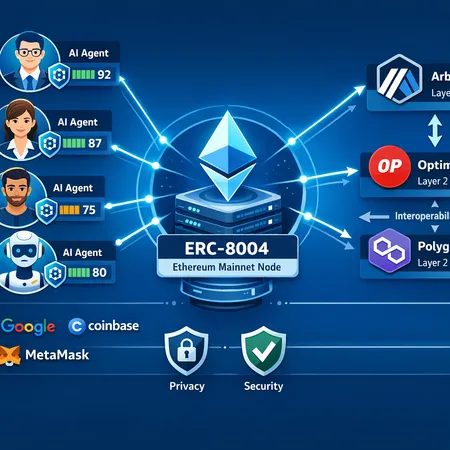
Ethereum’s ERC-8004 is a purpose‑built primitive for AI agents: standardized on‑chain identities and reputation records that let autonomous software present, prove, and port a verifiable presence across chains and apps. The goal is simple but consequential—move agent metadata off ad‑hoc implementations and into a shared schema so agents can interoperate instead of being siloed to single services.
For many builders focused on Ethereum, ERC-8004 feels like the missing layer between generic wallets and machine-native agents: it formalizes who (or what) an agent is, how it proves provenance, and how its trustworthiness can be expressed and consumed by contracts, oracles, and other agents.
The specification and mainnet rollout were covered in industry reporting—see coverage introducing the agent identity concept and agent-to-agent communication Cryptopolitan announced ERC-8004’s mainnet plans and CryptoNews explained the new on‑chain reputation possibilities.
What ERC-8004 defines (high level)
ERC-8004 provides a set of on‑chain data structures and behavioral expectations for agent identities and their reputational artifacts. At a minimum the standard defines:
- A canonical agent identifier (an on‑chain handle or address that represents an agent). This could be implemented as a specialized contract, an account, or a tokenized identifier.
- A schema for reputation scores and attestations: timestamped claims, aggregated metrics, and pointers to off‑chain evidence.
- Rules or recommended patterns for agent-to-agent messages, permissioning, and revocation.
The end result: other contracts, oracles, and services can read an agent’s identity and reputation with a predictable interface instead of parsing bespoke metadata blobs.
Mechanics: agent identities and reputation scores
Under the hood, agent identity and reputation typically combine these components:
- On‑chain principal: a contract or account that owns the agent identifier and signs agent messages. This principal is the root of authority for agent actions.
- Attestations and claims: third parties (oracles, services, other agents) issue signed attestations about behaviors—uptime, successful settlements, dispute history, KYC status, SLA performance. Those attestations are referenced on‑chain or stored off‑chain and hashed into on‑chain records.
- Aggregated reputation: a smart contract or indexing layer aggregates attestations into a score or profile. Aggregation logic can be simple (weighted averages) or complex (time‑decay, stake‑weighted voting).
- Verifiable credentials: to preserve privacy and limit on‑chain bloat, agents can reference verifiable credentials (VCs) or zero‑knowledge proofs that demonstrate properties without revealing full data.
These elements let a counterparty ask, in a single on‑chain call, "Has this agent completed X settlements successfully in the past 30 days?" and receive an interpretable answer.
Interoperability and Layer 2 considerations
ERC-8004’s practical value depends heavily on cross‑chain portability and L2 economics. Agents must be cheap and fast to run if they’re going to execute frequent tasks—making L2s and rollups the natural host for many agent workloads.
- L2 adoption drivers: Arbitrum, Optimism, zkSync and Polygon already provide lower gas for frequent state updates. Deploying agent identity contracts and reputation aggregators on L2s makes recurring signatures, heartbeat checks, and micro‑payments economically viable.
- Cross‑rollup identity portability: the standard encourages designs where the canonical agent identifier can be recognized on multiple rollups (via merkle proofs, canonical registries anchored on mainnet, or cross‑chain messaging). That portability is what turns an agent from a single‑chain bot into a multi‑chain service.
- State anchoring and finality: to guard against replay or fork issues, reputation anchors may periodically checkpoint to L1. That hybrid pattern—L2 for activity, L1 for long‑term anchoring—balances cost and security.
Expect to see early adopters run reputation aggregation on L2 with periodic L1 proofs for finality. This mirrors other patterns in scaling DeFi but applied to agent primitives.
Privacy, security, and Sybil resistance
Formalizing agent identity improves composability, but it also forces hard tradeoffs: binding persistent reputations to identities makes privacy leakage likely, yet unverifiable pseudonyms invite Sybil attacks.
- Privacy approaches: zero‑knowledge proofs and selective disclosure (verifiable credentials) let agents prove properties—"KYC passed" or ">100 successful settlements"—without revealing transaction history. Off‑chain attestations stored in IPFS or secure enclaves plus on‑chain hashes reduce bloat.
- Security primitives: staking or bonds can deter bad behavior: agents that misbehave lose stake or have their attestations slashed. Multi‑party attestation (multiple independent oracles sign reputation events) increases robustness.
- Sybil resistance: purely permissionless reputation systems are vulnerable. Effective strategies include economic costs (stakes, gas), social attestations (web‑of‑trust), known‑identity attestations (SBTs or verified VCs), or hybrid approaches tied to off‑chain identity providers.
Designers should treat reputation signals as probabilistic. No single score is absolute—composability with dispute resolution and fresh attestations is crucial.
Commercial use cases (practical examples)
ERC-8004 unlocks a range of product patterns for teams building agent‑native solutions:
Autonomous settlement agents: an agent with a high settlement reputation can automatically execute cross‑chain payments, arbitrate margin calls, or finalize invoices when conditions are met. Enterprises could delegate recurring settlement logic to vetted agents.
Subscription and keeper agents: agents that manage recurring payments, renewals, or contract maintenance (like keepers) can publish reputations so dApp developers select trusted providers. Bitlet.app and similar services could integrate subscription agents that charge in ETH or tokens.
DeFi orchestration: portfolio managers and yield optimizers become agent services that execute across protocols. New layers will route trades and actions to the highest‑reputation orchestrator for a given strategy—expect early integration within DeFi stacks.
Marketplace of AI services: agents offering analytics, on‑chain data indexing, or ML inference can be rated and composed into larger workflows. Enterprises (think Google Cloud marketplaces) and exchanges (Coinbase) may prefer agents with verifiable reputations for custody, liquidity routing, or compliance tasks.
Agent wallets & UX: MetaMask and custodial products like Coinbase could add native agent profiles so users pick or delegate to agent identities with known track records.
Each use case reduces friction for automation but increases reliance on reputation integrity and uptime guarantees.
Risks and attack vectors
ERC-8004 is powerful but creates new attack surfaces:
- Sybil attacks: adversaries spinning up many cheap agents to fabricate reputation signals or influence weighted aggregations.
- Reputation manipulation: bribery, fake attestations, or replaying benign behavior can inflate scores. Time‑decay and stake‑backed attestations mitigate but don’t eliminate the problem.
- Privacy leakage: long‑lived agent identifiers make behavioral profiling easier; adversaries can correlate activity across services.
- Economic centralization: if staking or paid attestations become the main route to high reputation, wealthy actors could gatekeep high‑quality agent roles.
- Operational risk: compromised agent keys or buggy agent code can cause systemic failures if agents have high privilege in settlement flows.
Mitigations include multi‑sig custody for agent keys, distributed attestation providers, slashing conditions tied to misbehavior, and robust monitoring and insurance markets.
How ERC-8004 could shape ETH demand and tooling
Near term, expect several measurable effects on the ecosystem:
- Increased transaction volume: agent activity—heartbeat updates, attestations, reputation refreshes, and cross‑chain messaging—generates transactions, especially on L2s. Some registrations and anchorings will hit L1, adding to ETH fee demand.
- Storage and indexing needs: reputation systems require indexing services and subgraph‑like tooling. Developer demand for agent SDKs, local simulation tooling, and test suites will rise.
- New middleware and oracles: specialized reputation oracles, ZK‑attestation services, and cross‑chain identity resolvers will become valuable.
- Developer workflows: expect standardized agent SDKs, templates for privacy‑preserving attestations, and integrations in wallets like MetaMask and custodial APIs from Coinbase.
Overall the standard nudges activity toward L2s for economic reasons while creating periodic L1 anchoring that still increases ETH utility. The cumulative effect could be modest incremental demand for ETH via transaction and storage usage, but the larger impact is on developer ecosystems and fee distribution across rollups.
Recommendations for teams building agent-native products
If you’re a blockchain developer, product manager, or Web3 AI team planning to build on ERC-8004, consider these pragmatic steps:
- Design for L2‑first deployments and L1 anchoring for finality. Balance speed and security.
- Adopt privacy‑by‑default: use selective disclosure, ZK proofs, or hashed attestations to limit exposure.
- Use multi‑party attestation and stake‑based incentives to harden reputation signals.
- Build observability and recovery: agent dashboards, key rotation, emergency pauses, and insurance hooks.
- Integrate with wallet and custody flows early—MetaMask, Coinbase, and enterprise providers will be key distribution partners.
- Monitor gas costs, and design reputation refresh cadence to limit unnecessary writes.
These steps will reduce risk and accelerate adoption while keeping operating costs manageable.
Final thoughts
ERC-8004 is not a silver bullet, but it is a foundational step toward machine‑native identity and trust on Ethereum and its rollups. By standardizing how agents identify, prove claims, and accumulate reputation, the spec opens practical automation and composability that were awkward or insecure before.
The next 12–24 months will be telling: expect rapid prototyping on L2s, merchant and wallet integrations, and a bifurcation in reputation models—permissioned, enterprise systems with rigorous attestations versus open, economic reputation markets. Both will coexist, and both will shape tools, ETH demand patterns, and the architecture of agent networks.
Sources
- CryptoNews coverage of ERC-8004: https://cryptonews.com/news/ethereums-new-erc-8004-lets-ai-agents-work-anywhere-is-this-the-future/
- Cryptopolitan announcement on agent communication and ERC-8004: https://www.cryptopolitan.com/ethereum-introduce-agent-agent-communication/