Institutional Access to Altcoins: What Grayscale’s BNB S‑1 and a $4B TradFi Day Mean
Summary
Executive overview
Grayscale’s recent S‑1 filing for a BNB product — widely reported as a push toward a Nasdaq‑listed vehicle — signals the next wave of institutional access to altcoins. Coupled with spikes in regulated trading flows and tactical institutional equity buys, the pieces are aligning for mainstream channels to route capital into tokens beyond Bitcoin. This article breaks down what Grayscale’s filing implies, why rising TradFi volume matters, and how custody, ETF arbitrage, and market structure could shape BNB price dynamics.
What Grayscale’s S‑1 for a BNB product actually means
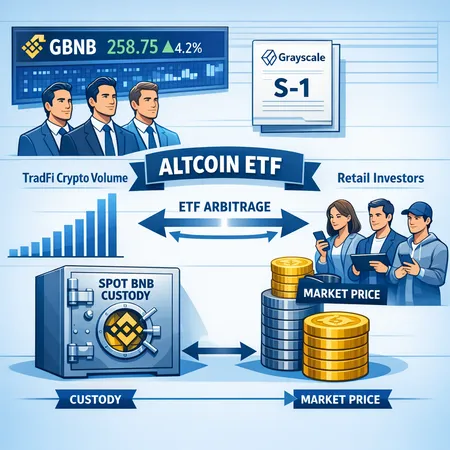
Grayscale filing an S‑1 for a potential BNB vehicle represents a concrete attempt to package a single‑token altcoin for regulated U.S. markets. Reporting suggests the filing aims to create a Nasdaq‑listed product that gives investors exposure to BNB without direct custody of the token itself (see the AltcoinBuzz summary of the filing).
How a Nasdaq‑listed BNB vehicle would differ from existing crypto ETFs
- Structure: Unlike futures‑based or multi‑asset funds, a Grayscale BNB product appears targeted at direct spot exposure to a single native chain token. That resembles the path Grayscale took with its Bitcoin product transformations, but applied to an altcoin with very different market dynamics.
- Accessibility: A Nasdaq listing opens BNB to taxable brokerage accounts, 401(k) wrappers (subject to plan rules), and advisers who prefer regulated wrappers over spot custody.
- Operational needs: Spot altcoin ETFs require custodial support for the underlying token, audited holdings, and clear rules for creation/redemption — all operationally heavier than commodity futures ETFs.
Custody, compliance and counterparty considerations
Custody is the linchpin. For spot altcoin ETFs, the custodian must hold BNB directly (or an equivalent representation) with robust segregation, insurance and proof‑of‑reserve processes. A BNB ETF tied to a major custodian reduces individual custody risk for retail investors but concentrates reliance on trusted third parties. That tradeoff favors investors who want institutional controls but removes the self‑custody option.
Why TradFi volume and opportunistic institutional buys matter now
Two currents are converging: a rise in regulated trading flows and institutional balance‑sheet plays.
- Regulated spot/trading volumes: Platforms reporting TradFi flows have shown dramatic growth — Bitget TradFi reportedly hit a $4B daily volume milestone, a useful signal that traders are shifting capital into regulated rails and away from opaque venues. This creates a ready pool of execution and settlement demand for ETF instruments.
- Institutional opportunism: Ark Invest’s recent buy of crypto‑related equities during a Bitcoin dip shows institutions find regulated entry points into crypto attractive even when they avoid direct token exposure. Such behavior creates parallel channels for capital to flow into an ETF wrapper rather than raw tokens (see coverage of Ark’s activity).
Together, these trends mean that if an altcoin ETF like Grayscale’s BNB product lists, it may see immediate takers among asset managers, traders and brokerage clients already poured into TradFi rails.
Market mechanics: liquidity, ETF arbitrage and price dynamics for BNB
Understanding how ETF mechanics interact with an underlying token is critical.
Liquidity and spreads
A listed BNB ETF would likely funnel a portion of institutional and retail trading volume into the ETF’s shares. That typically tightens secondary‑market spreads for the ETF itself, and — importantly — can translate into tighter spot spreads if authorized participants (APs) have efficient access to BNB on primary markets. For BNB, the size of on‑chain and exchange liquidity will determine how large ETF creations can be without moving the underlying price.
ETF arbitrage: the stabilizer (and potential amplifier)
ETF arbitrage mechanisms are designed to keep ETF price close to Net Asset Value (NAV). For a BNB spot ETF, APs would buy or deliver BNB into the creation/redemption process when ETF shares trade away from NAV, capturing the spread. That relentlessly arbitrages away persistent premiums or discounts, which benefits investors by tightening the ETF/spot relationship.
But a caveat: if underlying BNB liquidity is thin relative to ETF demand, the act of buying BNB to create shares can push the token price up pre‑creation, producing short‑term volatility and possible slippage costs. Conversely, large redemptions could force APs to sell sizable BNB amounts into the market, adding downside pressure.
Custody and redemption mechanics matter
Whether creations/redemptions are in cash or in‑kind, the custodial model will shape arbitrage efficiency. In‑kind creations (delivering the token) reduce cash settlement frictions; cash creations require market purchases that may move price. The custodial setup Grayscale outlines in its S‑1 will therefore be a key determinant of how cleanly ETF and spot BNB prices track.
Comparative framework: ETF exposure vs. direct spot holdings
Financial advisors and retail investors should weigh these dimensions when deciding how to gain BNB exposure.
- Custody & security: ETFs remove the need for self‑custody and private keys, transferring custody risk to institutional custodians. Direct spot owning means personal custody responsibilities and risks (but also control).
- Regulatory & tax clarity: ETFs give a familiar regulatory wrapper and often simpler tax reporting. Direct tokens may have more complex taxable events depending on jurisdiction.
- Fees & drag: ETFs charge management fees and expense ratios that erode returns over time. Spot holdings avoid that fee drag but may incur trading fees and custody costs with other providers.
- Liquidity & execution: ETFs trade like stocks with intraday liquidity; direct spot may face exchange‑specific liquidity constraints and slippage.
- Tracking error & arbitrage benefits: A well‑operationalized ETF with strong AP participation will generally track spot closely thanks to ETF arbitrage. Poorly structured ETFs or thin underlying liquidity can produce divergence.
For advisors, the decision often reduces to client preferences on custody, taxable wrappers and tolerance for operational complexity. Retail traders who want intraday exposure and easy brokerage access may favor an ETF, while crypto‑native investors who prioritize full control and DeFi utility may prefer direct BNB holdings. For many traders, Bitcoin remains the primary market bellwether, but altcoin ETFs could change allocation decisions across portfolios.
Scenario analysis — three plausible outcomes
1) Bull case: Smooth approval and broad uptake
- Rapid inflows via brokerage platforms and asset managers.
- Tighter spot liquidity and narrower spreads as market makers and APs arbitrage effectively.
- Net positive price impact for BNB as demand absorbs supply, particularly if APs use in‑kind creations to limit market impact.
2) Base case: Gradual adoption with operational frictions
- Steady inflows that are tempered by custody or compliance hurdles.
- ETF arbitrage keeps a lid on persistent premiums; spot price benefits are modest and realized over months rather than days.
- Market structure adjustments: more regulated custody providers add BNB support; TradFi volumes migrate to ETF shares over time.
3) Bear case: Regulatory or structural shocks
- Approval faces delays, or custodial insurance/segregation requirements constrain AP participation.
- ETF creations are cash‑based or limited, increasing tracking error and potential selling pressure on redemptions.
- Short‑term volatility spikes and the ETF fails to generate durable inflows; retail investors who expected a ‘safe’ wrapper are disappointed.
Practical checklist for advisors and retail investors
- Read the S‑1 and prospectus: focus on creation/redemption mechanics, custodial counterparty, and expense ratio.
- Assess liquidity: compare average daily BNB spot volume vs. potential ETF inflows; large mismatches increase slippage risk.
- Monitor AP participation: strong AP involvement reduces tracking error and improves arbitrage efficiency.
- Consider tax and custody preferences: do clients need a brokerage wrapper or prefer self‑custody for use in DeFi?
- Watch regulatory signals: any special regulatory language related to Binance or Binance‑affiliated entities could materially change risk.
Platforms such as Bitlet.app and others bridge retail demand and regulated rails in different ways; advisors should understand the provider ecosystem when recommending pathways to exposure.
Final thoughts
Grayscale’s S‑1 for a BNB product is a meaningful signal: the industry is moving from conceptual altcoin access toward regulated, exchange‑listed instruments. Rising TradFi volumes and institutional tactical buys create ready channels for that demand to flow. But the net effect on BNB price and market structure will be defined by operational details — custody, creation/redemption mechanics, AP behavior and regulatory oversight. For advisors and retail investors, the right choice isn’t obvious or universal: it depends on priorities around custody, tax efficiency, cost and the desire for broad market access versus control.
Sources
- Grayscale’s S‑1 push for BNB: Grayscale takes aim at BNB with new ETF filing — AltcoinBuzz
- Bitget TradFi volume report: Bitget TradFi doubles to $4B in daily volume — Invezz
- Ark Invest activity amid a dip: Ark Invest bought USD21.5 million of crypto company shares — CoinDesk