Can XRP Overtake Bitcoin in a Liquidity Crisis? Testing the XRP Domino Theory
Summary
Executive summary
The idea that XRP could overtake Bitcoin during a liquidity crisis is not just rhetorical; it’s a structured claim with mechanics behind it. Jake Claver’s so-called XRP Domino Theory sketches how instant settlement and bridge-asset utility could make XRP the preferred medium of cross-border liquidity when traditional rails seize up. This article tests that thesis by juxtaposing the core mechanics against on-chain realities, Ripple’s expanding regulatory footprint, recent technical inflection points, and observable market flows such as ETF outflows that influence spot liquidity.
What is the “XRP Domino Theory”? (Claver’s thesis)
Jake Claver frames a multi-step logic: first, a global liquidity shock forces banks and payment providers to seek faster, cheaper settlement to reduce counterparty and credit risk; second, networks that enable near-instant settlement with minimal pre-funding win share; third, because XRP can act as a bridge asset in on-demand liquidity (ODL) flows, it becomes the instrument of choice — and because network effects compound, this leads to a rapid adoption cascade.
Claver’s write-up models not just adoption but a liquidity reallocation — capital that would otherwise be siloed in fiat/nostro accounts migrates to rails that settle instantly. The thesis hinges on two assumptions: that counterparties will prioritize settlement speed above other frictions in crisis moments, and that XRP’s liquidity and enterprise tooling are sufficient to handle the migration. The argument is provocative and useful as a scenario — but it’s not a fait accompli.
(For a detailed exposition of Claver’s chain of reasoning, see his long-form piece.)
How instant settlement mechanics matter in a liquidity crunch
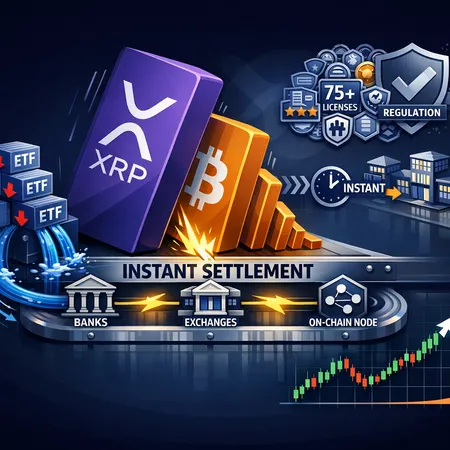
The practical advantage of instant settlement is simple: reduce time-in-risk. In a liquidity crisis, delays in settlement force institutions to hold larger prefunded positions or accept counterparty exposure — both of which magnify stress. Instant rails that use a liquid bridge asset let parties complete cross-border transfers with near-zero settlement lag and minimal pre-funding.
XRP’s role in On-Demand Liquidity (ODL) is to bridge two fiat legs quickly: fiat A → XRP (on exchange) → XRP transfer → XRP → fiat B. If counterparties trust exchanges and corridors enough, you remove the need for prefunded nostro accounts. In theory, that reduces the liquidity drag that can exacerbate a crisis.
Still, the mechanics are only half the story. For instant settlement rails to win, three operational boxes must be checked: deep and reliable spot liquidity across key corridors, compliant custody and settlement infrastructure that counterparties accept, and robustness to extreme market moves (slippage, funding dry-ups). Claver’s domino assumes those boxes can be satisfied rapidly under stress — a strong assumption.
Ripple’s regulatory footprint: 75+ licenses and why that matters
Enterprise adoption hinges on regulatory comfort. Ripple’s push to secure licensure globally — reporting that its license count has topped 75 — is the strongest evidence that Ripple is positioning XRP and its services as a compliant enterprise tool that can be used by regulated financial institutions. Licensing improves counterparties’ willingness to route value through Ripple’s rails because compliance counterparty risk declines.
This licensing momentum does not remove all legal risk, but it materially lowers the operational barrier to adoption. In practice, the difference between a guaranteed-compliant corridor and a gray-area one is the difference between immediate routing versus cautious, delayed routing — and in a liquidity crisis, that timing is decisive. Reporting on Ripple’s growing license count gives the enterprise adoption argument more heft, but it is not the only consideration.
Recent technical inflection: is XRP ready for a bullish expansion?
From a price-structure standpoint, multiple analysts have flagged XRP at a critical inflection point: a successful hold above specific support and a breakout through resistance would create a technical path for rapid expansion. Market commentators point to structure that could enable a bullish run if key levels hold and liquidity returns.
Technicals alone don’t create adoption, but they do matter for momentum flows. If market structure convinces market makers and liquidity providers to re-enter, you get a self-reinforcing cycle of tighter spreads and deeper order books — conditions required for a bridge-asset to function under stress. Analysts discussing this inflection and potential targets underscore that, if market structure flips bullish, price action could accelerate adoption narratives (and vice versa).
(See recent technical coverage for more granular levels and scenarios.)
ETF outflows, spot liquidity, and the immediate constraints
Liquidity is not an abstract variable — it is measured by order books, exchange balance, and large institutional flows. Recent reporting shows large ETF outflows have hit XRP — a technical note that spot liquidity may be weakening in the near term. Outflows of the magnitude reported (tens of millions) can matter when corridors require tight spreads for low-friction settlement.
When ETF vehicles pull capital, two short-term effects follow: tighter bid depth as makers withdraw, and increased volatility as passive liquidity evaporates. Both make XRP a riskier bridge asset during extreme moves. Thus, while Claver’s domino hinges on XRP’s bridge utility, ETF outflows are a real-world drag that must be resolved before the thesis can work at scale.
Macro scenarios where instant-settlement rails could dominate
To evaluate probabilities, we need explicit macro pathways where XRP-like rails win.
- Global banking run / correspondent bank freeze: If correspondent banking corridors seize up or require onerous pre-funding, instant rails that preserve settlement finality will be favored.
- Severe FX liquidity compressions in emerging markets: When local currency liquidity disappears, fast cross-border corridors reduce transactional friction and capital flight costs.
- Geopolitical sanctions creating fiat isolation: Entities cut off from SWIFT-style rails may prefer crypto-based settlement if they can find compliant on-ramps and off-ramps.
- Centralized clearing congestion: If central counterparties (CCPs) delay settlement due to capital constraints, instant rails can temporarily substitute.
These are plausible but rare events. Even if one happens, the timeline matters: adoption needs to be fast and trusted. That’s why Ripple’s licensing push and existing partnerships are relevant — they reduce deployment friction in crisis moments.
Tokenomics and structural counterarguments
Beyond licensing and mechanics, token design and distribution matter. XRP’s supply dynamics are different from Bitcoin’s: XRP has a large pre-minted supply with a portion escrowed, plus varied historical distributions. There is no block-reward inflation like Bitcoin’s — which is helpful for predictable supply — but concentration of holdings and the legacy of early company allocations remain points of scrutiny.
Bitcoin’s store-of-value narrative, mining-based issuance schedule, and wide custody ecosystem give it strong incumbent advantages. BTC is the asset most institutions cite when they want a non-sovereign macro hedge. Even if XRP becomes the go-to settlement asset in some corridors, displacing BTC as the primary macro or reserve crypto requires shifting decades of narrative, custody integration, and retail/institutional preference.
Exchange flows, custody, and regulatory tail risks
Two operational constraints could derail a liquidity-driven takeover: exchange flow dynamics and legal/regulatory action. Large withdrawals from exchanges can concentrate supply off-exchange (reducing tradable liquidity) or conversely flood the market if liquidations occur. Regulatory interventions — ranging from delisting, stricter custody requirements, or direct legal challenges — can still change the calculus quickly. Even with 75+ licenses, local regulators can act in ways that materially change on-the-ground availability.
The historical SEC dispute over Ripple’s token sales highlights that legal tail risk is real; licensing reduces, but does not eliminate, this category of uncertainty. Any scenario where institutions must pivot fast will penalize assets that have uncertain legal status in key jurisdictions.
Probabilities, portfolio framing, and practical takeaways
Putting everything together: the XRP Domino Theory is coherent as a specific crisis scenario. It identifies real advantages for instant-settlement rails and points to operational wins Ripple has achieved. However, the path from theory to systemic dominance is narrow and requires several low-probability events to align: a rapid global liquidity shock that prioritizes settlement speed, immediate and trusted on-ramps for XRP across major corridors, and a rapid refill of spot liquidity despite current ETF outflows.
For intermediate investors evaluating asset allocation between BTC and XRP: treat XRP as a tactical crisis-hedge with asymmetric upside in specified scenarios, not as a replacement for Bitcoin’s macro-hedge role. A pragmatic approach could be a modest position-size allocation to XRP tied to explicit triggers (for example: stabilization of exchange liquidity, continued licensing traction converting to active enterprise flows, and resolution of short-term ETF outflows). Platforms such as Bitlet.app that offer installment purchases can help investors scale exposure thoughtfully rather than betting all on a single narrative.
Risk management is crucial: monitor exchange balances, large ETF flows, on-chain adoption metrics, and regulatory developments. If XRP demonstrates sustained, corridor-wide liquidity and enterprise routing volumes in stress-event tests, it should graduate from speculative hedge to strategic allocation — but we are not there yet.
Conclusion
XRP overtaking Bitcoin in a liquidity-driven crisis is a plausible scenario in a narrow set of conditions. Jake Claver’s XRP Domino Theory maps the mechanism well: instant settlement reduces time-in-risk and, if paired with trusted corridors and sufficient liquidity, could re-route cross-border flows rapidly. Ripple’s 75+ licenses materially lower operational friction for institutions, and technical inflection points could catalyze market-maker re-entry if reversed. Yet current ETF outflows, constrained spot liquidity, lingering legal tail risks, and the deep incumbent advantages of BTC make a full dethronement unlikely in most macro paths.
For investors, the smart stance is conditional: maintain BTC for broader macro exposure and consider a measured, scenario-linked exposure to XRP as a tactical hedge against liquidity shocks.
Sources
- Jake Claver’s "XRP Domino Theory": https://coinpedia.org/news/can-xrp-overtake-bitcoin-analyst-warns-of-global-liquidity-crisis/
- Ripple’s global license count and adoption reporting: https://coinpaper.com/13993/xrp-price-prediction-recovery-on-thin-ice-as-ripple-s-global-license-count-soars-past-75?utm_source=snapi
- Technical analysis noting XRP’s inflection and potential expansion: https://www.newsbtc.com/news/xrp-at-critical-inflection-point-analyst-signals-major-expansion-if-this-level-holds/
- Coverage of ETF outflows and spot liquidity pressure: https://crypto.news/xrp-price-forms-a-risky-pattern-as-etf-outflows-hit-40-million/