From Speculation to Spending: How Bitcoin Payments Are Scaling in Latin America
Summary
Why Latin America is a bellwether for crypto payments
Latin America has long been fertile ground for crypto innovation: high remittance costs, periods of local currency depreciation, and a relatively young fintech ecosystem push people to seek alternatives. But the narrative is shifting. Instead of only being a speculative store of value, BTC is increasingly being used as a payments rail — especially where local pain points in traditional payments are acute. For many traders, Bitcoin remains the primary market bellwether, yet in pockets of LATAM the story is adding a second chapter: payments and daily utility.
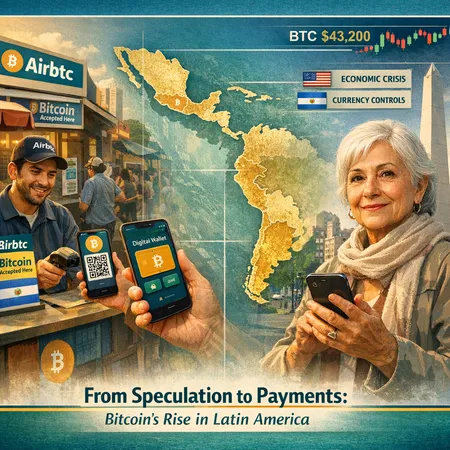
Two recent developments make that pivot concrete. First, Airbtc’s expansion into El Salvador — a country that already made headlines for adopting Bitcoin at a national level — is lowering merchant onboarding friction and widening consumer access. Second, Argentina is seeing a surprising demographic shift: seniors are adopting digital wallets at higher rates, which matters because durable payments adoption needs broad demographic buy‑in, not only early adopters.
Airbtc in El Salvador: merchant uptake and practical on‑ramps
Airbtc’s expansion in El Salvador represents a pragmatic step toward normalizing BTC payments at the point of sale. Local merchants report fewer barriers to accepting payments when on‑ramp and settlement tools are available; consumers benefit when wallet‑to‑merchant flows are simple and fees competitive. Coverage of the week’s LATAM stories highlighted Airbtc’s move alongside continuing merchant interest in BTC‑denominated transactions source.
What’s changing on the ground:
- Better UX: Airbtc and similar services minimize friction by simplifying wallet creation and payment confirmation flows, which matter more than raw protocol novelty for merchants.
- Merchant settlement options: Some POS integrations allow instant or near‑instant conversion to fiat or stablecoins, removing the exchange‑rate risk that would otherwise deter small businesses.
- Local partnerships: Tie‑ups with local banks, payment processors, and point‑of‑sale vendors speed onboarding and compliance checks.
These practical improvements reduce the classic excuse businesses give for not accepting crypto: volatility and complexity. While macro volatility remains a reality, infrastructure that lets merchants choose how and when to convert BTC into local currency removes a large portion of operational risk.
Argentina: seniors and the surprising growth of digital wallets
Argentina provides a useful counterpoint. Despite economic instability and high inflation, a new trend is emerging: older demographics are adopting digital wallets at greater rates. The Invezz roundup notes seniors leading digital‑wallet adoption in Argentina, a dynamic that matters for payments because older users typically represent higher transaction frequency for certain categories (pharmacy, groceries, utilities).
Why seniors matter:
- Trust and habit: When older users adopt a payment method, it signals a level of trust and usability that can broaden uptake across the population.
- Payment stickiness: Seniors often transact for essential goods and services; once they use a wallet regularly, that method becomes part of daily life.
- Network effects: Family members and small businesses adapt to the payment patterns of older relatives, accelerating merchant acceptance.
Crucially, this adoption isn’t just technological curiosity. It reflects simpler interfaces, educational outreach, and products that prioritize straightforward fiat conversion and support — not necessarily raw self‑custody complexity.
Payments adoption versus price volatility and geopolitical shocks
A frequent question for policymakers and business builders is: how does payments adoption hold up when BTC price swings or geopolitical events arrive? Tokenpost’s recent piece on Bitcoin’s price resilience provides useful context: BTC has repeatedly demonstrated capacity to act as a market‑leading asset even amid macro and geopolitical stress, but the price path is volatile and unpredictable (see analysis) source.
That volatility creates both challenges and design opportunities:
- Challenge: Merchants exposed to BTC receipts face P&L volatility. If a shopkeeper accepts BTC and holds it, sudden moves in BTC can affect margins for small businesses.
- Opportunity: Payment platforms can offer real‑time conversion, hedging tools, or instant settlement in local currency to decouple merchant economics from BTC market moves. This lets consumers pay in BTC while merchants receive stable, predictable settlement.
Geopolitical events also matter. In LATAM, sudden policy shifts or cross‑border frictions can rapidly change local demand for crypto as either a savings tool or a payments alternative. But that same sensitivity means payments adoption can surge precisely when traditional rails are strained — provided the on‑ramp infrastructure and regulatory clarity are in place.
Practical recommendations for businesses
For product and operations teams building BTC payment rails in Latin America, the playbook should be pragmatic and user‑centric:
- Prioritize settlement choice: Offer merchants instant conversion to fiat or stablecoins, and let them choose whether to hold BTC or convert. This reduces adoption friction.
- Simplify onboarding and KYC: Use progressive profiling and context‑aware KYC to avoid scaring off small merchants with heavy paperwork at first contact.
- UX for older cohorts: Design simplified wallet flows, large‑font interfaces, and clear recovery options to match the needs of seniors coming online in Argentina.
- Liquidity and routing: Ensure reliable liquidity for BTC↔fiat pairs, and partner with local banks or payment processors to smooth rails.
- Education and customer support: Local language, phone support, and in‑store onboarding sessions increase trust faster than purely digital campaigns.
Platforms like Bitlet.app, which combine installment, P2P, and payment experiences, illustrate how product breadth can lower friction for different user segments — but the execution detail matters more than the slogan.
Policy recommendations to accelerate safe on‑chain payments
Policymakers can nudge payments adoption while managing systemic and consumer‑protection risks. Recommended interventions:
- Regulatory clarity and proportionate AML/KYC: Define thresholds for low‑risk wallet features versus custodial merchant services so innovators can build without constant legal ambiguity.
- Sandboxes for payment innovations: Regulatory sandboxes let firms pilot instant settlement and consumer protections in a controlled environment.
- Tax and reporting guidance: Simple, predictable tax guidance for merchant receipts in crypto reduces compliance burden and tax‑avoidance fears.
- Consumer protections and dispute mechanisms: Ensure accessible redress processes for payment errors and fraud, which builds trust, especially among older users.
- Public education campaigns: Governments can partner with private sector players to create neutral educational resources about safe wallet use and common scams.
These measures reduce systemic risk while encouraging firms to create user‑friendly payment flows that work around volatility — for instance by enabling instant fiat settlement or mandatory disclosures.
What success looks like
In practical terms, success is not universal BTC invoicing overnight. Instead, look for measurable markers:
- Increasing share of everyday transactions (groceries, transit, utilities) routed through BTC‑aware wallets or payment apps.
- Growing merchant retention after initial onboarding — merchants stay because payment tools reduce costs or increase sales.
- Broader demographic spread in user bases, including increased usage among older adults and lower‑income groups.
- Stable, transparent partnerships between fintechs and regulated financial institutions that provide rails for settlement.
When those conditions are present, Bitcoin transitions from being predominantly an asset class to being a useful payments layer in regional contexts where it solves real frictions.
Final thoughts
Latin America’s mix of economic pain points and fintech creativity creates a living laboratory for payments innovation. Airbtc’s work in El Salvador and the surprising wallet adoption among Argentine seniors are concrete indicators that BTC payments are moving beyond speculation toward everyday use. But adoption will deepen only if infrastructure choices, merchant economics, and sensible public policy align to manage volatility and protect users.
For policy analysts and crypto business builders, the takeaway is pragmatic: design systems that separate consumer convenience from unnecessary market exposure; pursue regulatory clarity that allows pilots; and prioritize UX and education to bring more users — especially older demographics — into the fold.
Sources
- LATAM crypto roundup (Airbtc expansion, Argentine seniors) — https://invezz.com/news/2026/01/04/latam-crypto-news-bitcoin-travel-expands-in-el-salvador-as-seniors-lead-digital-wallet-adoption-in-argentina/?utm_source=snapi
- Analysis of Bitcoin’s price resilience amid macro and geopolitical events — https://www.tokenpost.com/news/investing/18203