Canton Network Rally: How the DTCC Collaboration Triggered CC’s Rapid Re-rating
Summary
Executive snapshot
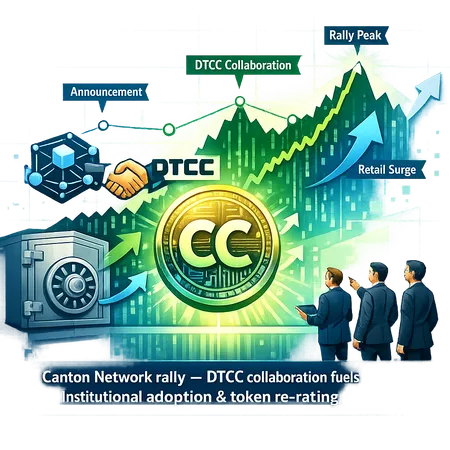
The Canton Network rally exploded after news of a strategic collaboration with the DTCC, producing outsized short-term returns and a renewed debate over what counts as true institutional adoption. CC’s price action looked like a classic headline-driven re-rating: strong, rapid, and accompanied by elevated on-chain transfers and speculative flows. Yet underneath the candles, the development raises a larger question for token investors and analysts: does a custody/clearing tie to a heavyweight like the DTCC represent genuine product-market fit, or is it simply fuel for a transient market narrative?
Timeline of the rally: headlines, runs, and on-chain echoes
The pattern was familiar. A single, impactful announcement — coverage that linked Canton’s DTCC collaboration to a broader institutional use case — produced immediate market interest. Media attention and social amplification accelerated buys, and CC posted sharp one- and multi-day gains (one outlet captured a ~17% surge in short order) that drew even more attention from momentum traders and liquidity-seeking bots. For contemporaneous reporting on the headline and the jump in pricing, see this CryptoPotato summary and the BeInCrypto analysis that ties the move to the DTCC work.
Price moves were paralleled by on-chain activity: larger-than-usual transfers between wallets, an uptick in exchange inflows followed by OTC-style withdrawals, and increased DEX volume as retail participants chased the breakout. Those behavioral patterns — rapid accumulation by a subset of addresses, short-term profit-taking, and higher trade frequency — are typical of speculative rallies sparked by perceived institutional endorsements.
Why a DTCC collaboration matters for institutional legitimacy
The DTCC sits at the center of the U.S. financial plumbing: clearing, settlement, and post-trade services for equities and fixed income. A strategic collaboration with such a counterparty can matter in several concrete ways:
- Operational de‑risking: Custody partnerships and clearing integrations reduce operational friction that often blocks institutional entry. Integrations with established custodians and settlement providers make back-office processes easier to reconcile with legacy systems.
- Perception and compliance signaling: Institutions are sensitive to counterparty risk and regulatory optics. A DTCC tie signals that Canton is addressing those needs in a way that raw protocol hype cannot.
- Product enablement: Beyond optics, custody and clearing connections can enable real-world institutional products — tokenized securities, committed settlement rails, or custodial custody solutions for client assets.
That said, a collaboration announcement is a necessary but not sufficient condition for mass institutional adoption. The market often rewards the expectation of product rollout before the product exists. As BeInCrypto reported, the DTCC mention likely catalyzed a re-evaluation of Canton’s roadmap — but the partnership must evolve into tangible services to sustain flows.
How on-chain and investor behavior amplified the move
Several behavioral mechanics turned a positive headline into a price cascade:
- Scarcity and liquidity mismatch: Canton’s circulating float and listed liquidity were compressed relative to the market interest generated by the announcement. When orders overwhelm available liquidity, price jumps can be dramatic.
- Whale accumulation and label-driven momentum: A few large wallets accumulating after the news can create a squeeze as liquidity providers widen spreads. Smaller traders, seeing the move, pile in, often via DEXes and leveraged derivatives, magnifying volatility.
- News-driven arbitrage and trading bots: Bots that parse headlines and liquidity conditions can front-run retail flows, creating a feedback loop that accelerates moves on low-liquidity tokens.
- Narrative adoption across cohorts: From retail socials to institutional PR desks, once the DTCC angle circulated, it became a convenient thesis for a wide set of market participants. The narrative attracted capital that might not have engaged absent the partnership.
On-chain metrics to watch during such rallies include new wallet counts interacting with CC, concentration of tokens among top holders, and exchange orderbook depth. Those indicators show whether accumulation is broad-based (healthier) or concentrated (riskier).
Is this a sustainable re-rating or a short-lived speculative spike?
Short answer: it depends. The DTCC collaboration provides a credible path toward institutional integration, but several conditions must be met before the market should grant a permanent, higher valuation to CC.
Conditions that favor sustainability:
- Product and integration milestones met on schedule: custody APIs live, settlement proofs available, and third-party custodians actively using the rails. Announcements alone won’t cut it over the medium term.
- Demonstrable institutional flows: observable inflows from known custodians, larger OTC trades with institutional counterparties, or client allocations announced by asset managers.
- Liquidity deepening: sustained increases in orderbook depth across major venues and lower slippage for large trades.
- Regulatory clarity and compliance: transparent KYC/AML practices and visible compliance frameworks that lower onboarding friction.
Signs this could be a short-term re-rating:
- Headlines without delivery: multiple press cycles with incremental clarifications but no product rollout.
- High concentration of holdings among a few wallets and persistent high volatility, which suggests speculative dominance.
- A quick dump after profit-taking by early whales once narrative-driven retail bids dry up.
Practical checklist for investors and analysts
If you’re tracking whether a partnership signals genuine institutional adoption or a pump, use this checklist:
- Verify engineering milestones: Are custody APIs, proof-of-reserve processes, or clearing integrations demonstrably live? Roadmaps are nice; deployed code is better.
- Monitor on-chain distribution: Is there widening of token ownership across many entities, or is ownership staying concentrated?
- Track OTC and block trades: Larger, off-exchange trades are likelier to reflect genuine institutional interest than small retail buys on DEXes.
- Watch orderbook health: Depth, spreads, and maker/taker dynamics show whether larger allocations can be absorbed.
- Read the fine print: What exactly is the DTCC collaboration? An exploratory sandbox, a technical integration, or a commercial product? Each has a different signal strength.
For many traders, Bitcoin headlines still steer big risk-on/off flows. But for tokens like CC, custody partnerships and clearing rails materially change the conversation about institutional adoption and product-market fit in tokenized use cases.
What to watch next (signal alerts)
- First commercial client announcements tied to the DTCC collaboration.
- On-chain indicators: uptick in unique active addresses holding CC and reduced supply on exchanges.
- Third-party integrations: custodians, prime brokers, or trading desks publicly listing support.
- Regulatory or compliance filings that clarify how CC will be treated in custody or settlement contexts.
- Sustained liquidity improvement across both centralized and decentralized venues.
These events, more than price alone, will determine whether the Canton Network rally becomes a longer-term re-rating or remains a short-lived narrative-driven spike.
Final take: cautious optimism
A DTCC collaboration is an impactful signal — it’s the kind of partnership that can open doors to institutional product flows and make custody partnerships more practical. But early-stage crypto markets are fast at pricing narratives, and the same mechanics that accelerate rallies can reverse them quickly when traders reassess risk.
For investors and analysts focused on institutional adoption, the right response is neither blind optimism nor reflexive dismissal. Treat the DTCC collaboration as a meaningful progress marker, then track measurable proofs: product deployments, client uptake, and liquidity improvements. Platforms such as Bitlet.app are increasingly used by investors to monitor pairing and custody developments, but the real fulcrum will be demonstrable institutional activity rather than headlines alone.