Late‑2025 Rotation: Why BTC/ETH Dominance Is Crushing Large‑Cap Altcoins — Tactical Playbook for Managers
Summary
Executive snapshot — the late‑2025 rotation
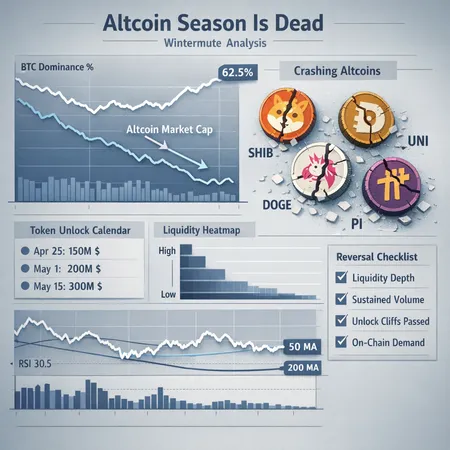
The end of 2025 has shifted the market narrative: capital that drove multi‑month rallies in mid‑cap and memecoin pockets is flowing back into BTC and ETH. Bitcoin dominance has risen, liquidity in alt order books thinned, and many retail traders have either de‑risked or re‑allocated into perceived safe caps. That’s the core of Wintermute’s view that “altcoin season is dead” — a market‑structure call driven by dominance metrics and shrinking depth rather than pure sentiment alone (Wintermute analysis).
For crypto portfolio managers and active altcoin traders this matters: heavier BTC/ETH flows compress bids in alt markets, making downside moves steeper and recovery trading more difficult. This briefing breaks down why, looks at specific vulnerable names (BTC, SHIB, DOGE, UNI, PI), and offers a practical framework for identifying a reliable trough‑to‑trend reversal signal.
What’s driving the rotation: structure, not just headlines
The rotation is not a single cause event — it’s a confluence of structural factors that amplify one another.
Liquidity and leverage
As BTC and ETH regain dominance, execution liquidity on smaller pairs evaporates. Thinner order books mean that identical sell pressure moves prices further. Closed‑out levered positions and rising funding rates accelerate sell‑side cascades. Coinpedia’s market roundups show how BTC/ETH drawdowns and macro liquidity swings drove broader crypto pressure earlier in the year, a pattern repeating in late‑2025 (Coinpedia analysis).
Bitcoin dominance: a behavioral magnet
Rising bitcoin dominance pulls headlines and capital. Institutions and retail alike gravitate to the two largest liquid assets when macro risk or execution risk rises — liquidity migration that creates an anaemic funding environment for alts. For many traders, Bitcoin remains the primary market bellwether, and a rising dominance ratio is a signal that the market’s preferred risk center has shifted.
Token unlock schedules and concentration risk
Large scheduled token unlocks act as predictable supply shocks. When an unlock coincides with thin markets and negative sentiment, the optionality of selling increases and holders start preemptively reducing exposure. The recent PI unlock is a textbook example: a material release that could trigger outsized selling if whales and early holders choose to realize gains (PI unlock coverage).
Vulnerable large‑cap alts: SHIB, DOGE, UNI, PI
Below are concise case studies: technical posture, flow/unlock risk, and why they’re particularly exposed during a BTC‑dominant regime.
SHIB (SHIB)
- Technical: SHIB is trading near structural cycle lows with weak volume on rallies. The pattern suggests lower highs and weak market participation on any bid attempts. U.Today notes SHIB is flirting with cycle bottoms and the risk of continued downside remains real (U.Today analysis).
- Flow risk: SHIB’s holder base is retail‑heavy; wide ownership by small wallets means coordinated accumulation is harder and panic selling can be widespread.
- Why this matters: In a BTC‑dominant market, retail reallocations away from memecoins to BTC/ETH are fast and impactful.
DOGE (DOGE)
- Technical: DOGE has faced a prolonged slump and clear technical resistance levels that cap rallies. Momentum indicators remain weaker than for many mid‑caps, making DOGE more susceptible to extended consolidation or drops (Coinidol coverage).
- Narrative risk: As a narrative‑driven asset, DOGE depends on viral flows. When those fade, price discovery relies on liquidity, which is currently compressed.
UNI (UNI)
- Technical & fundamentals: UNI sits at the intersection of governance token utility and DeFi activity. Declining DEX volumes and lower fee income reduce reinvestment flows into governance and stake‑based strategies. UNI’s supply schedules and past allocations to team/treasury create timing and concentration risk.
- Market‑structure effect: With funds pulling to BTC/ETH, protocol treasuries or large LPs may rebalance, adding selling pressure.
PI (PI)
- Unlock risk: PI’s upcoming/actual large unlock (millions of tokens entering circulation) is emblematic of the unlock‑triggered supply shocks we now see across the market. Crypto.news highlighted how an 8.7M token unlock could materially increase selling pressure if unlocked supply reaches exchanges (PI unlock reporting).
- Why PI is sensitive: New supply entering a thin market doesn’t need broad participation to move price sharply; a few concentrated sellers can set off a cascade.
How token unlocks and thinning liquidity amplify downside — mechanics
- Predictability matters: Unlocks are calendarable events; markets discount them ahead of time. But in low liquidity regimes the discounting accelerates as holders de‑risk early.
- Exchange flows & listing risk: If unlocked tokens hit exchanges, visible sell pressure grows and algorithmic market makers widen spreads.
- Feedback loops: Falling prices reduce depth further, increasing realized slippage on subsequent sells — a procyclical loop.
This is why desks flagged by Wintermute see altcoin season signals fading: rising dominance plus scheduled unlocks create a near‑term structural headwind to broad alt rallies (Wintermute analysis).
Framework: spotting the next altcoin trough‑to‑trend reversal
This is the tactical checklist portfolio managers should use to identify a durable shift back to altcoin leadership.
1) Macro and dominance inflection
- Watch BTC/ETH dominance: a sustained downshift in BTC dominance (7–21 day smoothing) while BTC remains flat/positive suggests capital rotation back to alts.
- Confirm with flows into ETH and large alt‑cap baskets.
2) Liquidity and depth restoration
- On‑chain & off‑book depth: monitor order‑book depth across top exchanges for target pairs; depth recovering to pre‑drawdown levels is a prerequisite.
- DEX volume upticks: sustained increasing DEX volumes for several weeks indicates genuine on‑chain activity versus short‑lived swaps.
3) Funding, open interest, and leverage unwinding
- Neutral or negative funding that relaxes (i.e., no longer incentivizing longs to pay shorts) is helpful. A cooling of extreme open interest levels reduces liquidation risk.
4) Unlock calendar and concentration clearing
- Ensure major unlocks are past or that unlocked tokens are subject to lockup/vesting that prevents immediate exchange dumps. For PI‑style events, confirm whether supply has been absorbed by OTC desks or treasury buyers.
5) On‑chain accumulation by non‑exchange wallets
- Look for accumulation by long‑term holders and protocol treasuries increasing their non‑exchange holdings. Whale accumulation with declining exchange balances is a positive structural sign.
6) Sentiment breadth and retail participation
- Breadth matters: more tokens showing green daily performance and rising active addresses is healthier than a single memecoin spike. Retail on‑chain participation that is measured rather than manic helps sustain reversals.
Practical rules for managers: trim, hold, accumulate
- Trim: tokens with upcoming large unlocks and high exchange concentration — even if you like the narrative, reduce position size pre‑unlock to limit forced selling risk. Examples: PI where unlocks are material.
- Hold: established protocol tokens (UNI) if their fundamentals (TVL, fee flows) are intact and no nearby unlocks exist. Size exposure to risk budget and be ready to trim into rallies.
- Accumulate: high‑conviction alts that pass the reversal framework — diminishing BTC dominance, improving liquidity, and visible non‑exchange accumulation. Use DCA and small limit orders to avoid front‑running by bots.
Trade execution and risk controls for a BTC‑dominant regime
- Use limit orders and TWAP-style execution to reduce slippage in thin books.
- Keep stop rules broader than normal; false breakouts are common when liquidity is shallow.
- Size positions relative to realized liquidity, not notional; a 1% market impact can turn a good idea into a loss if depth is poor.
Closing thoughts and checklist
Late‑2025’s rotation is a market‑structure event: rising bitcoin dominance + thinning liquidity + token unlocks. That trio raises the bar for altcoin recoveries — rallies that do occur will likely require clear on‑chain and market‑depth confirmation.
Quick checklist for action:
- Verify BTC/ETH dominance trend for rotation signal.
- Cross‑check unlock calendar and exchange flow ahead of adding exposure.
- Prioritize tokens with improving non‑exchange accumulation and rising DEX volumes.
- Use execution tactics tuned to shallow order books.
This is not a call to abandon alts — it is a call for disciplined selection and execution. Smaller market participants should expect more volatility; institutions and managers should price in execution risk. As you reassess allocations, tools and liquidity‑aware execution on platforms like Bitlet.app can help manage exposures in this regime.
Sources
- Wintermute warns altcoin season is dead as bitcoin dominance soars
- Shiba Inu (SHIB) hits bottom — is $0.0000004 reversal still possible?
- Dogecoin continues its slump
- PI Network price risks crash as 8.7M token unlock looms
- Crypto market under pressure — why Bitcoin and Ethereum plunge while gold and S&P mark ATH