Altcoin Pulse: SHIB Burn Spike, SOL Support Break, and Where SUI Fits in a Delayed Altcoin Season
Summary
Introduction — why this snapshot matters now
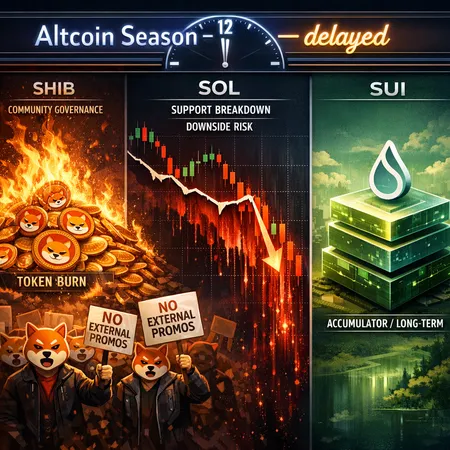
Altcoins are not a single monolith: memecoins, emerging Layer‑1s and big smart‑contract chains each respond to different catalysts. Right now, three narratives are colliding. Shiba Inu (SHIB) produced an eye‑watering token burn spike that fuels short‑term stories but also exposes governance friction. Solana (SOL) shows a technical support breakdown that raises real downside risk. And SUI is being pitched by some analysts as a buy‑and‑hold Layer‑1 accumulator for multi‑year exposure.
With altcoin season delayed and Bitcoin dominance climbing, traders and community managers need a clear framework: when to treat news as a conviction signal vs. a trade setup, and how governance or tokenomics can transform catalysts into liabilities.
Shiba Inu: the burn spike — catalyst, optics, and governance risk
A recent on‑chain event put SHIB back into headlines: an enormous reported burn-rate spike — a multiple that shocked observers and quickly became a buying narrative. Coverage flagged dramatic percentage growth in burn activity that traders immediately parsed as bullish ammunition for scarcity narratives Coinspeaker.
But numbers without context are dangerous. The spike was a rate change, not a guarantee of sustained deflation. Short‑term burns can be lumpy (one large transfer, coordinated batch burns, or token wrappers) and can create a headline‑driven squeeze that unwinds as fast as it arrived.
Community backlash and credibility concerns
Simultaneously, parts of the SHIB community pushed back on promotions tied to external tokens and what many see as blurred lines between project marketing and third‑party ramps. That backlash highlights two governance headaches:
- Transparency risk: Are burns verifiable and recurring, or episodic PR stunts? Detailed on‑chain proofs and burn addresses help, but narratives matter.
- Promotion conflicts: Endorsing external tokens or projects without clear disclosure can erode community trust and invite reputational risk, which in turn can translate into price weakness.
Read the critical coverage for nuance: the community concerns surrounding cross‑promotions were highlighted in reporting that questioned the project's promotional choices Coinpaper.
Trade ideas for SHIB (retail and swing traders)
- Short‑term traders: a headline‑driven pop from a burn announcement can be faded with tight risk. Look for intraday/multi‑day divergences between spot price and on‑chain burn follow‑through. Use 3–5% position sizing and place stops under a nearby structure (e.g., local two‑day low).
- Swing traders: require confirmation of sustained supply reduction (repeated burns, independent verification) before upping conviction. Consider scaling in with dollar‑cost averaging (DCA) and tightening stops as on‑chain metrics improve.
- Community managers: insist on public, auditable burn mechanics and a disclosure policy for promotions. If burns are a core narrative, automate proof (TX links, burn addresses, and a cadence). That reduces speculation that the burn is a PR moment.
Solana: support breakdown and asymmetric downside
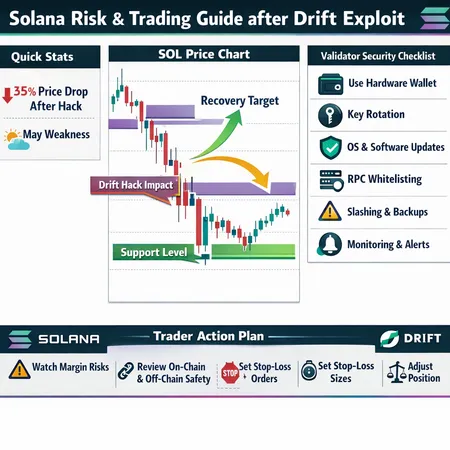
Technically, Solana has been a favorite on fast‑moving market breadth and memecoin activity. But analysts warn that a support break could open a much larger drawdown. Recent technical commentary suggested Solana’s major support levels have been shattered and a revisit toward lower price targets is possible without a clear structural reclaim NewsBTC.
This matters because Solana’s correlation with risk‑on flows (NFT minting, memecoins, high‑throughput DeFi) makes it vulnerable when speculative liquidity retracts.
How traders should react to a broken support
- If you’re long SOL with a low conviction horizon: tighten stops and consider partial profit taking. A broken higher‑timeframe support increases volatility and increases the likelihood of stop runs.
- If you’re tactical bearish or looking to hedge: consider options (if available) or small short exposures with wider risk control, since SOL can be whipsaw‑prone on network news.
- For swing traders: wait for a confirmed retest and reclamation of the broken level before re‑accumulating; otherwise, treat new lower highs as the regime.
Practical example: after a clear daily close below a defined support, reduce position size by 30–50% or shift the stop to breakeven on the remaining position. That preserves upside optionality while protecting capital.
SUI: the Layer‑1 accumulator thesis and how to size exposure
SUI is being positioned by some analysts as a multi‑year accumulation candidate among newer Layer‑1 chains. Longer‑term narratives point to differentiated technical choices and developer interest as the case for patient accumulation Crypto‑Reporter.
Why SUI may deserve a different treatment than memecoins:
- Layer‑1s typically follow adoption and developer activity, which can compound over years rather than days.
- If you believe in capturing long‑term protocol growth, a staged DCA into SUI with position caps can be sensible.
Practical accumulation approach
- Anchor a base allocation (e.g., 1–3% of overall crypto portfolio) as a long‑term conviction buy; then DCA incrementally on macro‑led pullbacks or defined technical supports. Avoid over‑allocating based on short‑term hype.
- For swing trades: shorter timeframes should respect SUI’s liquidity profile — wider stops and smaller position sizes than a mature Layer‑1 like ETH.
- Consider governance and token release schedules: early large unlocks or concentrated holdings are a risk and should factor into timing.
Altcoin season delayed: rotate conviction vs. trade setups
Macro context is crucial. Analysts have observed that altcoin season remains delayed while Bitcoin dominance rises, meaning liquidity often prefers BTC and rotation into risk assets is slower than in prior cycles Crypto.News.
This changes how to split capital:
- Conviction positions (multi‑year holds): keep them modest and distinct from trade capital. Use DCA and don’t let a single burn tweet or meme surge push you to over‑size.
- Trade capital (weeks to months): exploit events (burns, support breaks, network upgrades) but maintain strict risk rules and smaller sizing given rotation risk.
A simple allocation framework for a retail trader during delayed altcoin season:
- 60% BTC/core holdings (higher‑timeframe anchors)
- 20% long‑term altcoin convictions (small, DCA positions like SUI)
- 20% trade capital (event‑driven setups in SHIB, SOL, memecoins)
Adjust percentages to risk tolerance and timeline.
Governance and community checklist for managers
Community integrity often determines whether catalysts become sustainable. Practical checks:
- Publish burn mechanics with on‑chain TX visibility and historical cadence. If burns are a narrative, make proof easy to find.
- Maintain an explicit promotion policy: declare conflicts of interest, paid partnerships, and the provenance of external token pushes. This reduces reputational drain and regulatory scrutiny.
- Multisig and timelocks: critical for treasury moves that affect circulating supply.
- Tokenomics transparency: publish vesting schedules and concentration risk charts so the community and traders can price in supply shocks.
These items not only build trust — they reduce the chance that a headline event (like a dramatic burn) becomes a credibility crisis.
Actionable trader checklist (quick reference)
- For SHIB: treat major burn announcements as short‑term catalysts, not automatic convictions. Size small (3–5%), use tight stops, and require repeated on‑chain confirmations to increase position.
- For SOL: if major support is broken, pare positions, move stops to structural levels, or consider hedges. Avoid averaging down into a structurally broken trend.
- For SUI: use DCA for long‑term exposure; keep a separate smaller allocation for swing trades with wider stops.
- Risk per trade: conservative retail traders should cap risk to 1–3% of portfolio per trade; swing traders can flex to 3–5% with a clearly defined plan.
Remember that platforms like Bitlet.app make it easier to structure recurring buys or installments for long‑term accumulations — useful for conviction allocations that you want to DCA into over months.
Conclusion — separate noise from durable signals
The recent SHIB burn spike is a reminder that on‑chain events can create explosive short‑term headlines. But without governance clarity and repeatable mechanics, those same events can blow up into community backlash and price reversals. Solana’s technical weak point is a cautionary note: support breakdowns create asymmetric downside that needs active management. SUI looks like a reasonable longer‑term Layer‑1 accumulation candidate, but that thesis requires time, developer traction, and careful position sizing.
When altcoin season is delayed and Bitcoin dominance is rising, the smartest play is bifurcation: keep conviction capital patient and measured, while using trade capital to exploit transitory catalysts with strict rules. That discipline separates noise‑driven losses from opportunistic gains.
Sources
- Shiba Inu burn spike report — Coinspeaker
- Community backlash over SHIB promotions — Coinpaper
- Solana support broken and downside risk — NewsBTC
- SUI accumulation thesis — Crypto‑Reporter
- Altcoin season delayed, Bitcoin dominance rising — Crypto.News
For many traders, Bitcoin remains the primary market bellwether; for sector context, NFT and lending flows on DeFi rails often accelerate or retard memecoin cycles.