Terraform Labs vs Jump Trading: The $4B Suit That Could Redraw Crypto Market Structure
Summary
Executive summary
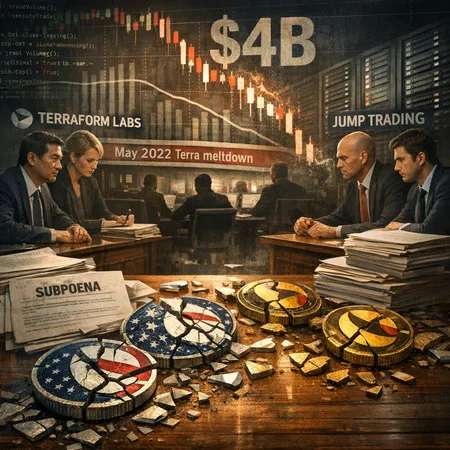
Terraform Labs' $4 billion lawsuit against Jump Trading is more than a private damages action — it's a probe into how high-frequency traders and OTC liquidity providers operated around one of crypto's most destructive meltdowns. According to press reports, the complaint alleges secret deals, market manipulation and roughly $1 billion in illicit profits tied to the UST/LUNA collapse. The case could set important civil-law precedents and prompt market-structure changes that affect HFTs, OTC desks, and token holders.
This article walks through the allegations, reconstructs the timeline back to May 2022, explains the legal standards Terraform will need to meet, and lays out plausible industry outcomes. For readers tracking legal risk and market structure, the stakes are simple: discovery in this case may be as consequential as any final ruling.
The core allegations: what Terraform claims
Terraform's complaint, as summarized in media reports, accuses Jump Trading of entering secret arrangements and taking positions designed to profit from — and in some respects accelerate — the collapse of Terra's UST stablecoin and its sister token LUNA. Shortly after LUNA and UST de-pegged in May 2022, those markets experienced extreme illiquidity and wild price moves that wiped out billions in value.
Two recent summaries of the complaint highlight the central claims:
- Cryptopolitan reports that Terraform seeks $4 billion and details allegations that Jump benefitted materially from trades and arrangements made during Terra's crisis. See Cryptopolitan's outline of the suit.
- Cryptopotato emphasizes reports that Jump profited about $1 billion from its actions tied to the collapse, and discusses the legal angle and damages claimed: Cryptopotato on the $1B profit allegation.
Put simply: Terraform alleges that Jump's conduct was not mere opportunistic trading but part of a coordinated pattern that yielded outsized profits while harms cascaded to UST/LUNA holders.
Reconstructing the timeline back to the 2022 meltdown
May 2022 — the fuse
UST lost its dollar peg in early May 2022; traders' confidence evaporated, and arbitrage mechanisms intended to stabilize the peg failed under stress. LUNA's mint-and-burn stabilizer model produced hyperinflation when markets flooded with selling pressure.
During the collapse — liquidity and counterparties
Markets that should have provided liquidity were thin. Bid-ask spreads blew out on spot venues and key OTC channels. In such environments, very large actors — including HFTs and proprietary desks — can move prices quickly and opportunistically. Terraform's complaint alleges that Jump used both exchange and OTC channels in ways that generated extraordinary profits as UST de-pegged and LUNA prices plummeted.
Post-collapse — litigation and discovery
Terra-related litigation has proceeded in multiple directions since 2022 (investigations, bankruptcy-adjacent litigation, creditor claims). What makes this suit notable is the direct claim against a trading firm for market conduct surrounding the collapse, not simply claims about protocol design. That turns the spotlight from protocol economics to counterparty behavior.
Legal theory: what Terraform must prove and likely defenses
At a high level, civil claims for market manipulation or fraud require plaintiffs to show (i) wrongful conduct, (ii) intent or reckless state of mind in many jurisdictions, (iii) causation connecting the conduct to the losses, and (iv) measurable damages. Crypto adds complexity: markets are fragmented, actors numerous, and causation hard to trace.
Strengths of Terraform's case
- Specificity: reports suggest Terraform will allege particular trades or arrangements and identify counterparties and timing. Concrete trading records — if produced in discovery — could support claims about profit and strategy.
- Damages narrative: Terraform's estimate of $4 billion, anchored in alleged $1 billion profits by Jump, gives a headline number that courts and media will scrutinize.
Likely defenses from Jump Trading
- Market participant defense: HFTs routinely argue they provided liquidity and acted as counterparties to willing buyers and sellers; opportunistic profit alone is not illegal.
- Causation and multiple actors: Jump will likely argue that many parties contributed to the collapse and that macro shocks, protocol design flaws, and mass withdrawals were the proximate cause.
- Jurisdiction and standards: Jump may contest factual predicates and argue the complaint conflates aggressive trading with culpable manipulation.
Relevant precedents
Outside crypto, courts and regulators have prosecuted spoofing and manipulative patterns — for example, CFTC enforcement against algorithmic spoofing strategies. Those cases show that algorithmic trading can be unlawful when designed to create false market signals. But civil claims against sophisticated HFTs for profit-driven trading during stress are less common and often hinge on whether deception, not just opportunism, can be proven.
If Terraform's complaint leverages similar theories (false signals, coordinated OTC deals that hid material information, or manipulative layering), discovery will be decisive: internal chat logs, API calls, OTC agreements, and counterparty records will matter more than legal argument.
Market-structure consequences if Terraform wins or extracts a large settlement
A large victory or settlement would not only transfer money; it would reshape incentives and transparency norms.
Immediate market responses
- OTC desks and large liquidity providers would harden contractual protections: more express representations, tighter termination clauses, and higher collateral to cover tail risk. Platforms like Bitlet.app and P2P venues will likely revisit how they model counterparty exposures.
- Exchanges and venues might increase surveillance and ask for clearer audit trails from algorithmic market-makers.
Longer-term structural effects
- HFT business models could shift away from strategies that rely on informational asymmetries in stressed markets. Firms may adopt explicit agency agreements when acting as principal in large OTC trades to avoid being treated as concealed counterparties.
- Regulators could accelerate rulemaking: clearer definitions of manipulative intent in crypto markets, mandatory reporting for large OTC trades, or exchange-level circuit-breakers for stablecoin dislocations.
- Institutional counterparties and custodians will price counterparty risk into token custody and lending: higher haircuts for protocols with fragile peg mechanisms (like UST), and more conservative margining for LUNA/LUNC positions.
What this means for LUNA/LUNC holders and broader crypto counterparties
For retail and institutional holders of LUNA/LUNC, the suit raises two practical risks: legal recoveries are uncertain, and market liquidity may be more constrained going forward. If the suit succeeds, some funds might be recovered via disgorgement or settlement, but those remedies rarely make investors whole after a systemic collapse.
For broader counterparties, the case serves as a wake-up call: counterparty due diligence, documented OTC terms, and active monitoring of liquidity providers are no longer optional. Large traders that previously relied on implied reputational constraints may face formalized checks.
Likely legal and market outcomes — an evidence-based forecast
- Settlement is more probable than a full trial verdict. Complex market cases often resolve once discovery reveals the risks to both sides, and settlements avoid precedent-setting court opinions. But the settlement size and terms will matter — a quiet payment is different from a settlement that includes injunctive relief or production of records.
- Discovery will be the most illuminating phase. Even if Terraform loses on the merits later, the documents unearthed could spur regulatory investigations and industry self-regulation.
- Regulators will pay attention. Civil litigation often triggers agency reviews; expect additional scrutiny by national regulators and possibly the CFTC/SEC analogues in jurisdictions where trading occurred.
- Market-structure reforms will be incremental. Exchanges and OTC desks will implement tighter controls, but wholesale changes to HFT models will take time given the profitability of many algorithms.
What to watch next
- Court filings and discovery orders: the scope of demanded trading records and OTC agreements will signal whether Terraform can prove the alleged secret deals.
- Third-party subpoenas: if exchanges or prime brokers are compelled to produce data, the factual record could shift quickly.
- Regulatory follow-ups: enforcement agencies using materials from discovery could bring parallel actions, increasing pressure to settle.
For market participants, the prudent play is to reassess counterparty risk, tighten OTC documentation, and expect higher compliance burdens if trading around stressed stablecoins becomes a regulatory flashpoint.
Final takeaway
Terraform's $4 billion suit against Jump Trading forces a critical question: when does aggressive trading become illegal manipulation in crypto? The answer will depend less on headlines and more on the forensic record uncovered in discovery. A finding for Terraform could produce meaningful reforms — greater transparency in OTC markets, higher compliance costs for HFTs, and a change in how token counterparties think about liquidity risk. A defeat would leave the status quo largely intact but may still extract concessions through discovery-driven settlements.
Either way, market participants — from LUNA/LUNC holders to institutional desks — should treat this litigation as a structural moment for how counterparty risk and algorithmic trading intersect in volatile crypto markets. For those running trading or custody businesses, now is the time to model scenarios where historical counterparties are no longer presumed risk-free.
Sources
- Cryptopolitan: Terraform Labs sues Jump Trading for $4 billion — summary of core allegations
- Cryptopotato: Terraform Labs sues Jump Trading for $4B over alleged $1B profit from Terra collapse
For readers interested in market-structure implications for decentralized finance, see how similar debates are unfolding in broader DeFi contexts.