Meme‑Coin Rotation and Capital Flows: Why New Meme Winners and Select Alts Are Winning
Summary
Why capital rotation matters now
The crypto market rarely moves in a straight line. After cycles of concentrated gains in a handful of large-cap names, capital seeks fresh returns — a process traders call capital rotation. In the current phase of altcoin season, that rotation looks less like a return to DOGE and SHIB and more like a flow into newer meme winners and selective, utility-driven alts.
For many traders, Bitcoin remains the primary market bellwether, but the direction of speculative capital is decided among smaller-cap tokens. Recent market action shows a pattern: traditional meme leaders have underperformed while a diverse crop of meme coins and product-led tokens attracted outsized inflows.
New meme winners vs legacy memes: what's changed
A recent industry roundup observed that while several meme coins posted triple‑digit rallies, the established meme blue chips have lost momentum. The report highlights the underlying market-structure shift: narratives and liquidity migrate quickly, and surprise winners can emerge outside the usual suspects (Bitcoinist report on meme rallies).
Why are DOGE and SHIB sitting this out? Several factors combine:
- Narrative fatigue: both tokens have long-running narratives with less incremental news flow.
- Distribution and supply dynamics: large circulating supplies make dramatic rerates harder without materially larger capital.
- Capital chasing novelty and higher short-term returns, often concentrated in low-liquidity pairs where price impact is larger.
That environment benefits newly minted meme projects and tokens attached to fresh product launches, which can offer tight tokenomics and concentrated initial demand.
Case study: Smardex and the SDEX surge
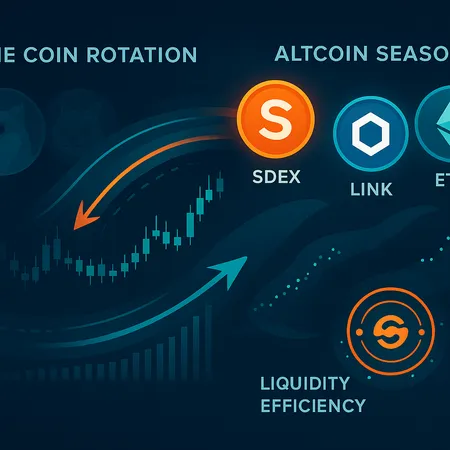
Product-driven catalysts still outperform hype alone. When Smardex unveiled its unified DeFi protocol, SDEX spiked roughly 160% in short order — a textbook example of a unified product narrative improving market perception and attracting capital (news report on SDEX surge).
What made that move meaningful beyond a pump? Two features matter:
- Liquidity efficiency — Smardex’s design aimed to route liquidity more efficiently across pools, reducing slippage and improving capital utilization for traders and LPs. When user experience improves, trading volume often follows, and volume attracts allocators.
- Visible product adoption — protocol upgrades and unified UX provide an observable metric for investors to anchor on, unlike speculative social-viral pushes that leave little on‑chain trace.
SDEX is a reminder that token price is ultimately a reflection of economic activity. In altcoin season, tokens with demonstrable product traction stand a better chance of sustaining rallies.
On‑chain flow signal: Chainlink whales are accumulating
Whale behavior is one of the cleaner flow signals available on chain. Recent reporting shows Chainlink whales reversing distribution and accumulating about $263M in LINK, which signals a shift from sell pressure to buy-side accumulation (NewsBTC on Chainlink whales).
Why pay attention to whales? Large, coordinated accumulation can:
- Provide a liquidity buffer that absorbs selling pressure.
- Signal conviction by sophisticated market participants who watch macro and product cycles closely.
- Precede multi‑week to multi‑month trends when paired with improving fundamentals.
Chainlink’s network growth, oracle integrations and clear use cases make accumulation a plausible precursor to structural rerating, especially compared with meme plays that lack real utility.
Which alt setups look technically clean right now
Not all alts are created equal during rotation. Comparative technical analysis of ETH, SOL and AVAX suggests differing breakout quality and continuation potential (CoinPedia comparative analysis).
High‑level takeaways:
- ETH tends to lead on macro upgrades and liquid infrastructure, so breakouts often have broader institutional interest.
- SOL offers higher beta and can produce sharper rallies, but network outages and concentrated tokenomics are recurring risks.
- AVAX often trades as a liquidity‑efficient L1 with attractive yield strategies in DeFi, giving it a product story that can complement a technical setup.
When capital rotation drives altcoin season, those technical setups determine who sustains moves when risk appetite shifts.
A practical framework to separate durable rerates from speculative pumps
Below is a repeatable checklist I use when sizing positions during meme coin rotation and altcoin season. Score each item 0–2 (0 = poor, 2 = strong) and prioritize tokens with higher totals.
- Tokenomics & supply mechanics
- Is the circulating supply reasonable relative to market cap? Are there scheduled unlocks or heavy vesting cliffs?
- Liquidity efficiency
- How deep are AMM pools and order books? Can realistic volume be absorbed without extreme slippage?
- On‑chain usage
- Active addresses, TVL, transactions per day — is usage trending up or down?
- Whale and flow signals
- Are large holders accumulating or distributing? Look for on‑chain wallets and exchange flow patterns.
- Product cadence & roadmaps
- Is there a tangible product or upgrade that could expand real usage (example: Smardex’s unified protocol)?
- Narrative durability
- Is the story sustainable beyond a few social-media cycles? Does it tie to real utility or user adoption?
- Correlation to macro and blue‑chip tokens
- Does the token move independently or merely mirror BTC/ETH? Independent movers with strong fundamentals can decouple positively.
Apply the checklist across meme candidates and alts. A token that scores well on liquidity efficiency, on‑chain usage and whale accumulation is more likely to offer a durable rerate than one driven solely by hype.
Red flags that signal a short-lived pump
- Extremely shallow liquidity and one or two centralized market makers controlling depth.
- Large upcoming unlocks or open‑ended inflation which can overwhelm demand.
- No on‑chain growth despite social buzz.
- Rapid exchange inflows without real outflows to staking or utility — often a sign of flipping between wallets.
Meme coin rotation can mask these risks: money chases a quick return, and when buyers dry up, price reverts fast.
Actionable signals and risk control for growth investors
- Watch on‑chain whale balance changes for tokens you care about; accumulation often precedes multi‑week trends. Chainlink’s whale reversal is a direct example of this signal.
- Prioritize tokens with demonstrable liquidity efficiency. Platforms or tokens that reduce slippage and improve capital utilization (like some elements of Smardex’s unified design) attract sustainable volume.
- Combine technical set‑ups with fundamental scoring. ETH, SOL and AVAX offer different risk/reward profiles — treat each accordingly.
- Size positions and use time‑based entries. During rotation, fast pumps are common; stagger buys or use installment buys to average in. Bitlet.app provides installment and DCA tools that can help implement disciplined entries without trying to time tops.
- Keep stop sizes reasonable and know the liquidity depth to avoid being trapped in low‑liquidity dumps.
Final thoughts
Capital rotation is a healthy market mechanism: it reallocates risk capital toward higher expected returns. But rotation during altcoin season is noisy — the winners are those with product relevance, liquidity efficiency and favorable on‑chain flows. The Smardex/SDEX episode and Chainlink whale accumulation are instructive: one shows how product and liquidity design can catalyze rallies, the other how flow data can confirm a shift in supply dynamics.
For growth‑oriented crypto investors and speculators, the edge lies in systematically combining on‑chain signals, liquidity analysis and narrative durability. That approach helps you separate speculative fireworks from potential structural rerating opportunities.