Why Institutions Keep Buying Solana ETFs While SOL Faces On‑Chain Headwinds
Summary
The paradox: heavy ETF inflows while the chain stumbles
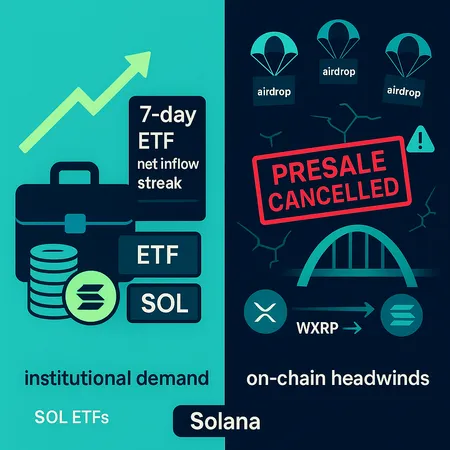
Institutional appetite for Solana exposure has become hard to ignore. Crypto outlets documented a seven‑day net inflow streak into Solana ETFs, an unusual run of demand for a single layer‑1 in recent weeks, and Cointribune reported a large, headline‑grabbing institutional placement — roughly $674 million into a Solana ETF even during a market downturn (Cointribune).
At first glance this looks contradictory: why pour regulated capital into an asset whose ecosystem is publicly dealing with developer churn, governance frictions and project‑level reversals? The short answer is that ETF exposure is not the same as on‑chain backing, and institutional allocators prioritize a different set of attributes than active protocol contributors.
Why institutions prefer ETFs: liquidity, custody and mandate efficiency
Institutional investors — pension funds, family offices, asset managers — have constraints that shape how they access crypto.
Liquidity and execution: ETFs provide large, blockable liquidity in familiar market structures. Buying millions through an ETF minimizes market impact compared with acquiring spot SOL across exchanges. That matters when mandates require precise exposures.
Custody and compliance: Custody is often the sticking point. Regulated institutions favor custodial solutions that sit within existing frameworks. ETFs bundle custody, reporting and AML/KYC standards in ways that buying native tokens does not.
Mandates and benchmark tracking: Many funds are benchmarked to indices or are limited to regulated vehicles. An ETF is a neat instrument to express a thesis on Solana’s market value without breaching internal rules.
Operational simplicity and settlement risk: ETFs remove the need to manage staking keys, keep node uptime, or deal with smart contract risk. For many institutions, those operational overheads create asymmetry in cost/benefit vs. ETF wrappers.
These drivers explain how flows into SOL ETFs can remain robust even as on‑chain activity or project news looks mixed. The inflow signal is real, but it is an off‑chain vote of confidence in price exposure, liquidity and productization — not automatically an endorsement of developer governance or tokenomics.
Case study — Fogo: presale cancelled, airdrop chosen
A useful flashpoint is the recent Fogo decision: the project canceled a planned $20M token presale and opted for an airdrop instead, a move covered by Blockonomi (Blockonomi).
From a developer perspective, converting a presale into an airdrop can be motivated by community optics, regulatory caution, or backlash against centralized allocation. An airdrop can broaden distribution and reduce early‑buyer concentration, which looks better for decentralization narratives.
But for tokenomics and price mechanics, the change is meaningful:
- Immediate sell pressure risk: Airdropped tokens distributed to retail or whales may hit markets quickly, producing downward short‑term price pressure absent lockups.
- Funding implications: Cancelling a presale removes direct project funding that could have gone to development, marketing, or liquidity mining; projects must find alternative bootstraps (grants, treasury swaps, partner funding) which can slow roadmaps.
- Investor signaling: Institutions watching on‑chain behavior may interpret the move as either prudent (avoiding regulatory traps) or as a sign of immature capital planning.
For SOL holders the Fogo example emphasizes how protocol‑adjacent governance and distribution choices can create friction between perceived long‑term network value and near‑term token supply shocks.
Case study — WXRP and cross‑chain liquidity: Hex Trust bridges XRP to Solana
Not all news is negative. AmbCrypto reported on efforts to bridge XRP liquidity onto Solana — notably the WXRP mechanism and Hex Trust involvement — suggesting potential for substantial liquidity inflows (AmbCrypto estimated an unlocking possibility in the billions) (AmbCrypto).
Cross‑chain liquidity can benefit Solana in multiple ways:
- Deeper markets: More assets bridged to Solana increase trading depth and reduce slippage for large orders, which is attractive to institutional desks and market makers.
- Utility and fees: Increased activity can translate to more fee revenue denomined in SOL and boost on‑chain utility.
- Ecosystem diversification: Successful bridges attract new DeFi activity, accelerating composability across assets like WXRP and SPL tokens.
Yet these bridges rely heavily on custodial or multisig designs and third‑party node operators, which can reintroduce centralized dependencies that institutions like (for custody) and critics warn about from a decentralization standpoint.
What the divergence means for token holders
Put together, these threads create a layered picture:
ETF inflows can prop up prices without improving developer health. Institutions buy regulated exposure and may not care about roadmaps or token distribution mechanics. Price can rise even if developer activity stalls.
Airdrops and canceled presales change supply dynamics. Token distribution flips influence sell pressure and treasury funding: both are crucial for long‑term project viability and therefore ultimately relevant to token value.
Cross‑chain liquidity can be a tailwind, but is conditional. Bridges like WXRP increase utility and market depth, yet they also introduce counterparty and custodial risk.
The practical implication: ETF inflows are an important macro signal but they are not a replacement for monitoring on‑chain fundamentals.
Trade and risk management takeaways for SOL investors
For portfolio managers and active investors reconciling these forces, here are actionable rules of thumb:
Distinguish exposure types — use ETFs for regulated, large‑ticket exposure; use spot/DeFi for active participation. If your institution needs custody or must remain in regulated vehicles, ETFs are the cleaner instrument.
Size positions relative to on‑chain health. If you hold SOL because you believe in on‑chain yield, developer momentum and DeFi activity, limit exposure to a fraction of your total crypto allocation when ETF flows are the only bullish signal.
Hedge selectively. Use futures, options or inverse ETFs to hedge macro/ETF risk. An ETF‑heavy rally can correct sharply if on‑chain fundamentals disappoint — don’t assume correlation will hold.
Monitor token unlocks and distribution changes. Track project announcements (airdrops, canceled presales, vesting schedules) since these materially affect short‑term supply dynamics.
Watch liquidity composition. ETF inflows improve headline liquidity but check order book depth on venues where you’d actually execute. Cross‑chain bridges can increase depth but also add custodial concentration.
Maintain a core‑satellite approach. Keep a smaller core exposure via regulated vehicles (ETFs) for stability and a satellite allocation to spot, staking or Solana‑native DeFi for higher conviction, rebalancing as on‑chain signals evolve.
Final perspective — reconcile the signals
The recent Solana ETF inflows are meaningful: they represent institutional capital validating Solana as a market exposure. But they don't magically fix developer funding, governance choices or token distribution risks exposed by moves like Fogo's presale cancellation.
Savvy investors and portfolio managers should treat ETF flow data as a component of a wider due diligence framework: combine macro, product‑level and on‑chain metrics, and use instruments that match your operational constraints. For hands‑on allocation decisions, internal platforms like Bitlet.app can help reconcile regulated exposure with direct token strategies — but always keep a clear separation between price signal and protocol health.
Sources
- Cointribune — $674M into Solana ETF despite market downturn
- Cryptopolitan — Solana ETFs see 7‑day inflow streak
- Blockonomi — Fogo cancels $20M token sale, opts for airdrop
- AmbCrypto — Solana hosts WXRP; can $3.9B liquidity unlock XRP’s DeFi future?
For context on Solana’s broader ecosystem dynamics, see pieces on Solana and emerging composability in DeFi.