YouTube Lets Creators Receive PYUSD: What It Means for Stablecoin Payouts and Creator Payroll
Summary
Why YouTube paying creators in PYUSD matters
YouTube's recent announcement that eligible U.S. creators can opt to receive earnings in PayPal's PYUSD stablecoin is not a niche experiment — it's a litmus test for whether mainstream platforms can operationalize crypto payments without alienating creators. Multiple trade outlets covered the rollout: Coinpedia reported the primary announcement and mechanics, while Coinpaper, CryptoPotato, and TheBlock added context about platform incentives and market positioning. Coinpedia and Coinpaper give the basic who/what; CryptoPotato explains why this is a step toward mainstream crypto integration; and TheBlock frames the market implications for PYUSD.
At a high level, the move normalizes stablecoins as a medium of exchange for digital labor. For creators, it presents a new option alongside direct deposit and other payout rails; for PayPal and PYUSD, it increases on‑platform utility — a critical metric for stablecoin adoption.
How PYUSD payouts work in practice
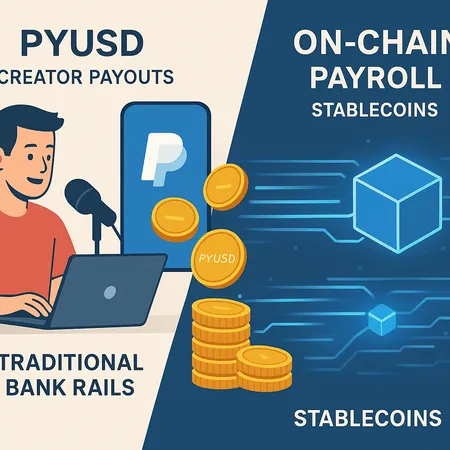
Mechanically, a creator who opts into PYUSD will have YouTube (via its payout system) instruct PayPal to mint or transfer PYUSD equal to the USD value of the payout. That stablecoin can then be custodied in a PayPal‑managed wallet or withdrawn to an external crypto wallet where the creator controls the private keys.
Key points creators should expect:
- Settlement timing: payouts can be made and confirmed on‑chain faster than multi‑day bank ACH lanes, depending on the wallet and chain congestion.
- Custody options: creators may keep PYUSD in PayPal's ecosystem for spending, convert to fiat on PayPal, or withdraw to third‑party wallets/exchanges to access broader DeFi rails.
- Conversion: moving from PYUSD to fiat typically requires a redeem process or exchange trade, which may incur fees, spreads, and timing differences.
This is different from pure bank payroll: the value is fixed to USD (a feature of PYUSD) but the settlement medium and custody model change. Platforms must therefore provide clear flows for conversion and reconciliation, especially for creators who prefer USD in their bank accounts.
Regulatory and tax considerations creators must know
Stablecoin payouts do not remove tax obligations. In the U.S., creators will generally recognize ordinary income at the fair market USD value of the payment when received, whether the payment comes as fiat or PYUSD. If a creator later converts PYUSD to another crypto or to fiat and the asset's USD value changes, that could trigger capital gains or losses on the disposition.
Practically:
- Recordkeeping: maintain timestamps, USD values at receipt, and records of conversions. Platforms should provide downloadable statements showing USD equivalents.
- KYC/AML: PayPal and platforms will apply identity verification. For creators, that generally means fewer privacy benefits than self‑custody but smoother compliance.
- Money transmitter risk and licensing: broader rollout to non‑U.S. jurisdictions may require platform and issuer licensing; some states in the U.S. have specific money transmitter frameworks.
Creators should consult tax professionals for nuances in their jurisdictions, especially creators with cross‑border income or who route large volumes through on‑chain rails.
What this means for PayPal and PYUSD's market position
For PayPal, the YouTube integration is strategic: it embeds PYUSD into high‑frequency payout flows and creates a predictable demand channel. Utility and transactional velocity are powerful stabilizers for a stablecoin's market position. As TheBlock notes, integrations like this are exactly what underwrites usage and market cap growth for an issuer‑backed stablecoin.
PayPal benefits in three ways:
- Increased stickiness — creators using PYUSD may remain in PayPal's ecosystem for conversion or spending.
- Data and revenue — transaction fees, spread income, and richer payment data.
- Market credibility — a major platform's endorsement signals other firms that stablecoins are commercially viable for payroll and payouts.
That said, PYUSD still competes with other fiat‑pegged coins and native fiat rails; sustained success depends on liquidity, redemption guarantees, and regulatory clarity.
On‑chain payouts vs traditional banking rails: speed, cost, UX
Stablecoin payouts shine in three operational areas:
- Speed: on‑chain settlement can be near‑instant once transactions confirm, versus ACH/SEPA which take days.
- Programmability: payments can be split, scheduled, escrowed, or conditioned (useful for revenue shares and automated payouts for collaborators).
- Cross‑border friction: stablecoins bypass slow correspondent banking and FX conversion in many cases.
But there are tradeoffs:
- Fees: on‑chain gas or network fees can be volatile; aggregated solutions or layer‑2 rails reduce this but add architectural complexity.
- UX friction: creators unfamiliar with wallets, private keys, and token approvals may find the experience intimidating. Platforms need to hide complexity with custodial options and straightforward conversion buttons.
- Liquidity/counterparty risk: while PYUSD is designed to be redeemable, issuer or market problems (e.g., redemption suspensions) create risk that doesn't exist with bank deposits.
For many creators the pragmatic model will be hybrid: receive PYUSD for speed and optional on‑chain utility, then convert to USD via a built‑in flow when needed.
Scenarios for broader platform and geographic adoption
There are several plausible trajectories:
Conservative growth on major Western platforms. Platforms that already partner with payments firms (Twitch, Patreon, Substack) may add optional stablecoin payouts for eligible creators, mirroring YouTube's pattern: opt‑in, limited geography, and heavy custody/convert options.
Rapid growth in remittance‑heavy or currency‑unstable regions. In LATAM, parts of Africa, and Southeast Asia where banking is slow or fiat volatility is high, PYUSD or similar stablecoins could be the default payout choice for faster, cheaper value transfer.
Platform ecosystems that embed on‑chain payroll natively. Marketplaces and gig apps might use stablecoins for micro‑payouts, tips, and instant settlements — especially if payroll compliance tooling matures.
Regulatory brakes. Some jurisdictions may restrict programmable payouts or require additional licensing, slowing global rollout.
Each path depends on improving fiat on‑ramps, regulatory coordination, and user education; platforms like Bitlet.app, which combine installment and P2P exchange services, offer a glimpse of the infrastructure that helps creators manage crypto income.
Practical checklist for creators considering PYUSD payouts
- Understand tax timing: report income at USD value when received and track subsequent disposals for capital gains/losses.
- Decide custody preference: keep funds in PayPal for simple fiat conversion, or withdraw to your own wallet to access DeFi and exchanges.
- Plan for volatility and liquidity: PYUSD is pegged, but conversion spreads and temporary liquidity issues are possible.
- Insist on clear statements: platforms should provide CSVs with USD equivalence and transaction IDs.
- Start small: test payouts with a fraction of income to learn workflows before migrating larger proportions.
Bottom line: practical benefits, real tradeoffs
YouTube enabling PYUSD payouts marks a meaningful step toward normalizing stablecoins as payroll rails for digital work. Benefits are concrete: faster settlements, programmable payouts, and expanded cross‑border options. But creators must weigh operational friction, tax complexity, and issuer risk.
For PayPal and PYUSD the upside is significant — mainstream utility and recurring transaction volume — but their longer‑term dominance will require reliable liquidity, transparent reserves, and regulatory alignment. Wider platform adoption is plausible and likely incremental: expect opt‑ins by major platforms, targeted use in remittance markets, and a hybrid future where stablecoins coexist with traditional banking rails rather than immediately replace them.
Sources
- YouTube rolls out PYUSD payments for U.S. creators — Coinpedia: https://coinpedia.org/news/youtube-rolls-out-pyusd-payments-for-us-creators-as-institutional-demand-accelerates/
- YouTube lets eligible U.S. creators get paid in PayPal's PYUSD — Coinpaper: https://coinpaper.com/13062/you-tube-lets-us-creators-receive-payouts-in-pay-pal-s-pyusd?utm_source=snapi
- YouTube enables PayPal stablecoin payments for content creators — CryptoPotato: https://cryptopotato.com/youtube-enables-paypal-stablecoin-payments-for-content-creators/
- TheBlock coverage of YouTube's PYUSD integration and market implications — TheBlock: https://www.theblock.co/post/382296/youtube-pyusd-stablecoin
For many creators, digital‑asset options will coexist with bank deposits for some time — and for traders and developers watching cross‑border liquidity, Bitcoin and DeFi innovations will continue to influence the contours of on‑chain payroll and payouts.