What Strive’s $500M Preferred-Stock Push Says About Corporate Bitcoin Treasuries
Summary
Executive overview — why Strive’s program matters
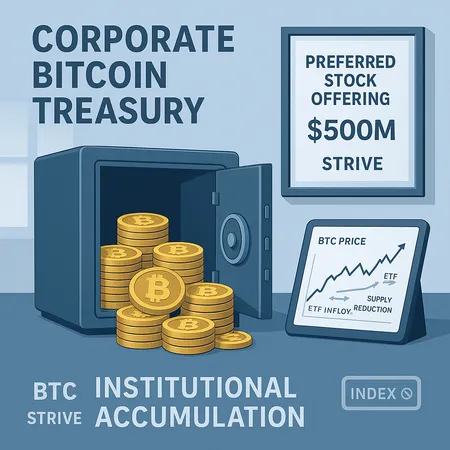
Strive Asset Management’s decision to launch a USD 500 million preferred-stock program to fund Bitcoin purchases is more than a funding round: it’s a template for how public firms might scale BTC treasuries without issuing plain-vanilla equity or taking on more debt. Reported details of the program—an at-the-money preferred-stock issuance dubbed SATA—indicate management wants a flexible, equity-linked vehicle that channels capital into BTC accumulation while managing accounting and financing optics (CoinDesk).
This matters for institutional investors and corporate treasury managers because it shows firms are experimenting with hybrid capital to obtain crypto exposure, altering both firm-level risk profiles and market-level BTC supply dynamics. For context, Strive already held thousands of BTC (about 7,525 BTC as reported), and this program signals an intention to scale that position materially (TheNewsCrypto).
How preferred-stock programs for crypto buying work
Preferred-stock programs come in several flavors—fixed dividend, convertible, or at-the-money preferreds with stock purchase rights. For a company targeting BTC accumulation, preferreds offer three practical advantages versus debt or ordinary equity:
- They’re not treated as senior debt on the balance sheet, which preserves corporate leverage capacity and may be more palatable from an accounting standpoint.
- They can be structured with conversion or purchase options tied to equity that reduce immediate dilution while enabling the firm to raise capital in tranches.
- They can be priced/structured to appeal to specific investor classes (institutions seeking yield or optionality) rather than the broad market.
In Strive’s case, the offered vehicle is presented as an at-the-money preferred-stock program designed to fund Bitcoin purchases. That suggests subscribers get equity-like upside with distinct preferences (dividends or liquidation preference), while Strive gets capital earmarked for BTC accumulation (CoinDesk).
Mechanics to watch in any preferred offering
- Conversion terms and conversion price: These dictate dilution risk for common shareholders and how quickly preferred holders share upside. An at-the-money strike compresses immediate upside but can limit early dilution.
- Dividend or coupon mechanics: High fixed dividends make the instrument more expensive and effectively like debt; discretionary dividends favor issuer flexibility.
- Use-of-proceeds covenant: Some programs legally earmark proceeds for BTC purchases; the strictness of that covenant affects corporate flexibility.
- Lock-ups and resale mechanics: Liquidity for preferred holders impacts who buys the paper—strategic long-term holders versus yield funds.
All these levers change the investor risk/reward calculus: preferred buyers may gain targeted exposure to corporate-managed BTC accumulation while common shareholders accept more concentrated crypto risk on the balance sheet.
How Strive compares to other corporate BTC treasuries (Saylor, MicroStrategy style)
Corporate accumulation so far has primarily been associated with large, active treasury buyers like MicroStrategy under Michael Saylor’s playbook: buy BTC with corporate cash, issue debt or equity, and position the company as a long-duration BTC holder. Strive’s approach mirrors the headline goal—scaling BTC on the corporate balance sheet—but it differs tactically.
- Funding vehicle: MicroStrategy used convertible debt and equity raises; Strive is emphasizing a preferred-stock program targeted at buyers who accept preference characteristics. That can be less dilutive or more bespoke depending on terms.
- Public signaling vs. pure treasury management: Saylor’s approach has been a broad public campaign—establishing the company as a BTC proxy for investors. Strive looks to replicate the accumulation but via financial engineering that may be more modular and repeatable.
- Scale and pace: MicroStrategy’s purchases were large and headline-grabbing; Strive’s program is explicitly sized ($500M) with the potential to scale in tranches, which could smooth market impact.
Observers framed Strive’s offering as emulating Saylor’s accumulation playbook but with a different capital-structure twist—an equity-linked vehicle rather than straight debt or share issuance (crypto.news).
Corporate BTC treasuries and BTC supply dynamics
Institutional accumulation changes the available BTC float in two connected ways: it reduces supply available to traders and may lengthen typical holding periods. Post-ETF, demand dynamics have also shifted—ETFs provide a regulated on-ramp that pulls liquidity from exchanges while corporate treasuries permanently absorb BTC into balance sheets.
- Effective float compression: When companies hold BTC on balance sheets, those coins are effectively taken out of active circulation until sold. Large corporate buyers can therefore tighten available spot supply, especially in environments where ETF flows are also net-buying.
- Price discovery implications: Corporate buys are often lumpy and transparent; predictable, programmatic purchases (like Strive’s tranche-based approach) can reduce intraday volatility but raise the baseline price if demand outpaces sell-side liquidity. Conversely, if corporates are forced to liquidate (balance-sheet stress or regulatory action), they can create outsized supply shocks.
- Interplay with ETF flows: ETFs aggregate retail and institutional capital, compressing trading spreads and centralizing custody. Corporates operating alongside ETFs mean multiple structural buyers are pulling the same supply pool, amplifying upward pressure during net inflows. The net effect: more persistent price supports and different seasonality in liquidity.
For treasury managers, that dynamic changes execution strategies: staggered buys, OTC counterparties, and algorithmic execution become essential to avoid market impact. Tools and platforms that track ETF flows and corporate holdings, including analytics available across providers and marketplaces, will be increasingly valuable — and even services like Bitlet.app can be part of that monitoring toolkit.
Investor risk/reward: what shareholders are buying into
When shareholders—or buyers of the preferred—fund corporate BTC purchases, they implicitly accept a shifted risk profile.
Upside:
- Direct exposure to BTC appreciation via corporate balance-sheet holdings without buying spot BTC personally.
- Potential for equity upside if the market re-rates the company as a strategic BTC allocator.
- Structured return features in preferred instruments (dividends, conversion optionality) that can be designed to suit investor needs.
Downside:
- Balance-sheet concentration risk: More BTC on corporate books links firm cashflow and credit risk to a volatile asset.
- Dilution or capitalization misalignment: Preferred conversions or equity raises to fund BTC purchases can dilute common equity or change governance.
- Regulatory and reputational risk: Holding BTC can invite scrutiny from regulators or precipitate index exclusion decisions (see MSCI debate below), which could depress share price.
From an investor vantage, the core trade-off is whether the structural benefits of corporate accumulation (stable custodial arrangements, professional management, potential corporate optionality) compensate for concentrated crypto exposure and the specific contract terms of the preferred issuance.
Regulatory, index, and institutional acceptance risks (the MSCI debate)
One of the less-discussed impediments to corporate BTC treasuries is index inclusion and labeling. If major index providers or benchmarks (like MSCI) decide to exclude or downgrade companies with material BTC holdings, that could force passive investors and funds that track those indices to sell or avoid such stocks. Some commentary around Strive’s offering specifically referenced that index-status implications are in play alongside corporate narrative decisions (crypto.news).
Regulatory posture also matters: a stricter accounting or capital treatment of corporate crypto holdings, or new rules on securities tied to crypto funding programs, could raise the cost of these strategies. For instance, if regulators treat preferred-led BTC programs as a form of asset management rather than corporate treasury management, disclosure and fiduciary rules could tighten significantly.
Finally, reputational and counterpart risk—banks, custodians, and exchanges that service these programs—face their own regulatory constraints that might cause them to limit participation, raising execution costs.
Practical checklist for treasury managers considering an equity-funded BTC program
- Define objectives and guardrails: Allocate a maximum % of total assets to BTC and create explicit liquidity and stress-test scenarios.
- Choose the correct instrument: Preferred, convertible, or straight equity each have different investor bases and accounting implications.
- Structure investor protections and conversion economics: Be clear on dividend terms, conversion price, and lock-up windows to manage dilution and signaling.
- Engage custodial and OTC partners early: To minimize market impact, pre-arrange OTC counterparties and custody with regulated custodians.
- Model balance-sheet stress scenarios: Consider margining, collateral, and the impact of rapid BTC drawdowns on covenants.
- Communicate with index providers and major shareholders: Anticipate index eligibility questions and proactively engage to reduce surprises.
- Monitor ETF flows and execution timing: Align tranches with market liquidity conditions and ETF inflows to reduce slippage.
These steps reflect lessons from early adopters and the specific mechanics shown in Strive’s program: targeted capital raises, earmarked proceeds, and a preference for structured instruments that can be sold to a defined investor base (TheCurrencyAnalytics).
Strategic takeaways for institutional investors and corporate treasury teams
- Strive’s preferred-stock approach is an explicit signal that companies will continue to experiment with hybrid capital to grow BTC treasuries—expect more structurally creative financings.
- The combination of ETF demand and corporate absorption materially changes BTC supply dynamics; treasury teams should plan execution to minimize market impact and reputational risk.
- Shareholders and preferred buyers get tailored exposure but must price the macro/legal risk: index exclusions or regulatory tightening can have outsized consequences.
- For institutional investors and corporate managers, the practical path forward is conservative: clear mandates, disclosure discipline, and modular capital structures that can be unwound without systemic forced selling.
Ultimately, corporate Bitcoin treasuries are no longer a niche PR stunt; they are a growing capital-allocation option in the post-ETF era. Strive’s USD 500M program will be watched closely as a case study in how market participants can use preferred equity to fund crypto accumulation—if the program works as intended, more firms may follow, but the balance between optionality and risk will determine how widely that playbook scales (TheNewsCrypto).
Sources
- Strive’s $500M preferred stock program coverage on CoinDesk: https://www.coindesk.com/markets/2025/12/10/strive-starts-usd500m-preferred-stock-at-the-money-program-for-bitcoin-purchases
- TheCurrencyAnalytics reporting on Strive’s $500M stock sale: https://thecurrencyanalytics.com/other-news/strive-asset-management-bolsters-bitcoin-holdings-with-ambitious-500-million-stock-sale-227712
- TheNewsCrypto summary of Strive’s current BTC holdings and offering: https://thenewscrypto.com/strive-launches-500m-stock-offering-to-expand-bitcoin-holdings/?utm_source=snapi
- Crypto.news analysis comparing Strive and the Saylor playbook and discussing MSCI/index issues: https://crypto.news/strive-launches-500m-stock-sale-to-expand-bitcoin-treasury-emulate-saylor/
For readers tracking market-level signals, follow ETF flows and corporate filings closely; for execution and custody, consider integrating third-party analytics and execution partners while keeping a tight governance framework. Tools like Bitlet.app can help monitor some market indicators relevant to treasury decision-making.
For broader context on institutional market structure and related topics, see commentary on Bitcoin developments and how crypto liquidity interacts with DeFi primitives.