Why Solana (SOL) Is Lagging in the Current Risk-Off: Signals, Paths to Recovery, and Trade Frameworks
Summary
Snapshot: what’s happening with SOL right now
Solana has been trading in the lower part of its recent range and showing a pronounced downside bias relative to other large-cap assets. Spot technicals are weak: short-term support levels are being tested while volume has failed to confirm rebounds, a classic sign of fatigue rather than healthy consolidation. Market commentary and technical reads from January 29 put SOL in the lower portion of its range during the current risk-off period, which aligns with what traders are watching on intraday and daily charts (Cryptonomist analysis).
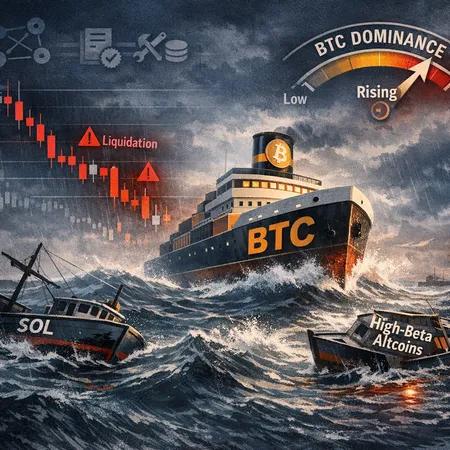
This is not just idiosyncratic weakness. Two cross-currents are reinforcing the pressure: macro-driven risk re-pricing that shifts capital away from levered or speculative allocations, and a reassertion of Bitcoin dominance that tends to crowd out high-beta alts.
Why SOL tends to lead on the downside in risk-off environments
High-beta profile and concentrated leverage
Solana behaves like a classic high-beta asset. When risk appetite rises, it can outpace gains; when risk falls, it tends to fall harder. That dynamic is amplified by concentrated leverage and liquidation risk in futures and margin markets: leveraged SOL longs get flushed first and fast when conviction weakens. The result is sharper, faster drawdowns than for BTC.
Liquidity and market microstructure
Although Solana has deep liquidity relative to many smaller tokens, order-book depth is still shallower than Bitcoin’s. In an environment where investors re-price bond safety and seek defensive cash flows, macro flows can quickly widen spreads and compound downside moves in SOL.
Correlation with BTC dominance
As Bitcoin reasserts dominance, funds and allocators rotate capital back into BTC and defensive crypto exposures (or into cash). CoinDesk notes that a meaningful portion of Bitcoin’s invested supply currently sits at high cost-basis levels, which changes the market’s risk profile and makes BTC movements more potent in reallocating capital across the ecosystem. That dynamic tends to push capital out of high-beta altcoins like SOL until BTC stability or price appreciation re-opens risk appetite (see analysis on BTC invested supply by CoinDesk: more than half of BTC’s invested supply has a cost basis above USD 88,000).
Macro backdrop: bond re-pricing and institutional flows
Institutional signals matter. A recent piece documenting bond market risk flagged a macro re-pricing that nudges institutions toward defensive or crypto-as-portfolio-defense strategies — often favoring large caps like BTC and ETH over smaller ecosystems. That shift both reduces speculative capital available to SOL and raises the threshold for new institutional allocations to higher-beta protocols (Crypto.News on BlackRock and bond risk).
Short-term technical picture for SOL (what to watch)
- Price action: watch whether the recent low holds. Failure to hold near-term support typically gives way to lower targets on a measured move basis.
- Volume confirmation: rebounds without above-average on-chain and exchange volume are suspect. A healthy recovery needs volume to expand on up days.
- Volatility and funding: elevated perp funding and widening bid-ask spreads signal liquidation risk; tight funding and narrowing spreads often precede more sustainable rallies.
Technical triggers that matter:
- Immediate support zone: recent intraday lows and multi-week demand bands. If these break decisively on volume, expect an acceleration lower.
- Short-term resistance to clear: the 20–50 EMA zone on daily charts. A clean daily close above this band with rising volume would shift the near-term bias back toward neutral-to-bullish.
(Technical readers should combine on-chain signals below with chart levels rather than trading price alone.)
On-chain signals and why they determine the recovery path
SOL’s bounce potential depends on four on-chain/ecosystem variables:
- On-chain volume and DEX activity — If DEX volume and token transfer volume stabilize or expand, that indicates retail and builder activity resuming. Without this, price rallies are vulnerable to fade.
- Developer activity — Solana has been a developer magnet for fast, low-cost apps. A visible uptick in commits, deployments, or new projects (particularly in DeFi and NFTs) signals a fundamental re-engagement that can support a multi-week recovery.
- Staking and liquid-staking flows — Staking rates and inflows into liquid-staking derivatives reduce circulating free-float and create a structural bid. If staking supply grows while active supply shrinks, that supports higher prices over time.
- TVL and real usage metrics — Decentralized application usage (DEX liquidity, lending TVL, NFT floor turnover) is a longer-cycle tonic. Sustained recovery likely requires renewed capital use inside the chain.
If these metrics remain weak, SOL will likely stay a high-beta laggard even if BTC steadies.
How BTC dominance affects rotation into and out of SOL
BTC dominance is a simple but powerful signal. When BTC dominance rises, capital tends to re-concentrate in larger market caps; when it falls, capital flows out of BTC and into alts. The interaction looks like this:
- BTC dominance rising + risk-off macro = money moves from SOL into BTC or cash, pressuring SOL further.
- BTC stabilizes but dominance falls = rotation back into higher-beta alts becomes more likely, supporting SOL rallies.
Use BTC dominance as a gating indicator: large tactical entries into SOL make sense only when dominance shows signs of plateauing or rolling over downward in favor of alts.
Actionable trade and allocation frameworks
Below are pragmatic frameworks for two audiences: intermediate traders and portfolio managers/allocators.
For intermediate traders (short-to-medium term)
- Treat SOL as a high-beta trade. Size positions smaller than BTC exposure — a rule of thumb is 30–50% of a typical BTC-sized trade when risk-off conditions persist.
- Use scaled entries: enter in tranches on either volatility contraction or clear on-chain/volume improvement. Example: 33% at a favorable support retest, 33% when 20–50 EMA is reclaimed on daily close, final 34% on volume-confirmed breakout.
- Tighten stop discipline: prefer stop losses based on technical structural breaks (e.g., below the recent swing low) rather than arbitrary percent stops. In risk-off, consider tighter absolute stops (5–10%) unless you size down considerably.
- Watch liquidation risk: avoid or reduce leverage. If using leverage, monitor perp funding and set liquidation-aware stops; a volatility spike can wipe over-levered SOL longs quickly.
- Hedge flexibly: if you want directional exposure without pure downside risk, consider pairing a small SOL long with a BTC long or buying protective puts on BTC to blunt a BTC-dominance driven drawdown.
For allocators and portfolio managers (strategic/tactical allocations)
- Reassess target allocation banding: tighten bands during risk-off. If your normal alt allocation is 5–10%, consider reducing to the lower end (e.g., 1–3% for higher-beta altcoins including SOL) until risk indicators improve.
- Use rules-based rebalancing: rebalance into SOL only when 1) BTC dominance stalls or declines, 2) SOL on-chain volume exceeds its 30-day moving average, and 3) developer or staking flows show net positive momentum.
- Consider laddered re-entry and tranche sizing: reintroduce allocations across three windows tied to macro/on-chain signals rather than a single market-timing call.
- Employ tail-hedges for concentrated exposures: options collars on BTC or small allocations to short volatility strategies can protect the portfolio against a rapid risk-off regime.
- Monitor counterparties and custody: in risk-off, funding spreads and counterparty risk matter. Use reputable platforms and consider partial use of liquid staking for yield while maintaining liquidity buffers. On platforms like Bitlet.app, execution and settlement conveniences can simplify tranche-based buys and staking management.
Scenario planning: 3 paths and what to do
1) Prolonged BTC-led risk-off
- What happens: BTC dominance keeps rising, liquidity flees alts, SOL makes lower lows. On-chain metrics deteriorate.
- Trader play: Short or stay out; if long, run tiny positions with very tight stops.
- Allocator play: Shift to BTC and stablecoins; reduce SOL to minimal strategic exposure.
2) BTC stabilizes, slow rotation back to alts
- What happens: BTC dominance plateaus; on-chain volume and DEX activity for Solana pick up incrementally.
- Trader play: Scale into SOL on confirmation (volume-backed daily close above resistance). Use 2–3 tranche entries.
- Allocator play: Begin tactical rebalancing back toward neutral alt allocation, prioritizing projects with demonstrable on-chain usage and staking growth.
3) Rapid risk-on surge
- What happens: BTC dominance falls quickly; speculative flows revive and SOL rallies strongly (high-beta behavior).
- Trader play: Ride momentum with trailing stops; trim into strength as liquidity metrics spike.
- Allocator play: Opportunistic reallocation to target weights, but take profits into rallies and reestablish risk controls for drawdown protection.
Key signals to put on your dashboard
- BTC dominance (and how it changes week-over-week).
- SOL exchange and on-chain transfer volume vs. 30/60-day averages.
- Perp funding rates and open interest for SOL (liquidation risk gauge).
- Developer activity (commits, deployments) and TVL snapshots.
- Staking inflows and liquid-staking derivative issuance.
Combine these with price-based triggers (EMA bands, swing lows/highs) rather than relying on one metric alone.
Final takeaways
Solana’s current underperformance is the product of market structure (high-beta, shallower liquidity), macro flows pushing capital toward BTC and defensive positions, and elevated liquidation risk in speculative positions. Recovery is possible, but it will be conditional: benign macro signals, a pause in BTC dominance gains, and — crucially — measurable improvement in on-chain activity and staking dynamics. Traders should treat SOL as a high-beta tactical trade with disciplined sizing and stop rules; allocators should prefer rules-based, tranche-based re-entry tied to on-chain and macro signals.
Watch the signals, size conservatively, and use BTC dominance as your gating metric for when to be aggressive versus defensive.
Sources
- Solana technical and market context: Solana: crypto price today analysis — Cryptonomist (2026-01-29)
- Macro and institutional flow context: BlackRock flags bond risk as investors eye BTC, ETH and SOL for portfolio defense — Crypto.News
- Bitcoin market structure and invested supply: More than half of Bitcoin’s invested supply has a cost basis above USD 88,000 — CoinDesk (2026-01-29)