Where to Base Crypto Operations: Lessons from Russia’s WhiteBIT Blacklist and Japan’s Bitcoin Treasury Push
Summary
Executive snapshot
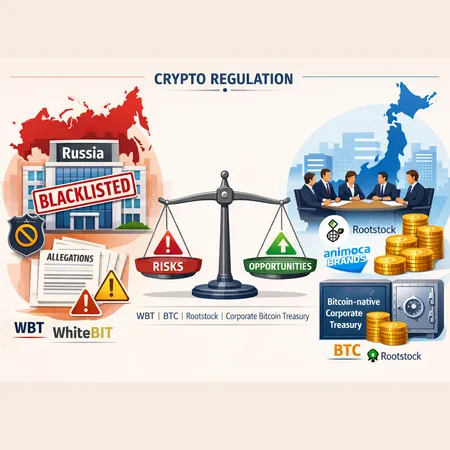
Geopolitical pressures and local policy priorities increasingly determine whether a crypto firm thrives or collapses in a jurisdiction. Russia’s decision to blacklist WhiteBIT over alleged support for Ukraine (reported in January 2026) is a sharp reminder that exchanges remain vulnerable to sudden enforcement and political action. By contrast, Japan’s cooperative industry-regulator environment is enabling corporate-grade, Bitcoin-native treasury infrastructure — a recent initiative involving Animoca Brands and RootstockLabs aims to deliver just that to Japanese firms.
This article compares those two real-world examples and draws actionable lessons for general counsel and corporate treasurers deciding where to locate crypto operations, custody assets, or implement an onchain corporate bitcoin treasury strategy.
What happened: WhiteBIT, the blacklist and immediate fallout
In late January 2026 authorities in Russia moved to blacklist WhiteBIT, alleging the exchange provided financial support related to the conflict in Ukraine. According to reporting, the decision triggered swift regulatory consequences inside the country: restricted market access, potential asset controls, and reputational damage for the exchange and any locally-exposed counterparties. The story is a practical example of how an "exchange blacklist" can cascade into banking de-risking, frozen fiat rails, and user withdrawals — all of which harm liquidity and business continuity for an exchange and for corporates that rely on that exchange for trading or treasury services.
WhiteBIT’s ticker (WBT) and public positioning make it easy for counterparties to identify exposure, but the greater risk for international treasuries is indirect: sanctions and public blacklists increase counterparty risk, complicate KYC/AML checks, and can force banking partners or on-ramps to cut ties to avoid regulatory penalties.
Read the coverage of the blacklist and its immediate regulatory consequences here: Russia blacklists WhiteBIT over claims of financial support for Ukraine.
Japan’s different path: a Bitcoin-native corporate treasury product
Japan’s regulators and industry have for some time taken a measured, engagement-first approach to crypto policy. In that context, Animoca Brands Japan and RootstockLabs announced collaboration on a Bitcoin-native corporate treasury product tailored for Japanese corporations. The initiative reflects a strategic push to make BTC usable as a treasury instrument at corporate scale — with a focus on custody models, onchain governance, and integration into existing corporate finance stacks.
Coverage of the joint effort highlights how Rootstock’s Bitcoin-layer capabilities combined with Animoca’s corporate relationships aim to create custody, settlement, and operational tooling that meets Japanese compliance and corporate governance needs. That project illustrates a policy environment where regulators and businesses work to design compliant infrastructure that unlocks onchain treasury use cases rather than shut them down.
See more on the Japan initiative here: Animoca, RootstockLabs to build Bitcoin-native treasury product for Japanese corporations.
Comparing regulatory philosophies and immediate consequences
Regulatory posture: punitive vs. facilitative
Russia’s blacklist is an example of a punitive posture: when authorities perceive an exchange as violating political or legal norms, they move quickly and visibly to restrict it. This can serve short-term policy goals but creates a high-risk environment for third parties. By contrast, Japan’s approach in the Animoca/Rootstock example is facilitative — regulators and market actors are building compliant products to enable new financial behaviors, reducing legal uncertainty for corporates that want exposure to BTC onchain.
For treasurers this matters: in punitive regimes, legal risk and sudden loss of services are material. Under facilitative regimes, you can expect clearer processes for licensing, custody standards, and ongoing dialogue with supervisors — all important for embedding BTC into a corporate treasury.
Commercial outcomes: market access, liquidity and counterparty risk
An exchange blacklist typically reduces market access for users inside the affected jurisdiction, drives liquidity out of the exchange, and prompts counterparties (banks, payment processors, custodians) to re-evaluate relationships. The commercial consequences include withdrawal pressure, spread widening, increased execution costs, and potentially forced asset migrations.
By contrast, a jurisdiction fostering products like a Bitcoin-native corporate treasury can spawn new commercial services: audited custodians, settlement rails compatible with corporate accounting, and liquidity providers willing to support larger, long-duration BTC holdings. That reduces operational friction and can lower execution costs for treasuries adopting onchain strategies.
Legal-compliance implications for exchanges and corporates
Exchanges in jurisdictions prone to political interference or sanction risk face a higher compliance burden: continuous sanctions screening, deeper transaction monitoring, and contingency plans for asset access. Corporates that rely on such exchanges for liquidity or short-term fiat needs must account for the legal tail risk — the chance that a counterparty becomes non-operational due to regulatory action.
In jurisdictions pushing onchain treasury innovation, legal teams still need to validate custody models, ensure accounting treatment (IFRS/GAAP) for onchain holdings, and confirm tax implications. However, proactive regulatory engagement often makes these issues tractable through pilot programs, regulatory sandboxes, or formal guidance.
Operational and risk-management implications for corporate treasury
Custody and settlement choices
Whether you plan to custody BTC on a corporate balance sheet, or use an intermediary, jurisdictional stability should guide your custody architecture. In a high-risk jurisdiction, self-custody or custody with internationally diversified custodians reduces counterparty concentration. Conversely, in supportive jurisdictions where local custodians provide strong compliance attestations, using certified custodians integrated with corporate ERP systems can simplify reconciliations and audits.
Rootstock-enabled solutions and partner ecosystems (as in the Japan example) are designed to reconcile onchain settlement with corporate controls. Corporates should insist on multi-signature governance, hardware security module (HSM) attestations, and clear legal agreements that address insolvency and cross-border enforcement.
Banking and fiat rails
An often-overlooked vector of risk is the fiat banking relationship. Exchanges that lose banking access after blacklisting can no longer process deposits/withdrawals reliably. Therefore, treasurers need to map not just their crypto counterparties but the banking partners behind those counterparties and assess exposure to local restrictions.
Accounting, auditability and corporate governance
Onchain treasury introduces new audit requirements. Immutable ledgers simplify some reconciliation tasks but raise questions about valuation methods, impairment recognition and internal controls over private keys. Corporates in proactive jurisdictions have a better prospect of working with auditors and regulators to standardize treatments — an advantage the Japan initiative seeks to deliver.
Practical checklist: how to choose a jurisdiction and partner
1) Legal and geopolitical risk scan
- Map sanctions lists and blacklist risk. The WhiteBIT case shows that reputational or political allegations can trigger immediate enforcement. Regularly refresh this scan.
2) Counterparty and banking continuity
- Verify banking rails for fiat conversion and stress-test contingency plans for on-ramps/off-ramps.
3) Custody models and enforceability
- Prefer custody arrangements with clear cross-border enforceability and multi-jurisdiction recovery paths. If using local custodians, confirm license status and regulator oversight.
4) Regulatory engagement and approvals
- Seek jurisdictions where regulators publish guidance or run sandboxes (Japan’s posture is instructive). Engage early with supervisors and auditors when planning a corporate bitcoin treasury.
5) Operational readiness and vendor due diligence
- Assess vendor solvency, insurance, keys management, and whether the vendor interfaces cleanly with accounting and treasury systems.
Recommendations for general counsel and treasurers
Treat jurisdiction as a strategic treasury decision, not just an operational one. Base choices on sanctions exposure, regulatory clarity, and financial infrastructure resilience.
Diversify service providers across legal jurisdictions to reduce single‑point failure risk: custody in one jurisdiction, execution in another, and reconciliation/settlement in a third can improve resilience.
Insist on contractual clauses that address blacklisting, access suspension, and exit protocols so the company can execute emergency withdrawal or asset transfer if a counterparty becomes sanctioned or blocked.
Use pilot programs and hard-limited proof-of-concept deployments to collaborate with regulators and auditors when entering facilitative jurisdictions. The Animoca + Rootstock example shows how industry projects can accelerate viable corporate treasury tooling under clear supervisory oversight.
Maintain a living playbook for sanctions compliance, KYC/AML reporting, and incident response tied into board-level treasury oversight.
Conclusion: balance risk and opportunity
WhiteBIT’s blacklist and Japan’s Bitcoin-treasury initiative are two sides of the same global coin. One illustrates the downside of opaque, politically exposed operating environments; the other demonstrates the commercial upside when regulators, technologists and corporates align to build compliant, scalable onchain treasury infrastructure.
For general counsel and treasurers the pragmatic path is clear: perform rigorous jurisdictional due diligence, design custody and banking redundancy, and engage regulators early when exploring corporate bitcoin treasury strategies. Where possible, favor jurisdictions that offer regulatory clarity and constructive engagement — they reduce legal tail risk and make it easier to adopt sophisticated onchain treasury models that a company’s board will accept.
Bitlet.app and other platforms show the growing ecosystem of treasury tooling; choose partners that can meet both your compliance demands and operational needs.