Why Bitwise’s Non‑Custodial On‑Chain Vaults on Morpho Matter for Institutional DeFi Adoption
Summary
Executive summary
Bitwise’s recent launch of non‑custodial on‑chain vaults built on Morpho marks a significant inflection point for institutional DeFi adoption. The offering aims to deliver stablecoin yield in the neighborhood of ~6% APY by supplying assets into Morpho’s optimized lending layer, while preserving on‑chain custody and auditability. For asset managers, corporate treasuries, and compliance officers, the important question isn’t just the headline APY — it’s whether the governance, custody model, and operational controls around the vaults meet institutional standards.
What Bitwise built: a high‑level product view
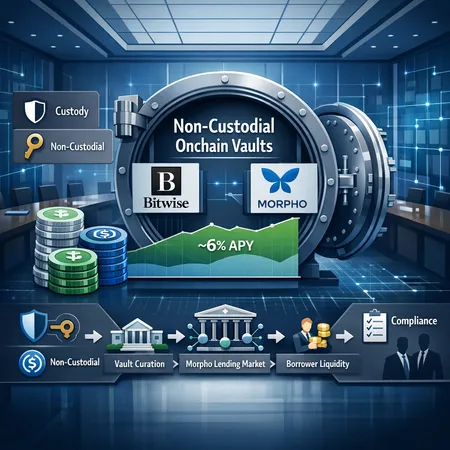
Bitwise has packaged a curated, non‑custodial vault that routes stablecoins to Morpho, a protocol that matches borrowers and lenders more directly to improve supply‑side returns. Media coverage and the Bitwise announcement describe the vault as a first‑of‑its‑kind curation that targets roughly 6% APY on stablecoin deposits while keeping funds on‑chain under the depositor’s control (CryptoNews, TheNewsCrypto, Bitcoin.com News).
This is not a custodial product where Bitwise holds private keys; rather, it is a set of smart contracts and curated strategy parameters that deposit assets into Morpho’s pooled markets. Bitwise’s role is curator and manager of strategy parameters — selecting which lending markets to use, setting rebalancing rules, and defining risk parameters — while the on‑chain state determines asset location and flows.
How Morpho works (concise mechanics)
Morpho is a lending layer that overlays existing money‑market protocols (e.g., Aave/Compound) and improves yields via a peer‑to‑peer matching engine. Instead of all supplied assets sitting in a pooled contract earning a protocol interest rate, Morpho attempts to match lenders directly with borrowers to reduce the spread captured by the underlying protocol and pass a larger share of yield to suppliers. The MORPHO token and governance layer enable protocol upgrades and fee mechanics, but the core value is efficiency for suppliers.
Architecturally, when a Bitwise vault supplies stablecoins to Morpho it:
- Locks stablecoins into vault smart contracts that then supply liquidity to Morpho-compatible markets.
- Receives protocol accounting credits (supply index or aTokens/ctokens analog) that reflect accrued interest.
- Periodically rebalances or migrates between markets depending on observed lending demand, gas costs, and risk thresholds defined by the curator.
That mix of automation (on‑chain composability) and human oversight (Bitwise curation) is designed to give institutional clients a familiar manager‑led product while retaining the auditability and composability of DeFi.
The yield profile: what “~6% APY” really means
Bitwise has publicly positioned these vaults as targeting around 6% APY for stablecoin depositors. This target is an economic outcome of routing assets through Morpho’s demand‑optimized lending stacks and depends on multiple moving parts:
- Underlying money‑market rates on Aave/Compound and other integrated markets;
- Morpho’s P2P matching efficiency and any protocol fees; and
- The vault’s rebalancing cadence and gas friction.
Expectations for a steady 6% should be framed as a target range, not a guaranteed fixed rate. Institutional buyers must model scenarios: base case (decent lending demand), stressed case (borrower defaults or mass withdrawals), and fee/gas squeeze (where net yield can compress). The sources announcing the product emphasize the target nature of the APY rather than a guaranteed yield (CryptoNews, Bitcoin.com News).
Custody and compliance trade‑offs
Non‑custodial vaults change the risk surface in familiar and unfamiliar ways. Below are the main trade‑offs compliance officers should weigh.
Upside: reduced third‑party custody counterparty risk
Because assets remain on‑chain, the depositor retains ultimate title via private keys or an institutional smart‑wallet arrangement. This eliminates the single counterparty custody failure mode that plagues centralized yield products.
New risks: smart‑contract, protocol, and oracle exposure
Non‑custodial does not mean risk‑free. Funds are exposed to:
- Smart‑contract bugs in Bitwise’s vault code or Morpho’s contracts;
- Underlying protocol insolvency or governance attacks on integrated lending markets;
- Oracle manipulation that distorts liquidation thresholds and interest accounting.
Institutions must demand independent audits, bug‑bounty coverage, and insurance or indemnity terms (where available). Bitwise’s institutional positioning suggests third‑party audits and robust operational controls, but auditors and insurers evaluate each deployment separately.
Regulatory and accounting considerations
Non‑custodial on‑chain yields complicate custody definitions under some regulatory regimes. Questions to resolve include:
- Who is the custodian of record for compliance and fiduciary reporting?
- How are yields recognized for accounting purposes—realized vs. accrued—and how are on‑chain accrual indices reconciled with books?
- How are KYC/AML processes applied to counterparties interacting with the vault (e.g., incoming borrower flows)?
Compliance teams will need playbooks that combine chain analytics, custodial attestations from institutional wallet providers, and contractual representations from the asset manager.
Implications for asset managers and product teams
For asset managers, Bitwise’s approach is instructive: managers can offer yield products that preserve on‑chain benefits while maintaining a familiar managerial overlay. Key implications:
- Product differentiation: managers can curate market access (which Morpho markets, rebalancing thresholds) to create risk‑graded products.
- Distributed auditability: on‑chain transparency enables faster reconciliation and forensic review, reducing operational friction for client reporting.
- Operational tooling needs: integration with institutional custody providers, accounting systems, and on‑chain monitoring will be necessary to scale adoption.
Bitwise’s rollout is effectively a proof point that asset managers can bridge DeFi primitive yields and institutional product wrappers without custodializing client funds.
What this means for corporate and sovereign treasuries
Treasuries are conservative by design. The Bitwise-Morpho model offers an attractive yield pick‑up versus cash or short‑dated money market funds, but treasuries must expand policy controls:
- Policy and mandate: define allowable smart contract risk, protocol caps, and auditing standards.
- Liquidity planning: stress‑test withdrawal and settlement timelines in on‑chain congestions scenarios.
- Reconciliation and custody: adopt institutional on‑chain key‑management solutions or multisig arrangements and ensure integration with TMS/ERP systems.
Sovereign treasuries will be especially sensitive to transparency and counterparty provenance. The on‑chain nature helps with audit trails, but legal frameworks must be updated to classify holdings and exposures properly.
How this fits into the larger trend of on‑chain institutional primitives
Bitwise’s vaults are part of a broader wave: institutional primitives are moving on‑chain — not just tokenized assets, but institutional operational building blocks like non‑custodial vaults, governance modules, and on‑chain accounting schemas. That trend includes:
- Standardized on‑chain interfaces that make institutional integrations repeatable;
- Composability that lets managers layer hedges or overlays without moving assets off‑chain; and
- Improved transparency that reduces reconciliation time and supports faster audits.
However, for institutions to fully embrace these primitives, the ecosystem must mature across four dimensions: oracle reliability, formal verification and audits, institutional custody for signing interactions, and clearer regulatory guidance. The Bitwise example is promising because it packages curation and operational rigor on top of an efficient DeFi primitive.
Practical checklist for compliance officers evaluating a Bitwise/Morpho vault
Before approving allocations, ask for and document the following:
- Smart contract audit reports and bug‑bounty history; proof of remediation for any findings.
- Clear legal docs specifying custody boundaries, manager responsibilities, and indemnities.
- Reconciliation procedures mapping on‑chain accounting entries to ledger reporting.
- Stress‑test scenarios showing NAV behavior during market and chain stress, with gas cost sensitivity.
- Insurance coverage limits and claims process for smart contract failures or protocol insolvency.
- Integration plan with institutional key management (e.g., multisig, HSM, or custodian signing flows).
Final thoughts
Bitwise’s non‑custodial vaults on Morpho are a practical step toward institutional DeFi: they show how asset managers can curate on‑chain strategies while keeping assets non‑custodial and auditable. The product targets appealing yields for stablecoins, but institutions must balance yield with smart‑contract and regulatory risk and build the operational scaffolding to support on‑chain exposure.
For compliance officers and treasury managers, the right posture is pragmatic: treat these vaults as new financial instruments that require layered controls — technical audits, contractual protections, reconciliation rules, and a governance ladder for emergency responses. If you’re evaluating on‑chain yield for client programs or corporate treasuries, this Bitwise launch is a useful case study in how DeFi primitives like Morpho can be curated into institutionally palatable offerings.
Bitwise’s initiative also signals the accelerating integration between traditional asset management and crypto‑native infrastructure — a trend you can track across other institutional deployments and broader market developments in DeFi. For perspective on how macro assets still anchor many institutional strategies, remember that narratives around Bitcoin and liquid stablecoins remain central to treasury conversations. Bitlet.app’s tools and reporting integrations can help teams bridge some of the operational gaps when piloting these strategies.
Sources
- Bitwise press/coverage: Bitwise launches non‑custodial vault curation on Morpho; targets 6% APY
- Initial industry report: Bitwise launches non‑custodial onchain yield vaults on Morpho targeting 6% APY
- Secondary coverage: Bitwise launches first on‑chain DeFi vault using Morpho for stablecoin yield