How Orbs + Gryps Bring Institutional Onchain Perpetuals to Sei via Perpetual Hub Ultra
Summary
Executive overview
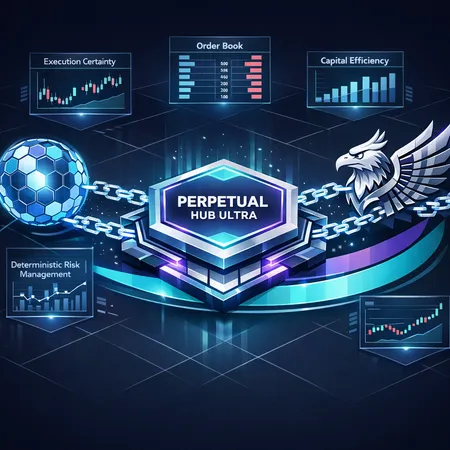
Orbs and Gryps are rolling out institutional‑grade onchain perpetual futures on the Sei Network using Perpetual Hub Ultra. This is not a simple front‑end launch: it’s a Layer‑3 approach that deliberately separates execution certainty, capital efficiency, and deterministic risk management from the base chain’s congestion and latency characteristics. For institutional DeFi strategists and product teams, the proposition is clear: bring exchange‑grade primitives onchain while preserving verifiable settlement and composability.
The rest of this piece explains what a Layer‑3 perpetual venue changes for derivatives, why Sei (ticker: SEI) is a strategic host today, how this offering stacks up against existing onchain perpetual venues and centralized derivatives desks, and what institutional adoption and custody models need to evolve to capture this market.
Why a Layer‑3 Perpetual venue matters
Layer‑3 constructs are often dismissed as a scaling fad, but when you build derivatives infrastructure the conversation shifts. Perpetual Hub Ultra—designed as a Layer‑3 execution and risk layer—reframes three critical primitives for perpetuals:
Execution certainty
Execution certainty is the property that traders and market‑makers can predictably get fills and rely on settlement semantics. Onchain order books and AMMs historically suffer from latency, MEV, and reorg risk. A Layer‑3 perpetual venue moves execution into an environment optimized for matching and price discovery, then commits final state to the host chain. That design reduces variability in fill outcomes and narrows the gap between offchain exchange latency and onchain settlement guarantees.
The practical upshot: institutional clients—who price in slippage, fill probability, and funding decay—can underwrite strategies onchain because the execution environment becomes more deterministic.
Capital efficiency
Capital efficiency in perpetuals means cross‑margining, isolated margin controls, and the ability to net exposures across counterparties. Perpetual Hub Ultra can implement richer margin models and compressed collateral engines at Layer‑3 without needing every micro‑interaction to hit layer‑1. By decoupling margining from base‑chain sequencing, the protocol reduces onchain gas overhead and allows more leverage per collateral unit while still committing settlement proofs to Sei.
That lowers the cost for market‑makers providing two‑way liquidity and lets institutions run capital‑efficient hedges rather than restless, overcollateralized positions.
Deterministic risk management
Derivatives need rules—liquidation mechanics, auction processes, oracle settlement and dispute windows—that are predictable and auditable. Layer‑3 composition enables deterministic, testable risk modules that can be stress‑tested in isolation. When combined with a final onchain settlement, it produces verifiable proofs that risk rules executed as advertised.
In short: you get the operational flexibility of offchain matching with the cryptographic assurance of onchain clearing.
Why Sei is a strategically sensible host now
Sei’s architecture gives Perpetual Hub Ultra a favorable host for several reasons. Technically, Sei was built with trading primitives in mind: native order matching, optimized mempools for trading messages, and a focus on parallelization and low latency. Those characteristics reduce the friction between a Layer‑3 execution environment and the base chain’s settlement layer.
Operationally, Sei’s active ecosystem and MEV/reorg mitigation roadmap provide predictable finality that derivatives desks prize. For market participants evaluating where to anchor high‑frequency order flow, SEI’s throughput profile and low confirmation variance matter.
From a commercial standpoint, Sei’s liquidity basins and specialist relayers are attractive to firms seeking a concentrated trading pool. The Perpetual Hub Ultra integration announced by Orbs and Gryps explicitly targets this opportunity—leveraging Sei’s trade‑centric architecture to host a product that otherwise might be hamstrung on slower general‑purpose chains. See the product highlights in the Orbs + Gryps announcement for specifics on the Gryps integration with Perpetual Hub Ultra on Sei.
Orbs, Gryps and the Perpetual Hub Ultra role
ORBS brings a proven track record in hybrid onchain/offchain execution design; Gryps provides the market execution and matching primitives that a perpetual venue needs. Together they are packaging a Perpetual Hub Ultra that sits as a specialized, verifiable execution layer: trade matching happens where latency is minimized, and settlement proofs anchor back to SEI for custody and composability.
That combination lets teams test production derivatives models in an environment that balances speed and finality—crucial for institutional risk desks.
How this compares to existing onchain perpetual venues
Existing onchain perpetual venues such as dYdX (v4), Perpetual Protocol, and various concentrated liquidity AMM derivatives platforms solved large parts of the onchain derivatives puzzle but made tradeoffs.
dYdX v4 and similar offchain matching + onchain settlement models already improved execution vs. purely onchain matching, but they rely on their own sequencers and bespoke settlement flows. Perpetual Hub Ultra differs by using a Layer‑3 pattern grafted onto Sei’s native trading primitives, aiming to reduce cross‑domain friction and improve finality timeliness.
AMM‑based perpetuals (Perp V2, GMX‑style) prioritize capital efficiency through automated pricing but can expose traders to large slippage and oracle latency on volatile moves. A Perpetual Hub Ultra can combine order‑book style price formation with AMM backstops to reduce extreme slippage events.
Centralized derivatives desks still win on liquidity depth and ultra‑low latency, and they provide custodian‑grade services that institutions prefer today. But they carry custody risk and counterparty exposure. Layer‑3 perpetuals narrow the operational gap by delivering exchange‑grade matching with onchain settlement proofs—removing opaque custody while keeping most execution advantages.
In practical terms, Perpetual Hub Ultra on Sei aims to be closer to the centralized trading experience in latency and fill predictability, while preserving onchain settlement and composability.
Compared to centralized derivatives desks: the tradeoffs
Centralized venues have decades of incumbent operational tooling: native custody, fiat rails, KYC/AML, deep OTC pools, and dedicated clearing engines. They are still the easiest route for institutions to scale large book sizes and complex hedges.
Layer‑3 onchain perpetuals reduce counterparty and custody risk by keeping final settlement trustless, but they introduce other considerations:
- Connectivity and latency: while Layer‑3 can approach centralized latency, it won’t match colocated exchange speeds for some high‑frequency strategies.
- Regulation and compliance: many institutions still require KYC/AML, which is easier to provide through centralized venues.
- Liquidity depth: early Layer‑3 venues will rely on incentive programs and interconnected liquidity routers to approach centralized depth.
This means that, in the medium term, institutions will likely run a hybrid model: large, bespoke OTC or centralized desks for the deepest books, and Layer‑3 onchain venues for transparent, auditable exposure and programmatic hedging.
Implications for institutional DeFi adoption and custody models
The migration of derivatives infrastructure onchain forces changes in custody and institutional primitives. Two trends deserve attention.
First, custody models are fragmenting into risk‑tiered options: fully custodial (centralized exchanges, custodians), non‑custodial institutional primitives (protocols that let institutions sign and manage keys while interacting with onchain rails), and hybrid custody solutions that split signing authority. The market is already experimenting with non‑custodial institutional products: Bitwise’s launch of non‑custodial onchain yield vaults on Morpho is an example of institutions embracing audited, non‑custodial primitives for yield and exposure management. That trend signals institutional comfort with onchain execution if the tooling is compliant and auditable.
Second, treasury and risk teams will demand verifiable settlement proofs, reproducible liquidation rules, and clear oracle governance. Perpetual Hub Ultra’s deterministic risk modules make it possible to demonstrate to risk committees that rules execute as written. That reduces internal friction for treasury onboarding of onchain derivatives.
Finally, platforms like Perpetual Hub Ultra create opportunities for custody vendors, banks, and prime brokers to build middleware: account abstraction, delegated signing, threshold key management, and KYC/AML attestation layers that make onchain venues palatable to regulatory and compliance teams. Bitlet.app customers, for example, will look for wallets and custody integrations that let them steward collateral while accessing these novel venues.
What product teams and strategists should watch next
- Liquidity metrics: monitor depth, slippage on large trades, and the presence of professional market‑makers on Perpetual Hub Ultra pools.
- Execution telemetry: compare fill latencies and reorg incidence versus centralized desks and other onchain venues.
- Custody integrations: watch which custodians and key‑management solutions announce support for Sei Layer‑3 flows.
- Regulatory signals: note how counterparties and custody providers handle KYC/AML and whether banks participate as settlement partners.
- Cross‑venue composability: track whether Perpetual Hub Ultra positions are easily composable with lending, collateral swaps, or structured products.
These indicators will tell whether institutional adoption is tentative or accelerating.
Conclusion
Orbs and Gryps bringing Perpetual Hub Ultra to Sei is a meaningful step in the evolution of institutional DeFi. The Layer‑3 pattern promises to reconcile many of the tradeoffs between centralized derivatives desks and native onchain venues: it improves execution certainty, raises capital efficiency, and enables deterministic risk management while preserving verifiable settlement. Sei’s trade‑focused architecture makes it a pragmatic host today, and the broader trend toward non‑custodial institutional primitives—exemplified by recent launches such as Bitwise’s onchain products—underlines a wider institutional appetite for audited, onchain exposure that still fits into compliance frameworks.
For product managers and strategists, the race is now to build custody integrations, latency‑tolerant hedging products, and composable liquidity that together turn a technically elegant Layer‑3 perpetual into a commercially viable institutional market.
Sources
- Orbs expands on‑chain perpetuals trading on Sei through Gryps integration — Finbold
- Bitwise launches non‑custodial onchain yield vaults on Morpho (context on institutional onchain productization) — CryptoNews
For additional background on the macro role of perpetuals in crypto markets, many strategists still reference narratives around Bitcoin and institutional flows into DeFi.