Wall Street Liquidity and 'Vibe Coding' Land on Solana: Market Structure and Developer Impacts
Summary
Why Wall Street liquidity on Solana matters now
Two developments converged quickly: institutional liquidity firms historically tied to NASDAQ/NYSE are provisioning markets for tokenized traditional assets, while a new layer of consumer-facing apps—often called vibe coding—is experimenting with UX-first assets and experiences on L1s like Solana and Layer 2s like Base. The combination is not academic. It changes how allocators and product teams should think about on-chain markets, settlement, and the economics of running apps on SOL.
For asset allocators this is a question of execution quality and counterparty assumptions. For Web3 product managers it's about composability, UX, and how much capital is likely to route through their primitives. For many traders and builders, Solana is now not just a high-throughput chain but a potential venue for daytime, exchange-like trading activity—thanks in part to ONDO’s recent expansion.
Ondo Finance brings 200+ tokenized US stocks and ETFs to Solana
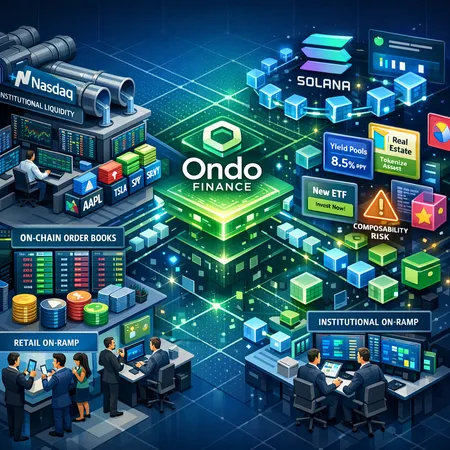
Ondo Finance recently expanded Ondo Global Markets to Solana, adding 200+ tokenized US stocks and ETFs that are backed by liquidity providers with ties to NASDAQ and NYSE. Coverage of the move highlights a practical outcome: more on-chain native exposure to commonly traded equities and ETF tickers, available with the settlement and custody design choices Ondo chooses to implement (bitcoin.com and dailycoin.com).
That expansion matters in three concrete ways:
- Liquidity depth: NASDAQ/NYSE-backed liquidity providers bring an institutional mindset to quoting and order book construction. That can reduce spreads and slippage for large trades executed on-chain, improving market quality for tokenized stocks.
- Trading hours and cadence: tokenized equities on Solana can enable near-24/7 trading windows even while primary markets remain open in U.S. hours—blurring the old trading-hours dynamic and creating paths for arbitrage, liquidity provision, and cross-market hedging.
- Institutional comfort: having established exchange liquidity providers participate signals to allocators that execution and price discovery can approach exchange-like robustness, a key psychological and operational step toward larger allocations.
Ondo’s move is both practical and symbolic—practical because it adds native liquidity and product choice on Solana; symbolic because it frames the chain as a destination for regulated-asset primitives.
How NASDAQ/NYSE-backed liquidity changes custody and settlement assumptions
Historically, tokenized traditional assets implied two thorny assumptions: (1) that on-chain tokens could be reliably backed by off-chain assets, and (2) that settlement would either mirror legacy rails or introduce new reconciliations. When liquidity providers with NASDAQ/NYSE relationships underwrite quotes, some of those assumptions shift.
First, quoting and market-making patterns become more predictable. Institutional LPs tend to enforce tighter inventory and hedging frameworks that professional traders expect. That reduces the execution risk for large institutional flows and increases the appeal of routed liquidity that originates on-chain but sits against exchange-level pricing.
Second, custody models can be hybridized. Custodians and prime brokers that service NASDAQ/NYSE flows may be willing to work with token issuers or custodial bridges that retain on-chain settlement while holding off-chain inventory or hedges. This is not the same as full on-chain settlement in all cases, but it narrows the gap between exchange custody and blockchain custody models—lowering the bar for allocators to engage.
Third, settlement windows change. Traditional T+2/T+1 processes can be decoupled from on-chain movement: trades executed on Solana could be legally settled off-chain according to existing market rules while economically settled on-chain via token movements. That layered approach can create two versions of settlement risk—legal vs economic—which requires careful legal and product design.
The practical upshot: institutions can now contemplate routing some execution and hedging activity through tokenized stock markets on chains like Solana while relying on the know-how of NASDAQ/NYSE-affiliated liquidity providers for price quality.
'Vibe coding'—a new asset and UX narrative
Parallel to institutional liquidity is a cultural and product shift on Solana and other fast L1s: the rise of vibe coding—apps that prioritize experiential design, social affordances, and novel asset types. Unlike classical DeFi primitive builders who optimized for composability and permissionless composability, vibe coding teams ship apps where narrative, community, and UI become primary value drivers (cryptopolitan.com).
Why care? Vibe-coded apps can act as accelerants for retail on-ramps. A slick UX that packages tokenized stocks, social features, fractional ownership slices, or hybrid NFT/stock narratives lowers onboarding friction. Users who come for the interface may stay for the liquidity, and when those users trade or provide capital, they materially affect fee capture and token velocity on Solana.
From a product manager's perspective, vibe coding creates two opportunities and one headache:
- Opportunity: UX-first products can bootstrap liquidity pools and user attention faster than generic primitives, enabling new monetization paths and organic growth.
- Opportunity: these apps can act as discovery layers that route retail order flow to institutional liquidity on-chain—bridging two previously separate user economies.
- Headache: UX-driven experiments often rely on heavy composability; loosely audited connectors, social token mechanics, or on-chain wrappers can multiply counterparty and smart-contract risk.
This trend matters particularly for Solana because its low latency and fee profile are well suited to interactive, real-time consumer apps.
On-ramps for retail and institutional users
Multiple pathways could funnel users to tokenized markets on Solana:
- Direct custodial rails: exchanges or broker-like apps that custody users' funds and provide a familiar fiat on-ramp, potentially integrating Ondo-style tokens under a single app umbrella.
- Institutional prime integrations: broker-dealers and custody providers could white-label tokenized stock products for their clients, using on-chain execution but off-chain legal settlement where required.
- Social and UX-led onboarding: vibe coding apps that simplify KYC, wallet UX, and fractionalization will attract retail users who value experience over raw permissionlessness.
The exact mix depends on regulatory clarity, KYC/AML flows, and how custodians and prime brokers decide to play. Services like Bitlet.app and others that stitch fiat rails into crypto infrastructure will likely be part of this puzzle, though each player will pick distinct custody and settlement stances.
Composability risks and how to mitigate them
Composability—one of blockchain's great strengths—becomes a double-edged sword when institutional capital mixes with experimental UX products. Key risks:
- Liquidity dislocation: if an app routes retail flow into a leveraged, composable product that relies on on-chain hedging, a liquidity shock could cascade into thinly capitalized pools.
- Settlement mismatch: economic settlement on-chain but legal ownership off-chain can create disputes if an intermediary fails or market conditions move quickly.
- Smart-contract fragility: vibe-coded wrappers and UX experiments might use novel token standards or complex cross-contract logic that hasn’t seen institutional-level audits.
Mitigations product teams and allocators should consider:
- Clear separation of custody primitives: delineate what is legally custody vs what is economic exposure; document it for allocators.
- Liquidity-aware UX: surface liquidity metrics, spreads, and guaranteed execution size so high-volume users can make informed decisions.
- Audit and insurance: stronger audit regimes and insurance primitives (either market-provided or third-party) reduce tail risk for institutional counterparties.
Likely effects on SOL demand and transaction fees
Institutional trading activity and retail UX growth affect SOL economics in predictable ways, with nuances:
- Increased on-chain trading volumes raise transaction fees in aggregate but not necessarily fee-per-transaction if throughput remains ample. However, persistent demand for on-chain settlement and UX interactivity increases total fees paid into the network, which benefits fee burn and rent economics tied to SOL.
- Developer demand: as teams build integrations, tooling, and market-making infrastructure, demand for SOL to pay for compute and transactions goes up, especially for state-heavy apps and high-frequency interactions.
- Token utility vs. speculation: institutional usage tends to value network reliability and settlement finality more than speculative narratives. If Solana establishes itself as a reliable venue for tokenized securities, a structural baseline of utility-driven SOL demand could emerge, shifting tokenomics subtly away from purely speculative flows.
Yet, there are caveats. If composability failures cause high-profile outages or if gas spikes during stress events, retail and institutional users may temporarily move to alternatives, pressuring SOL short-term. Product managers should design for worst-case UX and heavy-load scenarios.
What builders and allocators should do now
For Web3 product managers:
- Prioritize liquidity-aware UX: show users how on-chain prices relate to NASDAQ/NYSE markets and where execution sits.
- Build custody clarity: be explicit about what a token represents legally and economically, and document settlement workflows.
- Add throttles and circuit breakers: protect composed positions from cascading failures.
For asset allocators:
- Evaluate execution quality: measure spreads, depth, and latency when routing trades to tokenized markets on Solana versus off-chain venues.
- Understand legal exposure: determine whether the token is a direct claim, a synthetic, or something backed by off-chain inventory—and what that means for recovery in default scenarios.
- Add operational checks: vet custodians, liquidity providers, and audit histories before allocating meaningful capital.
Conclusion: a hybrid future for on-chain markets
Ondo’s expansion and the rise of vibe coding apps are complementary forces. One brings institutional-grade liquidity and credibility; the other brings retail attention and UX experimentation. Together they create a hybrid on-chain market environment where exchange-quality liquidity, social-native products, and fast settlement coexist—but not without new operational and composability risks.
For product managers and allocators considering Solana-based tokenized markets, the takeaway is pragmatic: the rails are maturing, and institutional liquidity providers tied to NASDAQ/NYSE reduce certain execution risks, but you must still design for legal clarity, liquidity shocks, and smart-contract resilience. If executed carefully, this convergence can increase structural SOL demand and spur a richer developer economy on Solana.
Sources
- Ondo expands to Solana — Ondo Global Markets adds 200+ tokenized US stocks and ETFs backed by NASDAQ/NYSE liquidity: https://news.bitcoin.com/ondo-expands-to-solana-adding-hundreds-of-tokenized-us-stocks-and-etfs/
- Report on Ondo adding tokenized stocks to Solana and broader market context: https://dailycoin.com/ondo-finance-tokenized-stocks-solana/
- Analysis of 'vibe coding' apps launching on Solana and Base: https://www.cryptopolitan.com/vibe-coding-solana-new-type-of-asset/
(Note: This analysis is intended for professional due diligence and product design. For product integrations and fiat on-ramps, services such as Bitlet.app and others can be part of routing and custody solutions.)