BNB Chain's Fermi Upgrade: Will 250 ms Blocks Spark DeFi Growth and BNB Price Recovery?
Summary
Why Fermi matters: a short framing
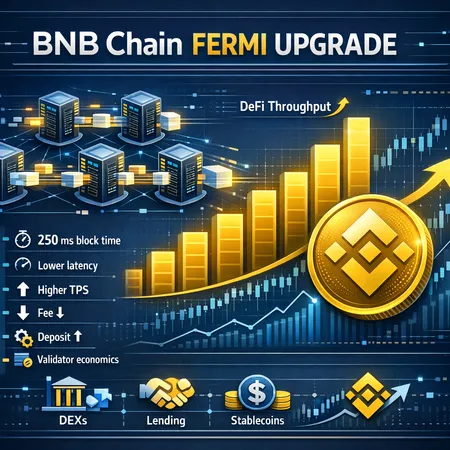
BNB Chain’s Fermi upgrade — which cuts block time down to 250 milliseconds — is one of the clearest examples this year of a chain trying to buy latency and responsiveness for dApps. Announced as a mainnet activation to accelerate confirmation times, the change targets one of the most visible UX frictions on EVM-compatible chains: the feeling of waiting for transactions to finalize. The public announcement details the change and tradeoffs; the activation is described in the project note announcing Fermi and block-time targets.
This piece evaluates three questions developers, validators and on-chain investors care about: (1) what technically changes and how it affects UX/fees, (2) whether performance gains translate into real DeFi throughput and protocol growth, and (3) how the market might price the upgrade — including short-term BNB price scenarios.
The technical changes: what 250 ms blocks actually do
Fermi changes the cadence of block production, producing smaller, more frequent blocks. At a basic level the impacts are:
- Lower latency: transactions propagate and are included faster; a user waiting for a visible confirmation will usually see it sooner. Faster feedback improves UX for wallets and AMMs.
- Higher block frequency: more blocks per second means more opportunities for transactions to be recorded, which can increase effective throughput if the chain’s gas limit per second is managed appropriately.
- Networking and consensus pressure: validators must handle a higher rate of block gossip, validation and state-sync operations. This increases I/O and CPU pressure and tightens the requirements for low-latency networking.
Operationally, shorter blocks do not magically create extra gas per second unless the chain adjusts gas limits or block gas allowances. The net effect on transactions per second (TPS) depends on both block frequency and per-block gas caps. For builders, that means block time reduction is an enabler rather than an automatic throughput multiplier — it changes the envelope but not the demand curve.
For the initial technical announcement and activation details, see the Fermi rollout note.
Expected impacts on UX, fees and deposits
From a user perspective, confirmation time matters. Faster blocks make swaps, limit fills, bridge receipts and meta-transactions feel snappier. Common UX wins include:
- Near-instant UI updates for swaps and limit orders.
- Faster on-chain deposit/withdrawal cycles for custodial services or bridges that wait for N confirmations.
- Reduced perceived risk for end users during high-volatility windows — a trade that matters for UI retention.
Fee dynamics are more subtle. In theory, lower latency and larger effective capacity can reduce fee pressure during normal conditions. But higher throughput can also enable new demand: faster block production can support bots, MEV strategies and high-frequency users that increase gas competition. Whether fees fall or rise will depend on the interaction of supply (gas capacity) and demand (user activity). Historically, chains that grow demand faster than capacity see fees increase even as latency improves.
Historical precedent: do upgrades move price?
Network upgrades can provide visible narratives for markets — but not all upgrades produce sustainable rallies.
- Some upgrades (or highly anticipated forks) create short-term speculation and volume spikes. Traders often buy the narrative pre-activation and sell into the event.
- Larger structural upgrades that unlock new functionality or deflationary mechanics (e.g., token burns, new staking mechanics) sometimes have longer-lasting price impacts.
Two lessons follow: (1) expect some 'buy the rumor, sell the news' dynamics around Fermi, and (2) for price to stick, the upgrade must measurably increase user engagement, TVL and revenue capture for the protocol. Protocol-level performance is necessary but rarely sufficient.
Will lower block times translate into DeFi throughput and TVL growth?
The short answer: maybe — but only if other pieces align.
Performance reduces friction, but DeFi growth needs: liquidity incentives, composability, developer tooling, cross-chain flows and user demand. Builders can now create snappier DEX UX and faster liquidation mechanisms, which helps products that benefit directly from lower latency. Yet institutional or retail inflows depend on capital efficiency (APYs, slippage, fees) and broader narratives.
Examples of how Fermi could help real DeFi metrics:
- AMMs and order-book style DEXes can tighten spreads with faster confirmations.
- Cross-chain bridges that wait for confirmations could lower withdrawal latencies, improving arbitrage and capital rotation.
- High-frequency strategies and on-chain derivatives desks gain lower latency, increasing volumes that generate fees.
But if the chain doesn't also attract liquidity (incentive programs, partner integrations, or bridge flows), throughput gains remain underutilized. Builders and DAOs should combine performance upgrades with targeted liquidity mining or partnership campaigns to convert technical gains into TVL and user retention.
For developers comparing ecosystems, remember that raw latency is only one axis of competitiveness. Interoperability, tokenomics and application-level UX are equal partners.
Current BNB technicals and price outlook (short-term)
Market technicians and traders have been watching BNB’s behavior around key levels. Recent coverage shows BNB faced resistance below certain ranges and consolidation around sub-920 levels as traders digest catalysts. One analysis highlighted BNB halting below 920 after short-term pressure, noting support/resistance dynamics that matter for near-term traders.
Market commentators writing near the upgrade argued case scenarios where BNB could recover toward a 950–1,100 range into January if the upgrade and on-chain flows improve sentiment and demand. That range is not a guarantee — it’s a short-term recovery scenario contingent on improved activity and macro appetite.
From a trading standpoint: treat the Fermi rollout as a catalyst window. That means: define entry and exit rules ahead of events, monitor on-chain metrics (active addresses, gas usage, TVL) and watch how the token reacts around the upgrade rather than assuming momentum will persist. For reference on price behavior and short-term targets see a technical note and a forecasting piece discussing recovery scenarios.
Validators and node operators: economics and operational implications
Shorter blocks change the game for validators in multiple ways:
- Higher resource needs: increased block frequency requires better networking, faster CPUs and more efficient I/O to avoid missed blocks or higher latencies.
- Potentially tighter slashing risk: if consensus time windows shrink, validators with less reliable infra risk penalties or reduced uptime rewards.
- Reward cadence: more frequent blocks can change the timing of reward distributions; however, the total reward supply typically remains governed by protocol tokenomics unless explicitly adjusted.
From an economics lens, validators must weigh CAPEX and OPEX upgrades (better peers, colocated infrastructure) against incremental staking yield. For large operators, the upgrade is a prompt to benchmark latency and throughput across validators and to re-evaluate monitoring stacks.
Smaller validators may find the bar to competitive participation slightly higher; that could concentrate stake if costs deter some operators. That consolidation risk matters for decentralization metrics and should be monitored by delegates and delegators alike.
Builders: what to change in your stack
For dApp teams, Fermi is a chance to re-evaluate architecture:
- Revisit retries and nonce handling: faster blocks alter how your front-end handles pending states.
- Tune RPC endpoints: more frequent blocks require robust RPC infrastructure and backpressure handling to avoid timeouts.
- Reassess batching and gas strategies: with more frequent blocks you can design smaller, faster batches which reduce per-tx wait time.
Teams should also run canary releases and load tests post-upgrade to ensure assumptions (gas limits, state sync behavior) match reality.
Trading implications and risk management
For on-chain investors and traders eyeing a catalyst-driven trade:
- Anticipate volatility around activation. Some traders will trade the narrative; others will use on-chain metrics to confirm that throughput and TVL increase before committing to larger positions.
- Use technical levels and time-based stop rules. The upgrade might produce a multi-day window of repricing — don't assume immediate follow-through.
- Watch for secondary effects: if MEV extraction rises, effective user slippage can worsen, which in turn affects DEX volumes and fee capture.
Bitlet.app users and other platform participants should combine chain-level signals with market structure before sizing trades.
Conclusion: necessary but not sufficient
The Fermi upgrade is a technically meaningful step for BNB Chain Fermi: lower latency and potential throughput wins that materially improve UX for many dApps. But history and economics teach caution: protocol-level performance improvements create opportunities; converting those into durable DeFi growth and a sustained BNB price recovery requires aligned liquidity incentives, developer adoption and continued product-led improvements.
Validators should prepare for higher operational requirements; builders should optimize stacks to exploit the latency window. Traders can treat the upgrade as a catalyst but should tie positions to on-chain confirmations of increased usage rather than narrative alone.
If BNB Chain executes the upgrade cleanly and the ecosystem couples it with liquidity programs and integrations, the combination could support a multi-week recovery scenario. If not, the most likely outcome is a short-lived bump followed by mean reversion.
Ultimately, Fermi buys time and responsiveness — now it’s on validators, DAOs and builders to turn that performance into sustained demand.
Sources
- [BNB Chain steps up with Fermi — 250 ms block times] (https://www.cointribune.com/en/january-14-2026-bnb-chain-steps-up-with-fermi/?utm_source=snapi)
- [BNB halts below 920 — technical price update] (https://coinidol.com/bnb-halts-below-920/)
- [BNB price prediction targeting 950–1100 recovery by January] (https://blockchain.news/news/20251227-price-prediction-bnb-targeting-950-1100-recovery-by-january)
(Note: internal coverage and tags: BNB Chain and DeFi are referenced above.)