How 2025’s “Stealth” Bitcoin Bear Could Seed a Multi‑Year Bull Run
Summary
Executive snapshot
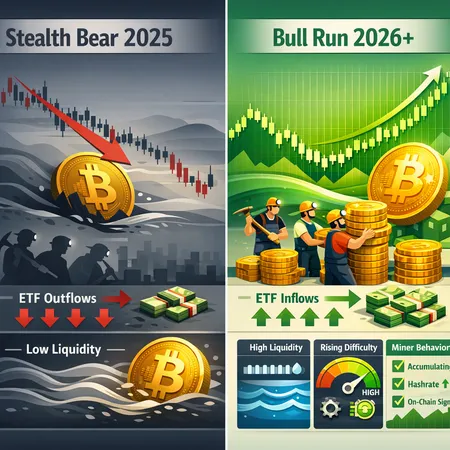
2025 looked calm on the surface: price oscillated in wide ranges, headlines shouted ETF outflows, and yet a handful of on‑chain signals point to a structural reset beneath the noise. Proponents such as Samson Mow and PlanC argued this was a stealth bear market — a quiet deleveraging that removes weak hands and concentrates supply, creating a springboard for a sustained bull run into 2026 and beyond. This article parses that claim, reconciles competing ETF narratives, and lays out the concrete liquidity and on‑chain metrics traders should watch next.
The stealth bear argument: what Mow and PlanC claim
Samson Mow and PlanC frame 2025 as a stealth bear because, despite headline stability or even sporadic rallies, the market underwent a prolonged contraction in marginal liquidity and leverage. Mow’s commentary — summarized in coverage of the thesis — positions 2025 as the sort of quietly destructive year that erodes speculative depth and compresses available BTC supply for future demand shocks Samson Mow & PlanC framing.
The core mechanics they highlight are simple: derivatives deleveraging, miners and weak hands selling into rallies, and capital shifting into less volatile stores (e.g., metals or cash equivalents). Over months this can look like a “range” rather than a violent drawdown, but the long‑term outcome is similar to a classical bear market — fewer participants willing to sell at prior levels. If demand returns while supply remains constrained, realized upside can be larger and more persistent.
ETF flows: headline noise vs. net absorption
Public discussion in 2025 fixated on “record outflows” from Bitcoin spot ETFs, but that story is incomplete. CryptoSlate’s analysis shows that headline ETF outflows were deceptive: across the broader universe of crypto products — ETFs, ETPs and other institutional wrappers — the industry still absorbed substantial capital in 2025 ETF product absorption analysis.
Two reconciliation points matter:
- Short‑term redemptions from specific ETF vehicles can coexist with net inflows into the crypto ecosystem when other institutional products or secondary demand pathways soak up supply. ETF ticker activity alone is an incomplete liquidity proxy.
- Rebalancing and tactical withdrawals (tax reasons, margin calls elsewhere) create temporary outflows that don’t equal structural demand destruction. Look at cumulative flows, not just monthly headlines.
Put another way: an ETF headline can move retail sentiment, but institutional absorption across products determines durable liquidity.
Mining difficulty and miner economics: supply dynamics to watch
A core on‑chain input to the stealth bear thesis is miner behavior. In 2025 mining difficulty rose substantially — reported increases aggregated to roughly +35% over the year — which has two implications: miners needed more capital to sustain operations, and short‑term revenue streams tightened when price dipped mining difficulty rise in 2025.
When difficulty climbs while prices are sideways or down, weaker miners either sell reserves or shut down rigs, temporarily increasing selling pressure. Conversely, a sustained price recovery coupled with rising difficulty signals stronger network health and a diminishing supply overhang (because miners increasingly hoard BTC if operations are profitable). Track these miner cues:
- Difficulty adjustments and their pace (multi‑week trend).
- Miner reserve changes on‑chain (spend patterns from known miner addresses).
- Hashrate trends: sudden drops imply capitulation; steady rises show reinvestment.
Those metrics tell you whether the supply side is still bleeding or starting to firm up.
Reconciling price signals: short‑term targets vs. structural setup
Technical commentators called short‑term targets through late 2025 and early 2026 that sometimes clash with the stealth‑bear narrative. For example, price forecasts projecting immediate targets (e.g., a near‑term run toward ~$105k) reflect trading momentum and technical confluences rather than the structural supply‑demand shifts Mow and PlanC emphasize short‑term price outlook.
These views aren’t mutually exclusive. A stealth bear is about the underlying positioning of holders and institutions; technical setups and momentum can produce transient rallies or pullbacks. The crucial question for allocators is whether rallies are demand‑driven and accompanied by shrinking exchange inventories and positive ETF product absorption — or whether they’re liquidity‑driven dead cat bounces.
Macro rotation and headwinds: metals flight and central‑bank narratives
Macro flows remain a wildcard. A clear 2025 example: BTC dipped below key levels when capital rotated into metals during a period of risk aversion, highlighting how BTC can trade as a risk asset in the short run dip amid metal rotation. Two macro forces to monitor:
- Metals flight and commodity rallies: when investors seek a perceived hard‑asset hedge, bitcoin can lose short‑term demand.
- Central‑bank expectations: dovish surprises (rate cuts or prolonged accommodation) historically boost risk assets; hawkish surprises do the opposite.
This interplay means macro headlines can accelerate or stall a bull run regardless of on‑chain health. For that reason, on‑chain confirmation remains central to long‑horizon conviction.
Key liquidity and on‑chain signals to watch (actionable checklist)
Below are metrics that intermediate traders and crypto allocators should monitor to determine whether the stealth bear has finished digesting supply and whether a durable bull run is beginning.
- Exchange BTC balances: falling exchange reserves over consecutive months signal supply compression. Look for persistent withdrawals, not one‑off transfers.
- ETF & product net absorption: aggregate flows across ETFs/ETPs and custody products — net positive absorption is a strong institutional demand indicator. CryptoSlate’s aggregate perspective is useful context crypto product absorption.
- Miner reserves and spend rate: miners selling at decelerating rates while holding longer is bullish. Watch known miner address clusters and their balance changes.
- Mining difficulty & hashrate trends: continued difficulty increases alongside price gains suggest a robust network — past 2025’s ~35% difficulty lift, the next adjustments will tell whether miners reinvest or capitulate mining difficulty data.
- Stablecoin supply and active balance: rising usable stablecoins on exchanges can fund rallies; a shrinking stablecoin float limits immediate buy power.
- Futures funding and open interest: compressed funding rates with rising open interest and positive roll yields imply structural demand; large negative funding spikes warn of forced deleveraging.
- On‑chain realized metrics (MVRV, realized cap): improving MVRV after a period of depressed values often precedes extended bullish cycles.
Instead of a single threshold, look for confluence: e.g., falling exchange reserves + positive ETF product absorption + miners reducing sell pressure.
What would invalidate the stealth bear thesis?
A few scenarios would weaken the case that 2025 set up a multi‑year bull run:
- Exchange reserves rebound sharply (new sellers appear at higher bands).
- ETF and custody products shift to net redemptions over multiple quarters rather than transient outflows.
- Miner capitulation renews at scale (large, sustained miner sell‑offs tied to an inability to finance rigs).
- Macro shock that reallocates risk capital for years (longer‑term commodity supercycle or a sharp global tightening).
Any of these would suggest supply is still abundant and that rallies are temporary.
Tactical trade ideas by risk profile (intermediate trader focus)
Below are pragmatic tactics tied to different risk tolerances. These are educational, not financial advice.
Conservative (allocators focused on capital preservation):
- DCA into spot BTC over 6–12 months, increasing cadence if exchange reserves fall and ETF products show net absorption.
- Use non‑directional structured products (e.g., covered calls where available) to monetize premium while holding long exposure.
- Keep an emergency allocation to stablecoins for re‑entry after confirmed on‑chain buy signals.
Balanced (medium risk, multi‑month horizon):
- Tranche buys with clear trigger rules: tranche 1 on a 20% drawdown from local highs, tranche 2 when exchange reserves decline month‑over‑month, tranche 3 at confirmed positive ETF product absorption.
- Use LEAP options or put spreads as downside insurance around larger spot positions during macro uncertainty.
- Rotate a small percentage into higher‑beta altcoins if on‑chain activity (smart contract TVL, real flows) improves — but cap exposure to 10–20%.
Aggressive (short‑term traders and active allocators):
- Tail risk plays: controlled leverage on futures with strict stop rules and position sizing; prefer short expiries and active risk management.
- Event plays: trade around major macro releases or miner‑related events (difficulty re‑target windows). Scale exposure down if funding rates spike negative.
- Use options to express directional conviction with limited downside (buy calls, or call spreads) rather than unlimited‑loss futures.
Across all profiles: set clear stop levels, watch liquidity metrics (exchange depth, funding, OI), and be prepared to reduce size if macro risk spikes.
Putting it together: why stealth bear could precede a durable bull run
If 2025 indeed compressed supply via deleveraging, miner recalibration, and institutional reallocation into durable custody vehicles, then a return of marginal demand in 2026 can amplify price moves. Key reinforcing dynamics:
- Lower circulating sell pressure (miners hoard, exchanges drain) amplifies demand shocks.
- Institutional product absorption (broadly defined) can provide large, persistent bid beyond retail cycles.
- Network health (rising difficulty and sustained hash) attracts confidence and capital, reducing tail risk.
That combination — supply compression + institutional absorption + healthy network fundamentals — is a textbook recipe for multi‑year bull runs. But the outcome depends on confirmation across the liquidity signals discussed above.
Watchlist and timeline (practical next steps)
- Monitor exchange reserves weekly and ETF/product flows monthly.
- Track miner reserve spend every block cycle; pay attention to large single‑entity dumps.
- Watch difficulty and hashrate quarters for reinvestment signals.
- Keep an eye on macro crosswinds: commodity flows and central‑bank comments can alter the trajectory quickly.
- Rebalance positions when at least three major signals confirm (e.g., falling exchange reserves + positive net product absorption + declining miner spend).
For many traders, Bitcoin remains the primary bellwether; for those who hedge across ecosystems, monitoring DeFi activity and stablecoin flows is instructive. Bitlet.app is one of many platforms that can help execute DCA and tranche strategies as you act on these signals.
Conclusion
Calling 2025 a stealth bear market is a defensible view if you prioritize structural supply dynamics over headline price action. The thesis matters because a quiet deleveraging can set the stage for a powerful, multi‑year bull run once demand returns — especially if institutional absorption keeps pace and miners stop net selling. Traders and allocators should therefore prioritize on‑chain liquidity signals (exchange reserves, miner behavior, difficulty) and look past raw ETF headlines to aggregate product flows. Combine that on‑chain discipline with macro awareness and clear risk rules, and you’ll be well‑positioned whether 2026 delivers a sustained rally or another consolidation.
Sources
- Samson Mow & PlanC framing of 2025 stealth bear: https://cryptonews.com/news/bitcoin-may-enter-decade-long-bull-run-after-2025-bear-market-samson-mow/
- ETF flows and crypto product absorption analysis: https://cryptoslate.com/bitcoin-etf-record-outflows-are-deceptive-as-crypto-products-absorbed-46-7-billion-in-2025/
- Short‑term BTC price outlook and targets: https://blockchain.news/news/20251227-price-prediction-btc-bitcoin-targeting-105000-by-january-2026
- Mining difficulty trends in 2025: https://bitcoinist.com/bitcoin-mining-difficulty-rose-35-in-2025-data/
- Example of macro rotation into metals affecting BTC price: https://thecurrencyanalytics.com/altcoins/bitcoin-dips-below-87000-amid-rising-metal-prices-231768