AI16Z to ElizaOS: What South Korean Exchange Warnings Mean and How Traders Should Respond
Summary
Why the AI16Z → ElizaOS story matters right now
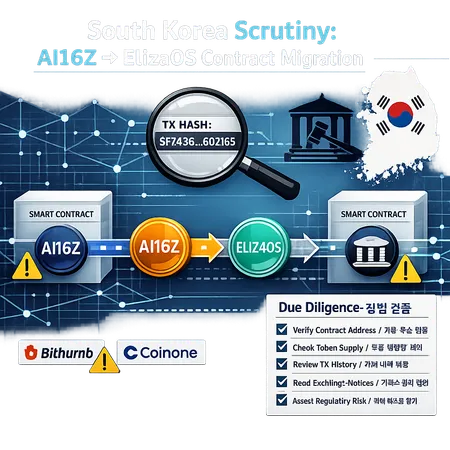
The rebrand of AI16Z to ElizaOS (ELIZAOS) and its reported contract migration touched a raw nerve: exchanges Bithumb and Coinone publicly flagged the token, and South Korean market participants—retail traders, compliance teams, and regulators—took notice. At face value, a rebrand and contract migration might be a routine technical upgrade. But migrations also change the on-chain trail: balances can be moved, old contracts deprecated, and visibility into historical token flows can be altered. That makes it harder for exchanges and investigators to trace provenance and for holders to assess counterparty risk. The primary report documenting the rebrand and ensuing scrutiny is available at Invezz, which details the contract migration and exchange warnings in Korea Invezz report.
What is a contract migration — technically and practically?
A contract migration usually means the token's smart contract is replaced, and holders are moved to a new token address through a swap, snapshot + mint, bridge, or wrapper. Technically, options include: a direct upgrade (if the original contract is upgradeable), a snapshot and minting of new tokens on a new address, or a trust-based swap that requires holders to claim tokens. Practically, these approaches differ hugely in traceability. A native on-chain upgrade that keeps historic state intact preserves an unbroken audit trail; a snapshot-and-mint can sever the link between old and new balances unless the team publishes verifiable proofs. A claim-based swap shifts custodial risk to holders who must interact with a new contract.
From a holder’s point of view, contract migration raises several immediate questions: Who controls the new contract admin keys? Are token economics unchanged? Is the migration verified on-chain and by the project team? If answers are murky, the migration can be an opportunity for malicious actors to siphon liquidity or for an opaque owner to move coins off-chain. That lack of clarity is exactly why exchanges sometimes respond with warnings.
Why exchanges like Bithumb and Coinone flagged ELIZAOS
Exchanges typically step in with warnings when a migration introduces any combination of technical ambiguity, potential security risk, or regulatory exposure. In the AI16Z → ElizaOS case, the reported factors prompting exchange action included a sudden change in token contract addresses, rapid migration announcements with limited verifiable proofs, and the possibility that on-chain continuity was disrupted—each making compliance teams nervous about AML/KYC traceability and investor safety. The Invezz piece covers the exchange alerts and local scrutiny in detail Invezz report.
Concrete reasons exchanges warn are often:
- Unverified new contract code or private admin keys that could permit rug pulls or unilateral minting.
- Non-transparent migration mechanics, especially claim-based swaps where phishing or scam contracts proliferate.
- Large holder concentration and suspicious transfers immediately before/after migration, which look like exit liquidity.
- Regulatory caution—if the move complicates transactional provenance, exchanges may be liable under local laws if they leave deposits open.
When domestic exchanges publish warnings, it’s not just a CYA move: local regulators in Korea have been known to use such warnings as triggers for deeper inquiry. That raises the stakes for tokens flagged in this way.
On-chain traceability: what changes after a migration
A migration can either preserve or sever traceability. If a project performs a transparent, verifiable migration—e.g., a fully on-chain transfer from an upgradeable contract with published proof—investigators can follow tokens across blocks. However, migrations that require off-chain steps (manual swaps, third-party custodians, or burns followed by re-mints) create blind spots. Those blind spots are where illicit fund flows, wash trading, or sudden supply shifts hide.
Key traceability impacts to watch for:
- Token provenance: Can you show an unbroken path from old to new contract?
- Holder mapping: Are top holders preserved in the new registry, or did some large holders decline/avoid the swap?
- Liquidity movement: Was liquidity migrated to new DEX pairs or withdrawn to private wallets?
Blockchain analytics firms can often reconstruct migrations, but that costs time and money—and exchanges acting under time pressure may opt for immediate warnings or freezes rather than wait for a forensic report.
Regulatory implications in South Korea
South Korea’s regulatory landscape tends to emphasize investor protection, AML controls and exchange accountability. When high-profile tokens like AI16Z/ELIZAOS are flagged, exchanges may face pressure from the Financial Services Commission (FSC) and related oversight bodies to take conservative action. Possible outcomes include temporary deposit/withdrawal suspensions, enhanced monitoring, forced delisting if the token is deemed risky, or even criminal probes if funds are misappropriated.
A couple of important realities for holders and compliance teams in Korea:
- Exchanges are likely to respond before regulators do; a warning often precedes administrative or enforcement steps.
- Local regulators consider information from exchanges when evaluating market stability risks—so a public alert can accelerate regulatory interest.
- KYC/AML pathways become critical: if suspicious flows are observed post-migration, exchanges must demonstrate they tracked the movement and reported suspicious transactions.
In short, a migration that reduces on-chain clarity can quickly escalate from a technical event into a legal and market-stability issue in Korea, which is why traders and compliance officers should monitor both the blockchain and exchange notices closely.
Case comparison: why large unlocks and migrations can wreck prices (Pi Network example)
The market reaction to structural token events is instructive. For example, Pi Network faced a sizable unlock that analysts warned could exert strong downward pressure on price as many tokens became sellable around the same time. Crypto.News covered the Pi unlock risk and how it could prompt a crash as tokens flood the market Pi Network unlock risk.
Compare that to a contract migration: even absent a classic unlock, a migration can create functionally similar selling pressure if: owners use migration to consolidate balances, liquidity pools move, or claim mechanics incentivize immediate sells. The lesson is simple—technical changes often translate into market mechanics quickly, and price volatility can be large and fast.
Practical due-diligence checklist for token holders (step-by-step)
Below is a compliance-minded, stepwise checklist retail traders and international holders can follow when a token reports a contract migration or an exchange issues a warning. Treat this as a living checklist—conditions change rapidly.
- Confirm official channels
- Verify the migration announcement on the project’s verified website, official social handles, and signing keys. Beware imposter posts.
- Cross-check the new contract address in the official announcement.
- Validate the contract on-chain
- Use block explorers to inspect the new contract address: is the source code verified? Are admin/owner keys visible?
- If the contract is upgradeable, note proxy/admin addresses and whether renounce actions occurred.
- Audit holder and liquidity movement
- Check the top holder distribution before and after migration. Are the largest addresses unchanged or did they move?
- Look for sudden liquidity migration to new DEX pairs or withdrawals to centralized exchange addresses.
- Confirm exchange status
- Read exchange notices (deposit/withdrawal status, trading halts, risk warnings). Exchanges may also publish FAQs for migrated tokens. Bithumb and Coinone’s alerts in the AI16Z/ElizaOS case are good examples of why to monitor exchange pages closely Invezz report.
- Assess tokenomics and unlock schedules
- Pull token supply metrics and vesting/unlock timetables. Large immediate claimable balances are a red flag—recall how Pi Network’s unlock risk created downside pressure Pi Network unlock risk.
- Check third-party verification and audits
- Look for independent audits or professional attestations of the migration. If none exist, assume higher risk.
- Decide custody posture
- If you held tokens on an exchange with a warning, weigh the exchange’s deposit/withdraw policy: sometimes moving assets off-exchange during a migration can be safer, but interacting with an unvetted new contract exposes you to phishing. Consider cold-wallet self-custody after verifying the correct contract.
- Monitor for regulatory or legal actions
- Watch local regulator statements and exchange follow-ups. In Korea, an exchange warning often precedes stricter measures.
- If you trade, use risk controls
- Tighten position sizes, add stop-loss rules, and avoid entering during initial migration windows when liquidity is thin and spreads widen.
- When in doubt, seek professional help
- If material sums are involved, consult blockchain forensic services or legal counsel experienced in Korean crypto regulation.
On-the-ground tips for using on-chain tools
A few pragmatic on-chain checks save time: inspect the migration transaction(s) to see who called the transfer, verify whether the old contract’s supply was burned or locked, and use analytics platforms to tag addresses tied to centralized exchanges. If you want an immediate sanity check: search the new contract on a block explorer and confirm source verification and ownership renouncement. If the code isn’t verified, treat the token as high risk.
For many traders, the market bellwether remains Bitcoin, but contract-level events like these often have outsized short-term effects. Similarly, migration mechanics are common in DeFi upgrades, but that prevalence doesn’t remove the need for careful scrutiny.
Putting it together — a short playbook for retail holders
- Pause before you transact. Don’t click on claim links sent by airdrop-style messages.
- Verify the announcement and contract address from multiple official sources.
- Confirm the exchange’s operational stance—if deposit/withdrawal is suspended, you may not be able to move assets.
- Run the checklist above and decide on custody based on answers.
The AI16Z → ElizaOS episode is a practical reminder: migrations can be benign technical upgrades or the prelude to market disruption. Exchange warnings are signals, not definitive judgments; treat them as triggers to run your own forensic checks rather than as invitations to panic-sell. Bitlet.app users and others looking to navigate such events should prioritize verifiable on-chain facts and conservative risk management.
Sources
- Primary reporting on the AI16Z → ElizaOS rebrand, contract migration and Korean exchange warnings: Invezz
- Example of a token-unlock event that illustrates selling-pressure risk: Crypto.News — Pi Network unlock risk