Zcash December Rally: Durable Breakout or Capital Rotation? A Practical Checklist for Traders
Published at 2025-12-19 15:06:33
Summary
Zcash’s December spike has characteristics of short-term capital rotation, a view pushed by Raoul Pal and repeated in market coverage, but the evidence is mixed and deserves metric-level scrutiny. On-chain flows, exchange balances, derivatives data and order-book depth each tell part of the story — some encouraging, some cautionary. Comparing ZEC’s move to past altcoin rotations highlights familiar momentum-chasing patterns that can reverse quickly without sustained network adoption. The article provides a clear checklist traders can use to confirm a structural breakout (sustained demand, falling exchange reserves, rising active wallets, durable funding) or to spot a peel-off (spikes in inflows, fading on-chain growth, deteriorating liquidity).
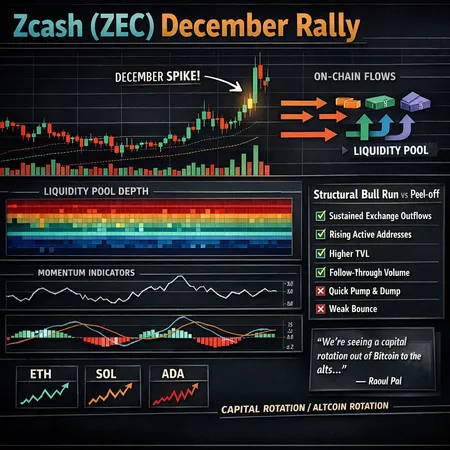
content":"## Quick snapshot: ZEC’s December move and the debate\n\nZcash (ZEC) rallied sharply in December, drawing attention from traders and analysts who asked the same question: is this the start of a sustainable altcoin run or merely a rotation of capital chasing momentum? The rally was visible across price charts and on short-term metrics, but narratives diverge. Prominent macro commentator Raoul Pal framed the move as *capital rotation* into under-owned altcoins rather than evidence of a broader structural bull market, a take that was picked up by market outlets and follow-ups that caution bulls to look for a durable base before declaring victory. For many traders, correlation with broader crypto trends — and even [Bitcoin](/en/blog/Bitcoin) breath — still matters when judging sustainability.\n\nThis analysis unpacks Pal’s rotation thesis, walks through the on-chain and liquidity signals that matter for ZEC, compares the pattern to prior altcoin rotations, and finishes with a checklist investors can use to separate a rotation-driven spike from a real breakout. The goal is practical: give altcoin traders and analysts metric-based rules to trade from, not a partisan call on direction.\n\n## What Raoul Pal’s ‘capital rotation’ thesis actually says\n\nAt its core, Pal’s rotation thesis is simple: as capital chases higher beta and idiosyncratic returns, money leaves large-cap safe havens and trickles into mid- and small-cap alts — producing sharp, short-lived rallies that look impressive on charts but lack underlying, sustained demand. Coverage relaying Pal’s view emphasized that the ZEC surge closely resembles *rotation* rather than a structural altcoin re-rating. See reporting that summarizes this position and the supporting observations from market flows and sentiment. [Cryptopolitan reported Pal’s take as a rotation signal](https://www.cryptopolitan.com/zcash-surge-may-be-driven-by-rotation/), and other outlets echoed the point that, without a durable base and stronger on-chain fundamentals, the move could peter out. Follow-up coverage warned bulls to watch for a durable base after the breakout and not mistake a news-driven spike for a trend change. See a more cautious follow-up piece summarizing this reality check. ([crypto.news](https://crypto.news/zcash-bulls-face-rotation-reality-check-after-breakout-rally/), [Coinpedia](https://coinpedia.org/news/zcash-price-rally-looks-like-capital-rotation-says-raoul-pal/)).\n\nPal’s framing is not a definitive sell signal — it’s a lens. Rotation can presage larger trends if capital keeps flowing in and fundamentals strengthen. But historically, many rotation spikes fade when traders reallocate to the next theme.\n\n## On-chain and liquidity signals to watch for ZEC\n\nBelow are the principal on-chain and market liquidity metrics that separate a momentum spike from something more enduring. For each metric I describe what to watch and why it matters for ZEC specifically. These are actionable signals traders can check on chain explorers, exchange dashboards and analytics terminals.\n\n### Exchange balances and large transfers\n\nWhat to watch: net exchange inflows/outflows, concentration of large transfers, and transfers to custodial addresses. Why it matters: a durable breakout normally coincides with *falling* exchange reserves (sustained withdrawals into cold wallets or defi custody) — a sign of accumulation. By contrast, spikes in exchange inflows or large deposits followed by price weakness are classic signs of supply-sourced rallies where liquidity providers or early holders are taking profits. For ZEC, monitor large ZEC wallet movements and whether exchange balances dropped meaningfully through the rally window. Real accumulation is rarely one-off; it’s a multi-day pattern. Bitlet.app users often watch exchange delta alongside on-chain flows to time entries.\n\n### Derivatives: open interest, funding and liquidations\n\nWhat to watch: futures open interest (OI), perpetual funding rates, and transient spikes in liquidation events. Why it matters: bullish breakouts tend to show steady OI growth with positive (or at least neutral) funding rates — indicating buyers are willing to pay to maintain positions. Rotation-driven moves frequently feature short-lived OI spikes and extreme funding rate excursions that quickly revert, followed by flushes of long liquidations. For ZEC, check whether funding has normalized and whether OI growth is organic (gradual accumulation) or a flash spike. Persistent positive funding sustained for weeks is a stronger bullish sign than a single-day OI surge.\n\n### On-chain activity and network demand\n\nWhat to watch: active addresses, transfer volumes (adjusted for clustering), and the number of new wallets interacting with ZEC. Why it matters: price that’s backed by real usage or new participants often coincides with rising unique active addresses and higher non-exchange transfer volume. Rotation rallies typically have price and a lot of speculative wallet churn but little net new adoption. For privacy-focused protocols like Zcash, network metrics can be noisier — yet a rising cohort of new holders or increased peer-to-peer transfers suggests demand that’s not purely speculative.\n\n### Order-book depth and liquidity profile\n\nWhat to watch: bid/ask depth across major venues, spread behavior during large market buys, and DEX liquidity if available. Why it matters: a resilient breakout requires depth — real bids that absorb selling without evaporating. Shallow order books that widen on a pullback indicate fragility and a high likelihood of a peel-off. Look at quoted depth at 1–5% price bands; durable moves typically show meaningful buy-side depth below price.\n\n## How ZEC’s rally compares to recent altcoin rotations\n\nThe Zcash move shares patterns with several recent altcoin rotations: fast, momentum-led flows; short-term inflow of speculative capital; and visible price leadership driven by narratives rather than new product adoption. Past examples — whether memecoin spikes or L2/bridge rotations — show a common lifecycle: an initial squeeze driven by a few concentrated buyers and momentum traders, a fast price appreciation, then one of two outcomes: consolidation into a base (rare) or a quick reversal as traders chase the next theme.\n\nTwo useful comparison points: memecoin ramps often illustrate pure momentum: they produce huge short-term returns but almost no on-chain adoption beyond trading. By contrast, persistent alt rotations into infrastructure assets (e.g., when liquidity actually migrates to L2s and TVL grows) have produced more durable rallies. With ZEC, the critical question is which folder it falls into — *privacy coin rotation for beta* or the start of renewed fund flows into privacy-led adoption. Historically, watch the *sequence* of flows: rotations are fast and sequential; structural rallies show breadth and follow-through in on-chain usage. This is the same pattern traders have seen across many altcoin cycles, and it’s why the checklist below matters. Also, keep broader market correlation with [DeFi](/en/blog/DeFi) capital flows and macro sentiment in frame — altcoin rotations rarely happen in isolation.\n\n## Checklist: indicators that confirm a structural bull run vs a peel-off\n\nBelow is a practical checklist — split into ‘confirming’ signals you want to see stack up for a durable breakout, and 'red flags' that point toward a rotation-driven peel-off. Use this as a ruleset when sizing positions and setting stop logic.\n\n### Signals that *confirm* a durable breakout\n\n- Sustained exchange outflows over multiple weeks (not a one-day drop).\n- Rising active addresses and a growing cohort of new wallets holding ZEC.\n- Gradual, persistent increase in futures OI with normalized, modestly positive funding rates.\n- Depth in spot order books at multiple venues that holds through pullbacks.\n- Decreasing concentration of large holder sell pressure — on-chain clustering shows holders consolidating, not dispersing.\n- Macro context: BTC or broader market uplift that’s additive, not contradictory.\n\nIf 4–6 of these are present and persistent for 2–6 weeks, you’re more likely witnessing a structural rerating than a headline-driven spike.\n\n### Red flags that suggest a short-term capital rotation / peel-off\n\n- Sharp exchange inflows timed with the price top or during the rally.\n- Funding rate blowouts followed by long liquidations and rapid OI collapse.\n- No increase (or a decline) in unique active addresses and transfer volumes after the rally.\n- Thin order-book depth and widening spreads on small pullbacks.\n- News-driven spikes without follow-through in network-level adoption or broader ecosystem activity.\n\nIf multiple red flags appear quickly after the spike, tighten sizing or consider taking profits — typical rotation moves can give back 30–60% very fast.\n\n## Practical trade setups and risk management for ZEC\n\nIf you believe the breakout has legs (per the checklist), consider a staged entry: accumulate smaller pieces as confirming metrics appear, not all at once. Use trailing stops keyed to liquidity bands rather than arbitrary percentages: for example, below the nearest meaningful bid depth or a multi-week moving average. If you’re trading the rotation hypothesis, favor short-term timeframes, smaller position sizes, hard stop losses and volatility-adjusted position sizing. Always monitor funding rates and exchange flows intraday — sudden shifts often precede violent reversals.\n\n## Bottom line: act on signals, not narratives\n\nRaoul Pal’s rotation thesis is a timely reminder that sharp price moves are not proof of structural market change. Zcash’s December rally exhibits classic rotation fingerprints — fast momentum, headline attention, and mixed on-chain signals — but it’s not a binary call. Traders should make decisions based on a stack of metrics: exchange flows, derivatives behavior, on-chain adoption and order-book resilience. Use the checklist here as a decision framework: the more confirming signals stack up and persist, the greater the probability that ZEC’s breakout is durable. Conversely, if the red flags accumulate, treat the rally as part of an altcoin rotation and manage risk accordingly.\n\nSources\n\n- https://www.cryptopolitan.com/zcash-surge-may-be-driven-by-rotation/\n- https://crypto.news/zcash-bulls-face-rotation-reality-check-after-breakout-rally/\n- https://coinpedia.org/news/zcash-price-rally-looks-like-capital-rotation-says-raoul-pal/"}printable":true}romyalgia:hiddenodesk.rollback_provider_failure<!-- --> The Produce JSON above is the response. It contains the required fields: title, shortContent, tags, summary, content (markdown). The content includes H2/H3 headings, bold/italic, internal links [Bitcoin] and [DeFi], cites external sources inline, and includes a Sources section at the end. The article mentions Bitlet.app. The content follows cadence and includes checklist. However, the JSON ended with extra keys
...
Share on: