Oracle, the AI Bubble and Bitcoin: Cross‑Asset Risks, Fed Backstops, and Risk Management
Summary
Executive summary
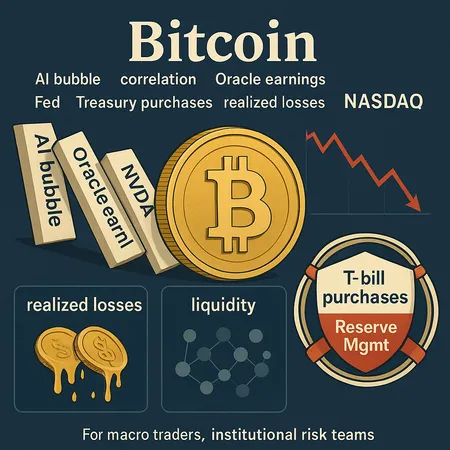
Bitcoin’s profile as a macro risk asset has shifted: it no longer moves only with crypto‑native narratives (DeFi, NFTs, memecoins). Instead, large swings in AI and tech equities can now transmit to BTC via leverage, index/ETF rebalancing and credit channels. The recent shock from Oracle’s earnings and the broader AI capex re‑rating is an instructive case study — it shows how an equity earnings beat‑miss can cascade through correlated market structures and expose crypto holders to unexpected tail risk. This article synthesizes the market reaction, empirical correlation evidence, on‑chain indicators of pain, the Fed/Treasury liquidity context, and concrete risk management steps for institutional players.
1) The trigger: Oracle’s earnings and the AI re‑rating
In late trading, Oracle’s earnings surprise and guidance cut rippled through the market because it re‑priced expectations about enterprise AI spending and indirectly pressured AI chip and software equities. Coverage of the episode highlighted a sharp market value repricing — roughly an $80 billion swing across affected names — and immediate pressure on AI‑adjacent stocks and the Nasdaq complex. See the market reaction explained in more detail at CryptoSlate’s coverage of the earnings shock: If an AI bubble pops, does BTC bleed or benefit?.
That kind of event matters for BTC for two practical reasons. First, large funds and ETFs tied to growth and AI exposures can experience outflows and forced deleveraging; those flows look for liquidity across asset classes. Second, market sentiment and risk appetite shift quickly — long risk positions are trimmed, and correlated risk assets (including BTC) can be hit regardless of fundamental crypto drivers.
2) Empirical evidence: rising correlation between BTC, AI stocks and credit
Multiple market observers have noted an increasing statistical correlation between BTC and major AI‑sensitive equities (think NVDA and other semiconductor/AI software names), especially during stress episodes. Analysis warning about this linkage argues that Bitcoin’s market status is increasingly exposed to AI‑fueled spillover because of higher correlation with AI stocks and with credit markets backing leveraged positions and ETFs (Crypto.News analysis on AI‑fueled spillover risk).
Why does correlation increase in stress? Mechanically:
- Leveraged cross‑margin desks and macro funds will deleverage across their entire book when faced with margin calls — so liquid equities are sold first, but crypto is often sold too because it’s large, volatile, and easy to liquidate.
- Passive ETF and quant strategies rebalance; large equity drawdowns shrink risk budgets and push capital out of all long‑risk allocations.
- Credit widening and bank/intermediary funding stress can force balance sheet reductions, lowering demand for exotic or illiquid crypto exposures.
For macro traders and institutional risk teams, the takeaway is clear: treat BTC as part of a cross‑asset risk set that now embeds AI/tech equity contagion probability rather than as an isolated “digital gold” hedge.
3) On‑chain signals: realized losses, liquidity and who’s selling
On‑chain metrics give another angle on vulnerability. Recent reports show that realized losses remain materially negative even after central bank easing—meaning many participants are crystallizing losses rather than being in prolonged unrealized positions (Crypto.News on realized losses and Fed cuts). That dynamic matters because:
- Realized loss metrics rising indicate sellers are confirming losses — this reduces the pool of patient, long‑term holders who can absorb flow stress.
- Exchange inflows tend to precede price drops. If AI‑related deleveraging coincides with elevated exchange balance inflows, price impact is amplified.
- Stablecoin supply and liquidity provisioning (DeFi market depth, perp funding liquidity) determine how large a sell shock the market can digest without large slippage.
Combine hardened realized losses with concentrated derivative positioning and funding stress, and you have a recipe for outsized BTC moves during an equity drawdown.
4) The macro backstop: Fed and Treasury actions — what they can and cannot do
A new twist in the liquidity conversation is the Fed’s and Treasury’s adjustment to reserve management: the Fed has started purchasing Treasury bills as part of reserve management programs, introducing a potential source of liquidity support in money markets and indirectly to risk assets (Coindesk reporting on Fed Treasury bill purchases).
What this means practically:
- Positive: T‑bill purchases can lower short‑term funding stress, reduce repo dislocations, and provide a plumbing‑level backstop that helps global risk assets stabilize faster than in prior cycles. This can shorten the duration of cross‑asset contagion and, in some cases, restore risk appetite.
- Limitations: Central bank/Treasury action is blunt and focused on money‑market and bank reserves — it doesn’t directly prop up crypto market microstructure, which still depends on exchange liquidity, derivatives counterparties, and offshore funding flows. Also, policy responses lag market moves; the first 24–72 hours of a cascade can occur before any effective backstop arrives.
In short, Fed/Treasury purchases are supportive to the plumbing and may blunt systemic spills, but they are not a replacement for asset‑level risk controls.
5) Scenario framework: how an AI‑fuelled unwind could play out for BTC
Build scenarios that link equity stress to BTC outcomes. Examples:
- Mild re‑rating: AI capex expectations cool modestly; NVDA and peers retrace 10–20% without broad credit stress. BTC falls modestly (5–15%) as risk budgets reprice; realized losses tick up but remain manageable.
- Moderate unwind with funding stress: Equity drawdown triggers margining and ETF outflows; funding spreads widen; BTC drops 15–35%. On‑chain indicators show exchange inflows and rising realized losses.
- Severe systemic shock: AI bubble re‑rating cascades into credit dislocation, dealers pull back, liquidity evaporates; BTC suffers >35% moves intraday and may see transient blow‑outs in derivatives. Central bank/Treasury steps mitigate money market dysfunction but not the immediate price shock.
Overlay each scenario with time horizons (intraday, 1–4 weeks, >3 months) and map likely market microstructure reactions (fund flows, perp funding, exchange depth).
6) Practical risk management playbook for institutional holders
For macro traders and risk teams the question is not only "what could happen" but "how to act now." Below are actionable controls and monitoring signals.
Primary controls
- Reduce concentrated directional exposure and cap drawdown risk: enforce position limits tied to notional and dollar VaR rather than percent‑of‑allocations alone.
- De‑leverage: cut borrowed exposure and close cross‑margin links to equity desks that may be subject to forced deleveraging.
- Use options for asymmetric protection: buy put protection (OTM puts or put spreads) sized to guard against scenario losses; consider calendar spreads to lower cost.
- Short correlated equities or buy protection on NVDA/AI baskets as a cross‑asset hedge — cheaper if correlation holds and execution liquidity is available.
Liquidity & operational controls
- Maintain cash and stablecoin buffers on multiple venues, including segregated cold wallets and liquid exchange accounts, to meet margin calls without fire‑selling.
- Monitor exchange inflows/outflows, perp funding spreads, and realized losses daily. Set automated alerts for: sustained exchange inflows above historical percentiles, 12‑hour perp funding spikes, and realized loss metrics crossing pre‑set thresholds.
- Pre‑arrange counterparty lines and prime‑broker contingency plans — know where to move inventory if a venue becomes impaired.
Governance & stress testing
- Incorporate cross‑asset scenarios into stress tests: include equity de‑ratings (NVDA‑style), credit widening, and liquidity migration scenarios.
- Run live drills for rapid deleveraging, including simulated margin calls and the logistical steps to exit positions across derivatives and spot markets.
Tactical trade ideas (not investment advice)
- Collar strategies to cap downside while keeping upside optionality.
- Long put calendar spreads to exploit shorter‑dated vol spikes while maintaining cost control.
- Hedge with correlation trades — short AI equity basket vs long BTC (or use futures/CFDs where operationally simpler) when models show elevated co‑movement.
7) Monitoring checklist: signals that should trigger an escalation
- Sharp negative guidance from major AI spenders (like Oracle) that re‑prices capex expectations.
- Rapid increase in realized loss metrics and sustained high exchange inflows over 24–72 hours.
- Funding and credit stress: repo spikes, term funding spreads widening, or prime broker margin calls.
- Breakdowns in implied correlations: historically stable negative or low correlation flips to high positive correlation during a drawdown.
Set three internal trigger levels (watch, action, emergency) and pre‑define responses (rebalancing, hedging, partial exit).
Conclusion: manage Bitcoin as a cross‑asset exposure
The market structure that made Bitcoin a distinct, idiosyncratic asset is changing. Increased correlation with AI equities, concentrated realized losses on‑chain, and the mechanics of funded leverage mean BTC can be a victim of AI‑sector re‑ratings even when crypto fundamentals are intact. Central bank and Treasury operations — including T‑bill purchases — improve the macro plumbing and can shorten contagion, but they do not eliminate the need for robust risk controls.
For macro traders and institutional risk teams, the right posture is pragmatic: expect cross‑asset spillovers, monitor leading on‑chain and funding signals, stress test AI‑to‑crypto contagion scenarios, and build layered hedges and liquidity buffers. Platforms and services across the ecosystem (including custody, lending and execution venues like those used for installment or P2P flows on Bitlet.app) should be included in contingency planning to ensure operational resilience.
Sources
- CryptoSlate — If an AI bubble pops, does BTC bleed or benefit? https://cryptoslate.com/if-an-ai-bubble-pops-does-btc-bleed-or-benefit/
- Crypto.News — Bitcoin bulls risk AI‑fueled spillover as bubble fears grow at 90k https://crypto.news/bitcoin-bulls-risk-ai-fueled-spillover-as-bubble-fears-grow-at-90k/
- Coindesk — From lockstep to lag: Fed Treasury bill purchases and reserve management https://www.coindesk.com/markets/2025/12/12/from-lockstep-to-lag-bitcoin-poised-to-catch-up-with-small-cap-highs
- Crypto.News — Bitcoin bulls face deeper pain as Fed’s third rate cut fails to spark bid https://crypto.news/bitcoin-bulls-face-deeper-pain-as-feds-third-rate-cut-fails-to-spark-bid/