Dogecoin Faces Its Toughest Q4 In Years — Can a Late Bounce Save 2025?
Summary
Market snapshot: DOGE at a crossroads
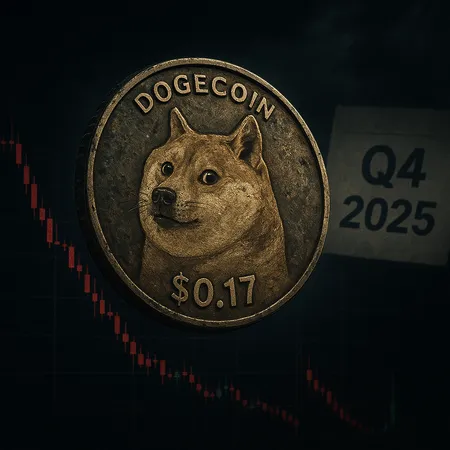
Dogecoin is trading near $0.17, struggling to hold its structure as the last weeks of Q4 tick away. Instead of the usual year-end pickup that has buoyed memecoins in past cycles, DOGE has spent much of the quarter drifting lower — a pattern that raises questions about momentum heading into 2025.
Price action is telling: volumes have been muted, social engagement has cooled, and the token has failed to reclaim the short-term thresholds that previously signaled renewed retail interest. That combination leaves the market vulnerable to either a quick relief bounce or continued consolidation under pressure.
Technical levels to watch
- Support: watch $0.15 as the nearest meaningful support — a break below could invite deeper mean reversion.
- Resistance: the $0.20–$0.21 range is the immediate barrier for bulls; a decisive daily close above it would improve the outlook.
- Pay attention to on-chain volume and exchange flows: sustained inflows to exchanges typically increase sell-side risk, while accumulation by large wallets can presage turnarounds.
Why Q4 has been tougher than usual
Several overlapping factors have muted Dogecoin’s seasonal strength. First, DOGE remains highly correlated with Bitcoin and the broader market; without a strong BTC impulse, memecoins often struggle to rally on their own. Second, macro liquidity and retail appetite appear more selective this quarter — flows that historically fed risk-on assets didn’t materialize at scale.
There’s also a narrative shift: traders have intermittently rotated attention into on-chain experiments and collectibles, including NFTs, while speculative capital chases the next viral trade. That rotation, plus lower social velocity for Dogecoin, helps explain the drifting price and the underwhelming year-end response compared with prior cycles.
Can a late bounce save 2025?
A credible recovery into 2025 is possible, but it needs catalysts. The most straightforward bullish triggers would be a renewed Bitcoin rally that restores market-wide risk appetite, large whale accumulation that reduces supply on exchanges, or a meme-driven social event that reignites retail demand. Conversely, lack of these events could keep DOGE rangebound or push it lower.
Scenario planning:
- Bull case: BTC-led market lift lifts memecoins, DOGE reclaims $0.20+, and retail FOMO returns ahead of year-end holidays.
- Bear case: continued low volume and profit-taking break $0.15, leading to extended consolidation into Q1 2025.
Traders should avoid assuming a repeat of past year-end rallies — every cycle has different drivers. Platforms like Bitlet.app, which offer P2P and earn features, make it easier for traders to manage exposure, but risk controls remain essential.
What traders and holders should watch next
Keep an eye on three practical indicators:
- On-chain accumulation — rising balance on non-exchange wallets suggests holders are not selling.
- Exchange flows and volume spikes — sharp inflows or sudden volume surges often precede volatility.
- Macro and Bitcoin moves — DOGE’s short-term direction often mirrors broader market sentiment.
If you hold DOGE, consider position sizing and stop levels aligned to the $0.15 support. If you trade it, look for confirmation — volume-backed breaks and retests — rather than chasing quick bounces. Finally, monitor how narrative rotations (into memecoins or NFTs) evolve; they frequently dictate where speculative capital flows next.
Takeaway: Dogecoin’s Q4 has been unusually soft, and a late bounce is possible but not guaranteed. Focus on clear on-chain signals and cross-market catalysts rather than hoping for automatic seasonal strength as 2025 approaches.