Turbo Energy and Stellar Pilot Tokenized Financing for Solar and Battery Projects
Summary
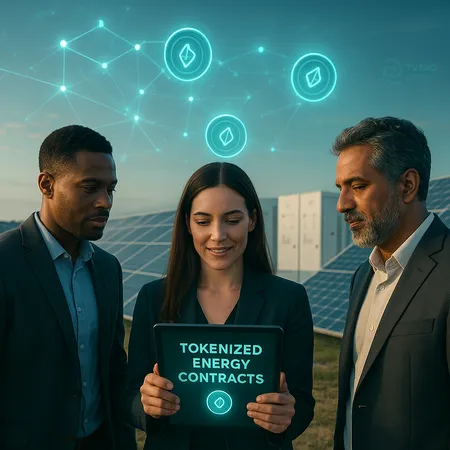
Turbo Energy has unveiled a pilot program that tokenizes financing for solar and battery projects, working with custody provider Taurus and the Stellar network to bring on-chain traceability to renewable energy flows. The initiative combines Energy-as-a-Service (EaaS) models with digital asset rails so investors can access tokenized energy contracts directly — potentially lowering entry barriers for retail participants while preserving institutional controls. Turbo’s ticker, TURBO, anchors the corporate identity behind the effort, but the broader innovation is in how capital and project cashflows are represented and transferred on-chain.
Market context and why tokenization matters
Capital shortages and transaction frictions remain major bottlenecks for distributed renewable deployment. Traditional financing often requires large minimums, slow onboarding and opaque servicing; tokenization aims to address these by fractionalizing cashflows and adding transparency. Using a network like Stellar enables low-cost transfers and settlement, while custody partners like Taurus provide regulatory and operational guardrails. For crypto-native audiences, this move signals increasing convergence between energy markets and the wider blockchain ecosystem — a trend that could bring energy assets into the same liquidity environment as other tokenized instruments.
The Turbo Energy pilot: partners, scope and goals
The pilot focuses on solar and battery projects and links project financing contracts directly to token representations on Stellar. Taurus supplies custody, compliance and issuance infrastructure; Stellar offers the ledger and payment rails to record ownership and payments with cryptographic proof. Turbo aims to demonstrate on-chain traceability of payments and contracts, faster capital deployment and simpler secondary transferability for investors. The program targets both institutional and retail investors, seeking to show that energy assets can be scaled globally without sacrificing auditability or investor protections.
How tokenized energy financing works in the pilot
Under the pilot, project cashflows — e.g., lease payments, power purchase revenues or EaaS subscription streams — are securitized and issued as tokens. Investors purchase these tokens representing a claim on future income; token transfers update ownership on Stellar with transparent transaction history. Custody and KYC/AML checks run through Taurus, while smart-contract-like arrangements and payment routing ensure revenues are distributed according to token holdings. This setup bridges traditional compliance and operational needs with faster settlement and potential integration into broader DeFi rails or secondary markets over time.
Implications for investors, developers and platforms
If successful, the pilot could reduce minimum investment sizes, increase liquidity for project sponsors and make small-scale renewable projects more bankable. Retail investors may gain access to diversified green income streams previously reserved for institutional players, while developers could secure capital faster and with clearer investor reporting. Platforms that offer crypto installment plans, P2P exchange or yield products — including services like Bitlet.app — might find new asset classes to integrate, enabling users to earn or hold tokenized energy exposure alongside other digital assets. Key challenges remain: regulatory alignment, standardization of contractual tokens and ensuring robust investor protections.
Takeaway
Turbo Energy’s pilot with Taurus and Stellar is a practical test of tokenized renewable finance at the intersection of EaaS and crypto infrastructure. By combining custody, ledger efficiency and fractionalization, the project seeks to expand access to solar and battery investments while maintaining traceability and compliance. Watch for pilot metrics — onboarding speed, liquidity outcomes and regulatory feedback — which will determine whether tokenized energy contracts move from promising experiment to scalable market solution.