Turbo Energy to Pilot Tokenized Financing for Renewable Projects on Stellar
Summary
Spain pilot brings tokenized debt to solar and battery projects
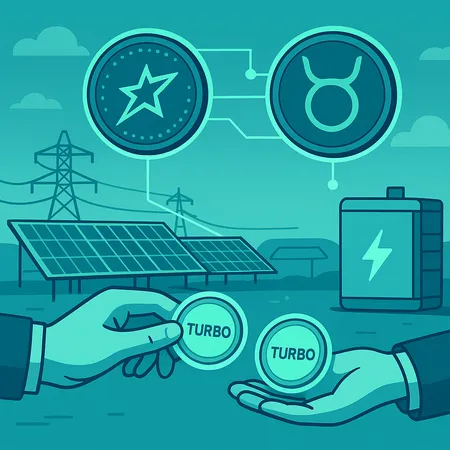
Spain-based Turbo Energy announced a pilot program to tokenize debt financing for solar and battery installations, partnering with institutional tokenization specialist Taurus and the Stellar Development Foundation (SDF). Announced on November 11, 2025, the plan will test token-based issuance and post-issuance settlement on Stellar’s low-fee, energy-efficient rails. The pilot targets smaller renewable projects that traditionally struggle to attract diversified capital at scale, using tokenization to enable fractional ownership and secondary trading.
How the pilot is expected to work
Taurus will handle issuance mechanics and custody while SDF provides the blockchain infrastructure and tooling to settle and move tokens. Turbo Energy will package project-level debt into tokenized instruments that represent claims on cash flows from solar arrays and battery systems. Investors could buy fractions of those instruments, offering greater accessibility and potential for faster liquidity compared with conventional private debt markets. By leveraging the Stellar network, the pilot aims for quick settlement, low transaction costs, and compatibility with on-chain marketplaces.
Why Stellar and Taurus matter for renewables financing
Stellar’s emphasis on cheap, fast transfers fits capital markets that need high settlement certainty without heavy fees. Taurus brings regulated tokenization capabilities — KYC, custody and compliance modules — that institutional buyers expect. Together, they address two core barriers to tokenized infrastructure finance: operational integrity and regulatory readiness. This combination could make it easier to attract pension funds, family offices and crypto-native investors to renewable assets while maintaining compliance standards.
Potential benefits for projects and investors
Tokenization can deliver several concrete advantages: fractional ownership, which lowers minimum ticket sizes; improved secondary liquidity, enabling earlier exit options; and streamlined administration, cutting time and cost for settlement and investor reporting. For developers like Turbo Energy, that translates into faster deployment cycles and potentially lower financing costs. For investors, the model opens exposure to real-world energy assets alongside existing crypto exposure, helping bridge traditional capital markets and crypto-native channels like on-chain marketplaces.
Risks, regulation and market readiness
Tokenizing debt doesn't eliminate underlying credit risk — project performance, offtake contracts and counterparty exposure still matter. Regulatory frameworks for tokenized securities vary across jurisdictions and will influence how freely these instruments can trade. Market liquidity is not guaranteed: secondary markets must develop depth and trusted custodial arrangements. Stakeholders will need clear disclosure, standardized token documentation and robust custodial practices to build investor confidence.
What comes next and broader implications
If the pilot proves operationally and commercially viable, it could become a template for scaling renewables finance across Europe and beyond. Expect more collaborations that blend regulated tokenization platforms, blockchain rails and traditional project finance sponsors. Platforms like Bitlet.app and other fintechs may explore integrations to offer retail or semi-institutional access to tokenized renewable debt instruments, further expanding investor choice.
Turbo Energy’s move underscores a growing trend: using tokenization and blockchain infrastructure to unlock capital for climate infrastructure while connecting those instruments to evolving DeFi workflows. The pilot won’t answer every question overnight, but it marks a practical step toward bridging clean energy capital needs with digital finance innovation.
Key takeaway: this pilot tests a pragmatic path for channeling new pools of capital into renewable projects through tokenized debt — promising efficiency and access, while leaving regulatory and credit considerations squarely in focus.