DYDX Strengthens Position With Bold Strategic Moves in DEX Market
Summary
DYDX's New Fee and Staking Incentives
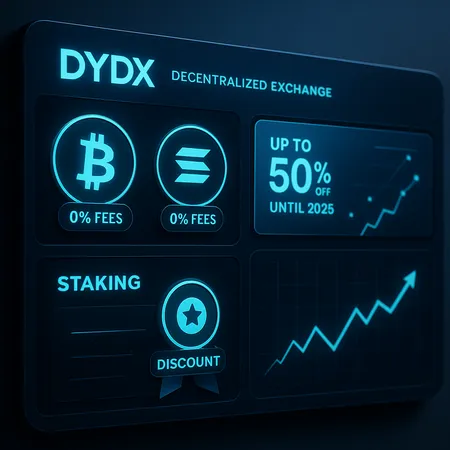
DYDX has launched an aggressive incentive package designed to pull more volume to its decentralized exchange. The protocol is introducing zero-fee trading days for major markets and a staking-discount program that grants users up to 50% off trading fees through the end of 2025. These measures target on-chain traders and liquidity providers by reducing direct costs and improving the effective returns of participating on-chain strategies.
The initiative focuses first on high-liquidity pairs — notably BTC and SOL — to create headline-grabbing flows and tighter spreads. By temporarily removing friction on large-volume markets, DYDX signals it wants to capture order flow that might otherwise route to centralized exchanges or competing DEXs.
Zero-fee Days and Staking Discounts — How They Work
Under the plan, trading fees for BTC and SOL pairs will be waived on specified promotional days, while other markets will benefit from fee reductions tied to staking tiers. Users who stake DYDX tokens receive incremental discounts, with the top tiers enjoying up to 50% off fees. These discounts remain active until the end of 2025, giving traders a predictable runway to plan strategies and evaluate the economics of on-chain trading vs. centralized alternatives.
Operationally, DYDX will likely coordinate fee waivers with liquidity reward windows and market-making incentives to ensure spreads don’t widen when fees drop. For traders, that means potential arbitrage and scalping opportunities, but also a need to watch for short-term liquidity shifts as market makers rebalance.
Strategic Impact on the DEX Landscape
This move is more than a marketing push — it’s a competitive play. By reducing execution costs on marquee pairs, DYDX aims to increase order flow, raise on-chain fee revenue indirectly through higher volumes, and reinforce its brand among active traders. Lower fees can accelerate migration of perpetual and spot liquidity from centralized venues and rival DEXs into DYDX’s orderbooks.
The broader crypto market may see knock-on effects: lower fees attract sophisticated traders and algorithms, which in turn tightens spreads and improves price discovery. That benefits derivatives traders and the broader DeFi ecosystem. However, competitors may respond with their own promotions, and margin dynamics for market makers will adjust accordingly.
What Traders and Liquidity Providers Should Consider
For traders, the primary opportunities are reduced execution costs on targeted days and the ability to combine staking discounts with active strategies. Evaluate whether your trading style benefits from fee-free windows or from longer-term discounted rates. Liquidity providers should model the net profit impact after accounting for potential spread changes and impermanent loss on leveraged or concentrated positions.
Risk management remains essential: promotional fee periods can concentrate volume and volatility. Monitor order book depth during zero-fee events and consider staggered entry and exit techniques. Tools and platforms such as Bitlet.app can help users compare fee structures and promotional windows across venues to optimize routing and execution.
Conclusion DYDX’s zero-fee days and staking discounts are a bold, measurable attempt to capture more on-chain activity and sharpen its competitive stance in the DEX market. Traders and liquidity providers who adapt quickly can gain a cost advantage, while the industry will watch how rivals respond and how these incentives affect liquidity distribution across the blockchain ecosystem.