World Liberty Financial Token Soars as Senate Advances Deal to End Shutdown
Summary
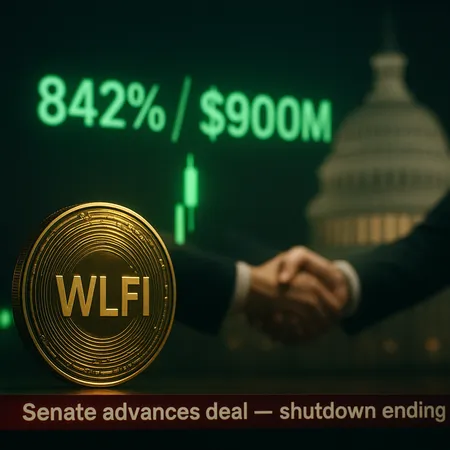
WLFI, the token tied to the Trump family's World Liberty Financial project, jumped sharply on news the Senate advanced a deal to end the government shutdown. The session stood out for its blistering activity: intraday volume rose 842%, approaching $900 million, and produced one of WLFI's most active trading days since launch. The move underscores how political catalysts can rapidly concentrate liquidity into politically charged tokens and drive outsized volatility in the broader crypto space.
Drivers behind WLFI’s rapid surge
The immediate trigger was the Senate's procedural step toward a shutdown-ending deal, which shifted sentiment from uncertainty to a short-term risk-on posture across markets. For WLFI specifically, three forces converged: heightened retail attention to politically branded tokens, coordinated social-media narratives, and heavy whale or market-maker participation exploiting thin order books. Political tokens often behave like memecoins — they react hard to headlines and community momentum rather than fundamental metrics — so a legislative breakthrough can become a lightning rod for rapid inflows.
Trading metrics and on-chain activity
Exchange and on-chain data showed a sharp concentration of trades over a few hours. Volume spiked 842% compared with the prior day, and cumulative trades neared $900 million in value. Order-book snapshots revealed wide spreads at times, implying that large market orders walked liquidity and amplified price moves. On-chain transfers and smart-contract interactions also ticked up, suggesting both exchange-driven and peer-to-peer flows. These patterns are typical when a market narrative pulls capital quickly into a thinly traded token, and they can result in steep, short-lived repricings.
Market implications and risks for traders
This WLFI episode highlights two key takeaways. First, politically linked tokens can produce spectacular intraday moves, but they often come with outsized tail risk and low predictability. Second, liquidity conditions matter: large spikes tend to be followed by sharp reversals when the news fades or profit-taking accelerates. Traders should watch order-book depth, on-chain whale movements, and exchange listings closely. Platforms like Bitlet.app, which offer P2P exchange and earn features, may see increased demand around such tokens and can be useful for users managing exposure across services.
Practical guidance
- Do your own research (DYOR) and set clear risk limits: political tokens are volatile.
- Use limit orders and smaller position sizes to avoid slippage on thin books.
- Monitor on-chain transfers and major wallet activity to anticipate supply shifts.
Conclusion
WLFI’s surge after the Senate advanced a shutdown-ending deal is a vivid reminder that headlines — especially political ones — can funnel vast liquidity into niche crypto assets overnight. While the spike produced eye-catching numbers (842% volume jump and nearly $900 million traded), traders should treat such moves as high-risk, event-driven episodes rather than durable signals of long-term value. For observers of the broader blockchain and crypto ecosystem, WLFI's session is another example of how fast narratives can reshape flows in the modern crypto market.