ICP Drops 11.2% to $6.69 After Losing Key $7.00 Support
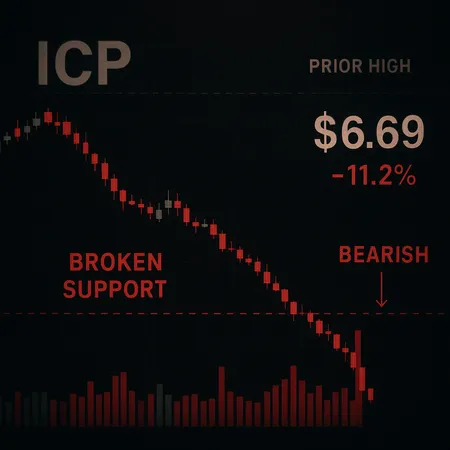
Market snapshot: steep pullback after a short-lived rally
Internet Computer (ICP) suffered a sharp sell-off on November 10, slipping 11.2% to $6.69 after losing the psychologically and technically important $7.00 support level. The decline extended a week-long retreat following last week's rally to $8.76, and — according to CoinDesk Research's technical analysis model — represents one of ICP's steepest intraday drops in recent months.
Why the $7.00 break matters
Traders treat round-number supports like $7.00 as reference points for entries and stops. When those levels fail, stop-loss cascades and short-selling can accelerate losses. For ICP, the $7.00 break did two things:
- It invalidated the near-term bullish bias that formed after the recent run to $8.76.
- It increased probability of testing lower support bands, putting pressure on on-chain sentiment and market liquidity.
Technical read: momentum turning bearish
Key indicators to watch
- Price action: The move below $7.00 signals a shift from higher highs to lower lows on short-term charts.
- Support levels: Immediate support now sits around $6.00 and the $5.00–$5.50 zone, where buyers previously stepped in.
- Resistance: Short-term resistance is now the $7.00 level, with a tougher barrier at the recent swing high of $8.76.
- Momentum: Oscillators like RSI and MACD (as noted in technical models) have turned down, suggesting bearish momentum is building.
- Volume: Elevated selling volume on the drop increases conviction that the move was not a shallow pullback.
Possible price paths
- Bear case: Continued downside toward $6.00 and potentially retesting the $5–$5.50 range if selling persists.
- Base-building: ICP could consolidate between $6.50–$7.50 while market participants absorb the sell-off and liquidity returns.
- Bull case: A swift reclaim of $7.00 on rising volume would negate some bearish signals and open the path back to $8.00+.
Broader context: token economics and market sentiment
ICP’s move is not occurring in isolation. Macro risk appetite, liquidations across altcoins, and rotation into or out of categories like DeFi and layer-1 projects have influenced flows. As a protocol focused on decentralized computation, ICP’s price action often reflects both developer activity and speculative demand — the latter can amplify rallies and subsequent retracements.
What traders and investors should consider
For short-term traders
- Manage risk tightly: use stop-losses and size positions to limit downside from high-volatility moves.
- Look for confirmation before re-entering long positions — volume-backed reclaim of $7.00 or bullish reversal patterns reduce risk.
For longer-term investors
- Reassess thesis: if you believe in Internet Computer’s fundamentals, downward price moves may present accumulation opportunities — but dollar-cost averaging and position sizing remain prudent.
- Monitor on-chain metrics and developer activity as leading indicators of long-term project health.
Implications for the wider crypto market
ICP’s drop is a reminder that short-lived rallies can quickly reverse without supportive volume and broader market tailwinds. Layer-1 tokens and application-focused projects can be especially sensitive to shifts in liquidity and risk sentiment. Traders often pivot between sectors like NFTs, blockchain infrastructure, and memecoins depending on market momentum.
Conclusion — risk management first
The loss of $7.00 and the move to $6.69 represents a meaningful shift in ICP’s near-term technical picture. Whether this becomes a deeper correction or a temporary pullback depends on market liquidity, macro drivers, and whether buyers reappear near lower support bands. Keep risk controls in place and watch for volume-confirmed signals before changing your exposure.
Bitlet.app users can find value in tracking alerts, setting limit buys, and comparing liquidity across pairs as they navigate volatile moves like this — integrating price action with platform tools helps manage trades more efficiently.