Bitcoin Mining Economics: Renewables, Falling Revenue, and Rising Capitulation Risk
Summary
Snapshot: BTC mining economics in 2025
The last 12 months have exposed a simple truth: Bitcoin mining is an energy business that pays in BTC. When BTC price action softens and on-chain issuance is fixed, miners feel the squeeze immediately through falling miner revenue. At the same time, operators are accelerating renewable energy integration to reduce variable costs and protect margins.
This article drills into the drivers behind falling miner revenue, the practical case studies of renewable integration and PPA structures, strategic levers miners can pull to improve margins, and the systemic risks that rising capitulation brings to both network security and investor portfolios.
Why miner revenue is falling: difficulty, price and fees
Two variables largely determine miner revenue in fiat terms: the BTC-denominated block subsidy and fees, and the fiat value of BTC. On the supply side, difficulty and the network hash rate decide how fast rewards are claimed.
Price pressure vs. difficulty dynamics
After the halving, the per-block BTC issuance dropped, permanently lowering gross supply-side inflows. When BTC price retreats or stalls, fiat-converted miner revenue contracts faster than fixed operating costs decline. Separately, difficulty can remain elevated if large pools or efficient farms keep running, compressing per-hash earnings even at constant BTC prices.
The result is a two-way squeeze: lower fiat per BTC and a higher work-per-reward due to difficulty. Short-term fee spikes can temporarily offset declines, but they're unreliable as a sustained revenue source.
Recent revenue data and capitulation signals
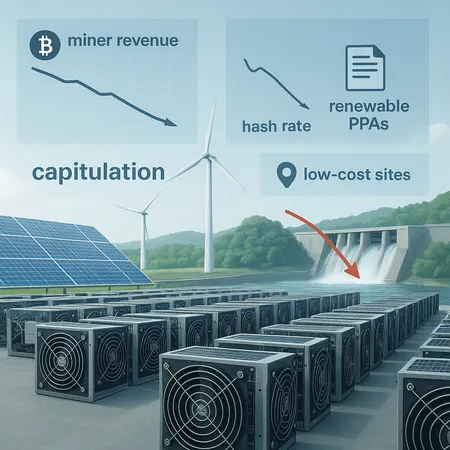
On-chain and industry reports in 2024–2025 flagged an ~11% drop in miner revenue over short windows, raising questions about whether smaller operators will capitulate under cash-flow pressure. Reporting like this frames the economic stress miners face and underscores why many are pivoting toward low-cost power and operational resilience analysis example.
Renewable integration: practical case studies and power types
Renewable adoption is not ideological here; it's pragmatic. Lower marginal energy costs, long-term price predictability, and regulatory preference for low-carbon operations make renewables an attractive cap-ex strategy.
Types of renewable and low-carbon power commonly used
- Hydroelectric: Attractive where availability matches demand seasons (e.g., run-of-river or reservoir-backed projects). Low marginal cost and high uptime make hydro a favorite for baseload mining.
- Solar + storage: Useful for daytime-heavy workloads and paired with battery storage for smoothing; economics depend on local insolation and storage costs.
- Wind: Complementary to solar in some regions; intermittent but increasingly competitive with PPAs.
- Natural-gas co-generation and flare capture: Not strictly renewable, but cheaper and sometimes marketed as lower-carbon when they replace methane flaring.
Practical deployments mix these: a miner behind-the-meter on hydro may run 24/7 at low cost, while a solar-plus-storage site trades off higher capex for predictable daytime generation.
PPA models and contractual choices
Power purchase agreements (PPAs) come in many flavors and materially change project economics:
- Fixed-price PPA: Buyer pays a pre-agreed price per MWh over the contract term. Predictable and preferred by miners seeking revenue certainty, but may ask for offtake creditworthiness or collateral.
- Merchant PPA / tolling: Power is sold at market prices; miners benefiting from negative or low spot prices can capture upside but take market risk.
- Virtual PPA (VPPA): A financial hedge where the miner pays or receives the difference between a strike price and market price—useful for financing renewables without physical delivery of power.
- Behind-the-meter/captive generation: Miner owns or leases generation assets; higher capex but full control over dispatch and availability.
Each model has trade-offs: fixed PPAs reduce price risk but often require longer contracts or financing guarantees; merchant models conserve upfront capital but expose miners to energy volatility. Several miners have publicly announced moves toward long-term renewable PPAs to lock in sub-$0.03/kWh costs where local resources allow—efforts that follow broader industry reporting on miners shifting to renewables to shave costs press coverage and trends.
Improving margins: operational, geographic, and financial levers
Improving margins is rarely a single action. Operators must simultaneously reduce energy intensity, optimize location, and de-risk balance sheets.
Efficiency: hardware and data center engineering
- ASIC selection and procurement: Transitioning to next-gen chips improves joules-per-TH. But timing matters: buying at cycle peaks can decimate returns.
- Cooling and immersion: Liquid and immersion cooling reduce PUE (power usage effectiveness) and improve chip throughput; they can lower OPEX meaningfully in hot climates.
- Fleet management: Firmware optimization, power capping, and workload orchestration (throttling during high price/difficulty stress) preserve hardware life and cash.
Location and energy arbitrage
Geographic diversification matters. Hydro-rich geographies deliver low LCOE (levelized cost of energy), while proximity to curtailed renewables (wind/solar) allows miners to access steeply discounted or even negative-price power. Location also affects permitting, electrical interconnection costs, and exposure to regulatory shifts.
Vertical integration and new revenue streams
- Owning generation assets (or long-term PPAs) stabilizes input costs and converts variable opex into financed capital.
- Hosting and co-location services let miners monetize excess capacity or provide collocation revenue to third parties.
- Grid services: Aggregated miner fleets can provide demand response, frequency regulation, or absorbing curtailed power—opening incremental revenue for savvy operators.
- Financial products: Hedging BTC receipts, forward sales, and collaborating with liquidity platforms can smooth cash flow. Some operators route rewards into DeFi strategies or lending desks to earn temporary yield, tying on-chain activity into treasury management—this sometimes involves interactions with DeFi markets.
Operators also partner with financial platforms and exchanges for settlement and liquidity—platforms such as Bitlet.app can be part of an operator’s broader treasury toolkit when used for non-core liquidity and settlement purposes.
Systemic risks: hash rate, difficulty, and the specter of capitulation
Miner economics are networked: individual failures ripple through difficulty, hash rate, and ultimately block time.
Hash rate drops and delayed adjustments
If a wave of unprofitable miners powers down, the hash rate falls. Difficulty adjusts algorithmically, but not instantaneously—there’s a lag through the adjustment window. During that lag, the effective cost per block for remaining miners can rise or fall unpredictably, and block times can temporarily lengthen. That creates two problems for markets:
- Transient slowdown in confirmations, impacting user experience.
- Temporary redistribution of revenue that can either punish or reward the marginal fleet, depending on timing.
Capitulation cascades and feedback loops
Capitulation happens when marginal operators sell equipment, exit contracts, or attempt to liquidate collateral. This can depress secondary ASIC prices, reducing acquisition costs for survivors but stranding lenders and counterparties. Because many miners use leverage—either for hardware leases or for power financing—liquidations can produce systemic contagion across financing providers and hosting partners.
Reports of an ~11% revenue drop are warnings, not destinies; yet they highlight the increased chance of cap-outs in less capitalized operators and raise broader counterparty risks for investors and service providers industry analysis.
What miner health means for BTC security and investors
Hash rate is the proxy for decentralized security. Lower hash rate reduces the cost to launch certain attacks and increases reliance on a smaller set of large operators.
From an investor perspective:
- Rising miner distress is a leading indicator of network risk and can precede increased volatility in BTC prices.
- For infrastructure investors, miner solvency affects hardware secondary markets, hosting revenues, and the credit risk in energy PPAs.
- For protocol-level risk, concentrated mining can raise centralization concerns that invite regulatory scrutiny—especially when concentration maps to single jurisdictions or large pool operators.
However, a controlled consolidation can improve efficiency: larger operators typically run more efficient fleets and can invest in renewables at scale. The key distinction is voluntary consolidation for efficiency versus forced capitulation due to liquidity stress.
Strategic checklist for operators and institutional analysts
- Model margin under multiple BTC price and difficulty scenarios (stress-test for -30% BTC and +20% difficulty).
- Prioritize energy cost certainty: secure a portion of load under fixed PPAs or captive generation, while keeping optionality for spot-market upside.
- Invest in next-gen ASICs and cooling to reduce joules-per-hash; evaluate trade-offs of buying used rigs at discounted prices versus lifecycle risk.
- Diversify geography to access low-LCOE resources and reduce single-jurisdiction regulatory exposure.
- Build treasury hedges: partial forward sales of BTC, options for downside protection, and partnerships with liquidity providers.
- Maintain capital buffers to avoid forced equipment sell-offs that amplify systemic contagion.
Closing perspective
BTC mining economics have entered a more mature phase: energy strategy and financial engineering matter as much as hashing capability. Renewable integration is not just an ESG story—it’s a margin story, and miners that combine technical efficiency with thoughtful energy contracts will likely outlast leveraged, short-term players.
For investors and analysts, watch revenue per TH, PPA coverage ratios, and balance-sheet runway. Those signals reveal far more about network health and security than headline hashrate alone.