Bitcoin User Pays Over $105,000 in BTC to Send Just $10
Summary
Unusual Bitcoin transfer drains over $105,000 in fees
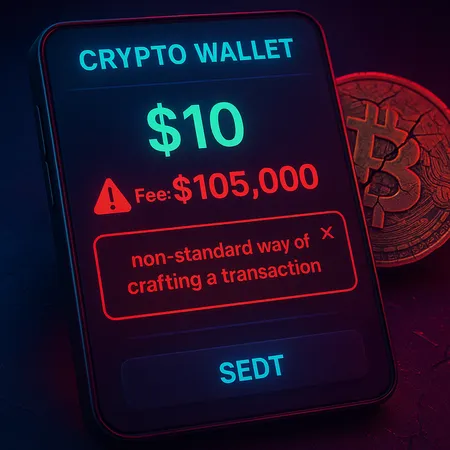
On November 11, 2025, a Bitcoin transaction made headlines when it reportedly paid more than $105,000 in fees to send roughly $10. The move was described by one expert as a "non-standard way of crafting a transaction," sparking debate among developers, analysts and wallet providers about whether this was a costly mistake, an experiment, or an exploit of fee mechanics.
The event is notable not only for the staggering fee-to-value ratio but also for what it reveals about on-chain operation: when human error, custom scripts or unusual wallet behavior collide with fee markets, outcomes can be extreme. This story sits at the intersection of everyday user risk and deeper technical nuance in the broader blockchain ecosystem.
How a $10 transfer became a six-figure fee
Chain data shows the transaction confirmed, which means the high fee was actually paid rather than stuck in mempool limbo. Public commentary from one analyst called it a non-standard construction, implying the transaction’s inputs, outputs or scripts were arranged in an uncommon way that led fee-estimation or manual settings to produce a very large fee.
There are several plausible mechanisms that can produce oversized fees without malicious intent: wallets with buggy fee sliders, manual fee entry mistakes, or bespoke transactions created by developers testing edge cases. Conversely, more obscure constructs — such as creating many tiny outputs (dust), using OP_RETURN data in novel ways, or chaining complex signatures — can also inflate transaction weight and thus fees.
Possible causes and technical context
Blockchain explorers and on-chain researchers rarely see sanity checks fail at this scale, which makes this case an outlier. Likely explanations include:
- Wallet misconfiguration or user error, where a fee value was set incorrectly relative to the transfer amount.
- Custom or experimental transaction scripts that increased virtual size, producing a fee that matched weight rather than value.
- Intentional burn or protest, where the sender deliberately paid an enormous fee to make a point, though this is uncommon.
Whatever the root cause, the incident underscores that fee mechanics are based on transaction weight and satoshi-per-byte (or sat/vB), not on the fiat or BTC value being moved. When weight or per-byte rate spikes, fees can quickly escalate.
Market reaction, lessons for users and services
The immediate market reaction was muted — this didn’t move BTC price materially — but the story circulated widely because it highlights user-facing risks. Exchanges, custodial wallets and P2P services have to anticipate interface errors. For example, platforms like Bitlet.app emphasize safer defaults and clear fee UX precisely to avoid scenarios where users accidentally overspend on fees.
Practical takeaways for users: double-check fee fields, prefer wallets with robust fee estimation and warnings, and avoid manual fee tweaks unless you understand transaction weight. Developers should add automated sanity checks and clearer messaging around fees when building on-chain features tied to DeFi, memecoins or NFTs.
Final thoughts
A single anomalous transaction can become a valuable case study. Whether this was an accidental loss, an experiment, or something else, it reinforces a simple truth: on-chain mechanics are unforgiving when UI, user intent and technical complexity misalign. As the crypto market matures, better tools and education will reduce these costly mishaps — but vigilance remains essential for anyone sending assets on-chain.