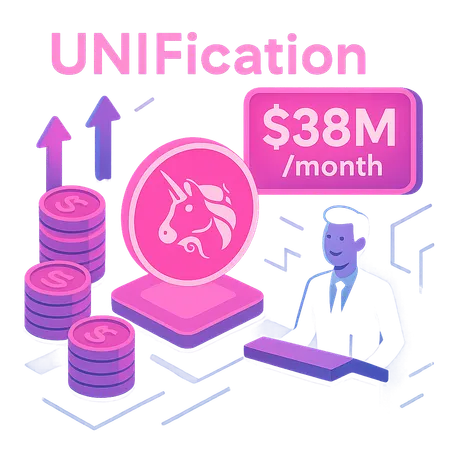
Uniswap's UNIfication proposal could trigger $38M in monthly UNI buybacks
Summary
Quick overview
Uniswap founder Hayden Adams has proposed “UNIfication”, a major governance redesign aimed at streamlining Uniswap’s decision-making and token economics. At the center of the plan is a mechanism that could trigger $38 million in monthly UNI buybacks — a scale that would materially alter supply dynamics if sustained. The proposal arrives as DeFi protocols revisit treasury strategies and token utility; for users and traders, the immediate question is how buybacks will be funded and governed.
What UNIfication aims to change
UNIfication is pitched as a consolidation of governance primitives and a clearer framework for allocating protocol-controlled assets. Instead of piecemeal proposals and ad hoc funding, the overhaul would give Uniswap a recurring pathway to deploy Treasury resources — including a structured buyback program for UNI. The document frames buybacks as a tool to support token value and align incentives between long-term holders and protocol stakeholders.
How a ~$38M monthly buyback could work
According to the proposal outline, buybacks would come from reallocated Treasury revenue streams and possibly a portion of protocol fee income. $38 million per month implies substantial capital flows: if approved, the program could reduce circulating UNI supply over time or provide frequent market support depending on execution (open-market purchases vs. on-chain burns). The specifics — cadence, execution windows, and anti-manipulation safeguards — will be central to community deliberations.
Funding sources, governance mechanics, and timeline
Key mechanics under debate include whether buybacks are discretionary or automated, how voting thresholds are set, and which Treasury buckets are eligible. Some community members prefer a transparent schedule to avoid signaling risk; others want flexibility to respond to market conditions. Implementation would likely require multiple governance steps and audits, meaning even if passed, full roll-out could take months. Services like Bitlet.app help retail participants monitor UNI availability and plan positions while governance debates play out.
Market implications and risks
A committed monthly buyback of this magnitude could provide recurring buy-side pressure and reduce free float, creating tighter tokenomics that may benefit price in favorable market conditions. However, there are risks: using Treasury funds for buybacks reduces capital available for ecosystem grants, liquidity incentives, or development support. Market participants will watch for front-running, execution drag, and whether buybacks are perceived as long-term policy or a temporary experiment. Comparisons to corporate buyback programs are useful but imperfect in on-chain, decentralized settings.
What to watch next
- Governance votes and snapshot discussions: community sentiment will shape final design.
- Detailed execution rules: safeguards against manipulation and clear funding sources will be decisive.
- On-chain implementation timeline: a phased rollout is likely if the proposal passes.
Uniswap’s UNIfication proposal marks one of the clearest moves yet toward active Treasury management in DeFi. If adopted, the $38M monthly buyback headline could become an important factor for UNI holders and the broader crypto market—but its ultimate impact will depend on governance choices and technical execution. For context on how token policies like this fit into the broader ecosystem, follow ongoing coverage of DeFi and blockchain developments.