Hedera Strengthens Transparency With Google BigQuery Integration
Summary
A major data win: Hedera on Google BigQuery
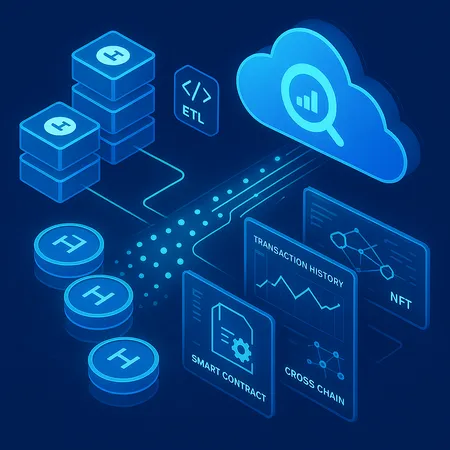
Hedera Hashgraph has been added to Google BigQuery’s roster of public datasets, giving anyone with BigQuery access the full transaction history of the Hedera network. For enterprises and analytics teams this isn’t just a CSV dump — Google Cloud keeps the dataset continuously synchronized with the live ledger and Hedera’s team published the extraction, transformation, and loading (ETL) scripts as open-source. That combination lowers the barrier for forensic analysis, compliance reporting, and large-scale business intelligence projects that require accurate, up-to-date chain data.
What the integration enables for developers and analysts
By surfacing Hedera data in BigQuery, developers can run SQL queries that compare transaction fees, throughput, and token movements across chains with familiar tools. Analysts can trace tokenized assets and NFTs with the same workflows they use for other public blockchains, and teams can build dashboards showing latency and cost trends over time. Because the dataset is in BigQuery, compute scales without the typical node management overhead — enabling both ad-hoc research and scheduled reporting that updates automatically.
Open tooling and real-time synchronization
Hedera’s choice to publish ETL scripts and deployment frameworks as open-source removes a common bottleneck for enterprise adoption: trust and reproducibility. Organizations can inspect the code that maps Hedera’s ledger model into BigQuery tables, fork it, or integrate it into CI/CD pipelines. Google Cloud handles the heavy lifting of replication and indexing, so datasets remain current and queries return consistent historical snapshots — a big advantage for audits, compliance checks, and automated alerting.
Use cases: from token tracking to DeFi trend analysis
The practical applications are immediate. Data scientists can run cohort analyses on token holders, monitor large transfers for suspicious activity, or calculate real gas-equivalent costs per transaction type. Market researchers can chart NFT minting and trading volume across time, and product teams can benchmark Hedera smart contract latency versus other chains. Cross-chain studies become simpler when you combine Hedera BigQuery data with datasets from Ethereum or other L1/L2s using standard SQL.
Implications for HBAR and the ecosystem
Greater visibility typically leads to faster developer adoption and stronger tooling. For HBAR, this integration should make it easier for exchanges, custodians, and analytics vendors to support the token and related assets. Institutional users that require verifiable, auditable datasets will find Hedera’s presence in BigQuery attractive. Services such as Bitlet.app and other analytics platforms can integrate the dataset to enrich dashboards, enhance trading models, and offer better compliance features.
Looking ahead: transparency, competition, and analytics
Making Hedera available in BigQuery is both a transparency play and a practical step toward broader ecosystem maturity. It reduces friction for building enterprise-grade analytics and enables nuanced comparisons of transaction costs, speeds, NFTs, and DeFi activity across chains. As more chains adopt similar public dataset strategies, multi-chain analytics will become the norm — enabling richer insight into the evolving crypto market.
Conclusion Hedera’s BigQuery integration is a clear win for transparency and developer productivity. With continuous sync, open ETL tooling, and Google Cloud’s performance, teams can scale analytics without managing nodes or building extraction pipelines from scratch. Expect to see faster tooling development, improved compliance workflows, and deeper DeFi and NFT research now that Hedera data sits alongside other major public datasets.
For hands-on exploration, analysts can start querying Hedera in BigQuery today and combine it with related datasets to surface new insights about token flows, smart contract performance, and market dynamics. Also check resources on NFTs and DeFi for ideas on cross-chain analyses and datasets.