Bitcoin Taproot Supply Drops 3% Since 2024 as Quantum Safety Concerns Rise
Summary
Market snapshot: Taproot supply contraction and dormancy flows
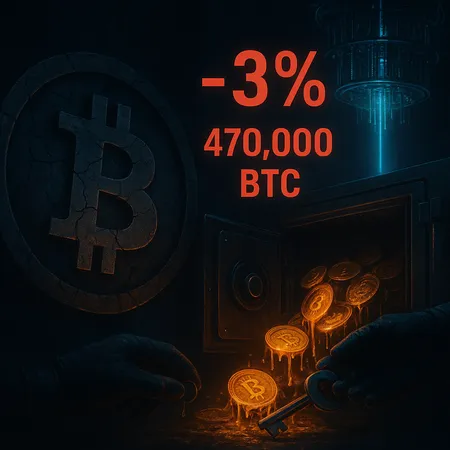
Since 2024, the amount of Bitcoin locked under Taproot addresses has declined by roughly 3%, while over 470,000 BTC moved out of long dormancy during 2025. On-chain analysts say these flows look like custody rotations — institutional rebalancing, custodian consolidations, and wallet hygiene moves — rather than panic selling or mass capitulation. Price action has been sensitive to these headline numbers, but deeper chain analysis suggests a structural, not purely sentiment-driven, change.
What drove the dormancy unwind? custody shifts, not capitulation
Large dormancy breaks usually raise alarm bells because they can signal looming supply pressure. Yet the on-chain profile of 2025 movements shows concentrated transfers between clusters identified as custody providers, multisig setups, and cold-storage consolidations. That pattern is consistent with planned operational changes: audits, KYC-driven migrations, or transfers into third-party custodians and exchanges for services like staking, lending, or insurance.
Importantly, many of these moves involve key rotations and address upgrades — activities that remove coins from older Taproot UTXOs and place them behind refreshed key material. That means supply available for active trading may not have increased nearly as much as raw dormancy figures suggest.
Quantum risk: emerging concern or headline noise?
The Taproot upgrade introduced Schnorr signatures and new script capabilities, improving efficiency and privacy. However, like other elliptic-curve schemes, Schnorr is theoretically vulnerable to sufficiently powerful quantum computers capable of solving discrete logarithms. That has sparked discussion about future-proofing keys and whether funds on-chain today could be exposed if public keys are revealed.
Experts remain divided. Practical quantum attacks that can break Schnorr or ECDSA are widely considered to be years — likely decades — away, but the risk profile changes if public keys are reused or published on-chain. As a result, some custodians appear to be proactively migrating funds and rotating keys to reduce long-term exposure. This is a conservative but rational operational choice, not necessarily a signal of imminent compromise.
Implications for investors, custodians, and on-chain services
For users and institutions the takeaway is operational: focus on key hygiene, multi‑sig setups, and transparent custodial practices. Retail holders should confirm whether their provider (or their own setup) exposes public keys on-chain and consider hardware wallets or proven custodians for long-term holdings. Institutions are increasingly factoring quantum-readiness into service SLAs and insurance discussions.
Platforms that monitor chain data and offer custody-to-earn pathways are also affected. Services like Bitlet.app note that better on-chain visibility helps distinguish rotation from sell pressure and lets users make more informed choices about liquidity and risk. For traders, the near-term effect is elevated volatility around headlines; for long-term holders, it's a reminder to review key management strategy.
Looking ahead: balancing practical risk management with perspective
The raw numbers — 3% drop in Taproot supply and 470,000 BTC leaving dormancy — are meaningful but not intrinsically catastrophic. Most evidence points to operational reorganizations and proactive security measures rather than mass liquidations. That said, the conversation around quantum risk has accelerated legitimate upgrades in custody practices.
Investors should: maintain robust backups, prefer hardware or multi-signature custody for large allocations, and monitor on-chain indicators rather than reacting solely to headline numbers. For context on related ecosystem trends, keep an eye on broader blockchain developments and how they intersect with NFTs, memecoins, and DeFi flows.
Conclusion
Taproot supply contraction and the 2025 dormancy movements highlight a maturing market where custodians and large holders are optimizing operations and hedging long-term risks. While quantum threats remain a theoretical future challenge, their practical impact today is driving better key management and clearer custody procedures — a net positive for systemic resilience. Staying informed with on-chain analysis and choosing reputable custody services will be key as the market adapts.