Wyoming Launches FRNT on Avalanche — First State-Issued Stablecoin to Modernize Public Finance
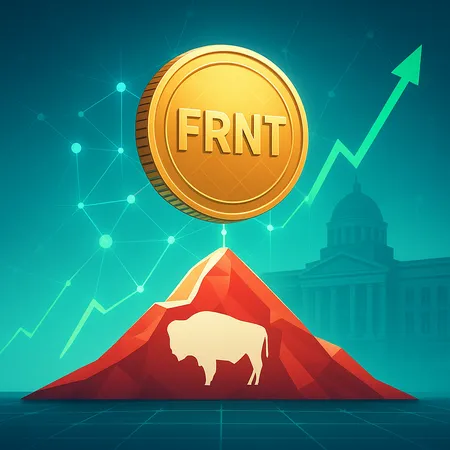
Wyoming’s FRNT Debut on Avalanche
Wyoming has launched FRNT on the Avalanche network, marking a milestone as the first state-issued stablecoin in the United States. Built on Avalanche (AVAX), the move signals a new chapter for how public bodies experiment with digital money to improve payment processes, transparency, and financial innovation.
Why this matters: practical use and public finance
State-issued digital currencies are more than PR headlines. By issuing FRNT, Wyoming aims to:
- Improve payment efficiency for government services and vendor disbursements.
- Increase transparency through on-chain records while potentially reducing reconciliation costs.
- Create programmable money rails that can support conditional payments, grants, and automated municipal services.
If implemented as expected, FRNT could make routine public finance operations—tax receipts, benefits distribution, and vendor payments—faster and cheaper. That said, adoption will depend on integrations across wallets, exchanges, and service providers.
Technical choice: Avalanche and network effects
Choosing Avalanche brings performance and composability advantages. Avalanche’s low fees and fast finality make it attractive for high-throughput use cases, and demand for AVAX could increase as activity rises. For developers, FRNT on Avalanche can plug into the wider DeFi ecosystem, enabling liquidity pools, yield strategies, and programmable contracts with near-instant settlement.
This also means new opportunities and questions for the broader crypto landscape: how will FRNT interact with existing stablecoins, what privacy guarantees will be offered, and how will reserve backing and audits be disclosed?
Regulatory and governance implications
A state-issued stablecoin sets an important precedent. Key governance considerations include:
- Reserve backing and transparency: Citizens and counterparties will look for clear proof-of-reserves and audit frameworks.
- Legal status: Whether FRNT becomes accepted for particular state duties or collections will depend on local law and federal guidance.
- Privacy and surveillance: On-chain traceability raises civil-liberties questions that policymakers must address.
The rollout will be watched closely by other states and municipalities considering similar experiments.
Market impact and DeFi integration
FRNT could increase on-chain liquidity and activity on Avalanche, influencing the crypto market in several ways:
- Short-term demand for AVAX could rise as users pay gas and bridge liquidity.
- Protocols on Avalanche might list FRNT in pools, enabling yield opportunities and integrations with DeFi primitives.
- New rails could support public-private financial products, from tokenized municipal bonds to programmable grants.
There may also be secondary effects on adjacent sectors — for example, improved stable payment rails could lower friction for creators and marketplaces that trade NFTs or memecoins, though FRNT’s primary role is public finance rather than speculation.
Risks and open questions
While the launch is promising, several risks remain:
- Centralization and single-point-of-failure concerns if custody and issuance remain tightly controlled.
- Interoperability and acceptance — commercial partners and other states may be slow to accept a state-issued token.
- Regulatory pushback at the federal level could create compliance burdens or limit cross-jurisdiction use.
Clear governance, transparent audit practices, and well-defined legal frameworks will be essential to mitigate these risks.
What to watch next
- Publication of FRNT’s reserve and audit framework.
- Integration announcements from wallets, exchanges, and payment providers.
- Any federal guidance or comment that clarifies how state-issued stablecoins will be treated.
For users and builders on Avalanche, FRNT is a development worth tracking for potential utility and liquidity shifts. Platforms like Bitlet.app and others that bridge traditional finance and crypto services may see new integration opportunities as municipal digital currencies evolve.
Conclusion
Wyoming’s issuance of FRNT on Avalanche is a landmark experiment at the intersection of public finance and crypto. It promises practical efficiency gains and richer on-chain civic tooling, while raising important governance, privacy, and regulatory questions. If Wyoming provides clear auditing and governance, FRNT could become a template for other jurisdictions exploring how digital currency can modernize government payments and public services.
For the broader crypto community, the rollout is a timely reminder that blockchain innovation now includes public-sector use cases as well as private DeFi and consumer applications. Watch for technical details and adoption signals — they will determine whether FRNT is a niche pilot or the start of a larger movement.