How Institutional Tokenized Products and ETF Filings Are Rewriting Bitcoin’s $70K Price Mechanics
Summary
Executive summary
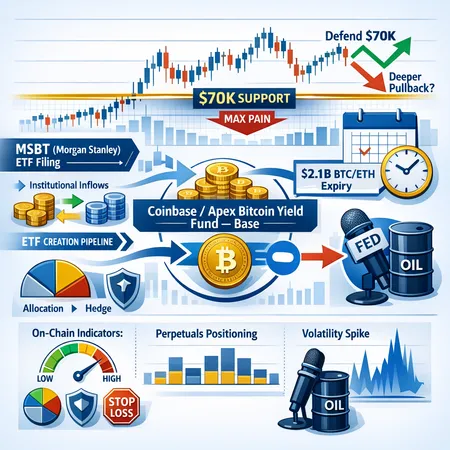
The market is negotiating a new plumbing of institutional demand. Traditional ETF filings (Morgan Stanley’s revised filing for an NYSE Arca Bitcoin ETF, ticker MSBT) bring seed capital, custodian choices, and redemption mechanics that alter how liquidity is absorbed. Simultaneously, tokenized institutional products — exemplified by Coinbase and Apex’s tokenized Bitcoin Yield Fund on Base — create on-chain, programmable demand outside classic ETF rails. Layer on large options expiries and a derivatives market skewed toward shorts (negative funding rates) and you get a fragile $70K support that can either be reinforced or rapidly undermined depending on flow timing. This article examines those pieces and offers actionable trade and portfolio frameworks for intermediate and advanced allocators.
Why institutional ETF filings matter for near-term BTC mechanics
When an institution like Morgan Stanley files an ETF and brings seed capital and specific custodian choices, it changes the supply/demand equation in a couple of concrete ways. First, seed capital is cash that anchors early share creation and often comes with an initial BTC allocation that the sponsor will either hold or manage through in-kind mechanisms. Second, the chosen custodian and listing venue (here, NYSE Arca and the proposed MSBT ticker) determine settlement and redemption efficiency — and therefore how quickly ETF share creations can soak up spot BTC or, in reverse, how redemptions can return supply.
These are not theoretical details. New institutional ETF supply can temporarily absorb large sell orders, smoothing downside. But conversely, the promise of a new ETF can encourage front-running by funds and HFT desks: if market participants expect consistent ETF inflows, they may build long exposure into futures and options, creating mechanistic leverage that amplifies a move when the flows fail to materialize. For context on the recent MSBT filing and institutional supply implications, see this Morgan Stanley revision and ticker confirmation.
Tokenized institutional demand: Coinbase/Apex’s Base product
Institutional demand is also moving on-chain through tokenization. Coinbase and Apex’s tokenized Bitcoin Yield Fund on Base shows how institutions can create products with ETF-like economics but with programmable settlement, fractionalization, and 24/7 execution characteristics. Tokenized products can sit in wallets, be used as collateral in DeFi, or be aggregated by market-makers — creating a steady, on-chain bid that is correlated but not identical to classic ETF flows.
That has two important consequences:
- Tokenized funds can provide carry and yield to institutional capital, attracting long-duration holders who are less likely to liquidate on a short-term dip.
- Because they settle on-chain, they can be arbitraged into futures/derivatives markets in real time, which tightens basis and can either reduce or increase volatility depending on who is providing the arbitrage (risk-averse banks vs. leverage-hungry desks).
Coinbase/Apex’s launch is a concrete example of these dynamics and suggests institutional demand will use multiple pipes — ETF rails and on-chain tokenization — to gain BTC exposure.
Options expiries, quarterly derivatives events, and the mechanics of ‘max pain’
Options expiries are time bombs for short-term volatility. Recent reporting highlighted a roughly $2.1 billion Bitcoin and Ethereum options expiry — the kind of concentrated notional that can centralize gamma and delta hedging activity. Large expiries compress and concentrate positioning around strike clusters; when many options expire worthless or in-the-money at specific strikes, that sets up a max pain level where the aggregate P&L across option buyers is least favorable.
How this translates to spot price action:
- Dealers delta-hedge option books. If dealers are short calls and long puts, they hedge by selling spot into rallies (compressing upside). If they are short puts and long calls, they buy spot into weakness.
- Gamma exposure (how hedges change as price moves) increases dealer reactivity around expiry — small price moves can force outsized hedging flows.
- Quarterly derivatives roll/expiry events concentrate notional, and liquidity can evaporate in the futures market, meaning liquidations and funding-rate moves become larger and faster.
A concentrated expiry near the $70K area can therefore either reinforce that level (if hedges force buying near $70K) or blow through it (if the direction of net hedging is selling). For a snapshot of how options expiries can act as immediate triggers, see coinpedia’s coverage of the $2.1B expiry.
On-chain indicators and macro risks that can flip the $70K defense
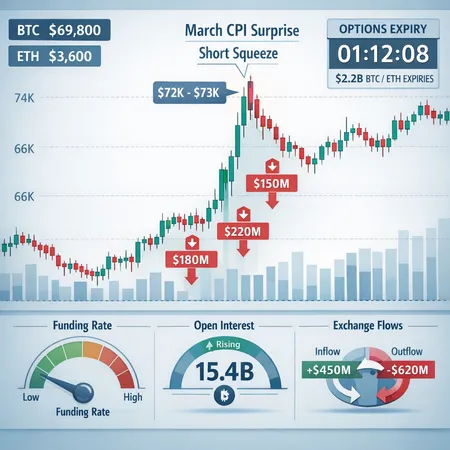
Two on-chain metrics deserve attention: funding rates and perpetuals positioning. Funding rates tell you whether perpetual futures longs or shorts are paying to hold. When funding rates are negative — as recent analysis shows — shorts are effectively being paid to hold position, indicating a bearish tilt in leverage. That configuration increases the risk that a run to the downside becomes self-reinforcing: shorts collect funding while liquidations of longs exacerbate the fall. Read the recent analysis on persistent negative funding rates for detail.
Perpetuals skew and open interest concentration also matter. Heavy short positioning concentrated at specific leverage bands can result in asymmetric liquidation cascades if spot moves lower. On the macro side, Fed commentary and oil-driven shocks are classic cross-asset flows: tighter Fed messaging can pull risk capital out of crypto; a sudden oil price shock can rotate risk away from equities and crypto toward commodities or treasury plays — pressuring BTC.
Markets are currently balancing ETF momentum against these macro and on-chain headwinds. Coverage noting BTC holding near $70K while ETF momentum grows but Fed/macro risks linger is useful context for short-term scenario planning.
Scenario-based trade frameworks (practical and actionable)
Below are scenario templates and concrete trade ideas tailored to intermediate and advanced allocators. Each starts with a base assumption, trade idea, sizing guidance, and exit/risk rules.
Scenario A — ETF inflows continue and expiries pass quietly
- View: Institutional demand (MSBT and other ETFs) and tokenized on-chain buying sustain $70K.
- Trade idea: Buy spot or accumulate via dollar-cost averaging; sell short-dated call spreads to monetize theta if you wish to fund cost basis. Consider covered-call overlays for 1–3 month horizons.
- Sizing: 2–6% of total liquid risk budget on directional spot; options positions sized so max loss is limited to a small fraction (e.g., 0.5–1% of portfolio) given volatility.
- Risk control: Reduce exposure if funding rates flip sharply positive and open interest surges (indicating crowded long risk).
Scenario B — Options expiry triggers downside squeeze then recovery
- View: Expiry pushes price briefly through $70K but deals and tokenized flows re-anchor price above the level.
- Trade idea: Buy cheap 1–2 week straddles or strangles around expected expiry if implied vol is low; size conservatively because gamma can work both ways. Alternatively, sell premium with an iron condor if you expect compression and want to collect theta.
- Sizing: Smaller, tactical bets (0.5–1% of portfolio) due to high execution risk.
- Risk control: Use stops and defined-loss option structures (e.g., vertical spreads) to avoid blowups.
Scenario C — Funding rates remain negative, macro shock flips $70K to a retest lower
- View: Short perpetual dominance and negative funding create a path to a deeper pullback.
- Trade idea: Buy protective puts (buy cheap downside protection) or establish a put spread to hedge spot exposure. Consider using short-dated, deep OTM put buying during liquidity windows to catch liquidations.
- Sizing: Hedge ratio 10–40% of spot exposure depending on risk tolerance; maintain cash buffers for margin.
- Risk control: Predefine re-entry levels and avoid aggressive levered shorting; monitor spot-futures basis and funding continuously.
Carry and yield via tokenized products
- Idea: For investors seeking yield and willing to accept counterparty/tokenization risk, tokenized Bitcoin funds (like the Coinbase/Apex product on Base) can provide yield and a partial hedge vs. pure directional exposure. Use these for a carry sleeve inside a broader BTC allocation rather than the entire allocation.
- Risk: Smart-contract, custody, and liquidity risks — size as a small-to-medium proportion of your BTC allocation and stress-test redemptions.
Execution and platform notes
- ETF flows can be large and time-of-day sensitive. Execute block trades or work with liquidity providers for large rebalances.
- On-chain tokenized products require awareness of Base network congestion and bridge slippage; use execution windows with sufficient liquidity.
- For custody and settlement efficiency, platforms and aggregators (including execution services such as Bitlet.app) can reduce slippage and help manage complex ETF/token transitions without wholesale market impact.
Portfolio-level risk management checklist
- Position sizing: Cap single trade exposure (directional or options) to a pre-allocated % of liquid capital.
- Diversify access: Use both spot, derivatives, and tokenized products to smooth execution risk.
- Monitor funding & basis: Set alerts for funding rate thresholds and spot-futures basis extremes.
- Expiry calendar planning: Maintain a calendar of major expiries and ETF settlement windows; avoid being illiquid into concentrated expiries.
- Stress tests: Run adverse scenarios that include a 15–30% drawdown over 72 hours and confirm margin/cash sufficiency.
Conclusion — what to watch this week
- Monitor MSBT-related filings and any institutional seed announcements; these change the predictable inflow model.
- Track tokenized issuance and on-chain flows into Base and similar chains; wallet-level accumulation from large entities matters.
- Watch the options expiry calendar and open interest concentrations; expiries near $70K are the immediate catalyst for gamma-driven moves.
- Keep a close eye on funding rates and macro headlines (Fed speak, oil shocks) — these are the tilting forces that can flip the defense of $70K into a deeper correction.
Institutional products are creating an architecture where flows are both more predictable and more mechanically powerful. That can reduce random noise, but it also makes certain dates and technical levels focal points for liquidity. For disciplined allocators, the opportunity is to blend directional exposure with hedged, yield-bearing tokenized sleeves and well-defined options-based protection — and to monitor funding, basis and expiry dates closely.
For traders and portfolio managers who want to act on these mechanics, combining on-chain signal monitoring with a clear expiry calendar and execution plan is the pragmatic path forward. Bitlet.app and similar execution platforms can help operationalize complex trades across spot, tokenized products, and derivatives without creating disproportionate market impact.
Sources
- Morgan Stanley revises Bitcoin ETF filing and confirms MSBT ticker — ZyCrypto
- Coinbase and Apex introduce tokenized Bitcoin Yield Fund — The News Crypto
- 2.1 billion Bitcoin and Ethereum options expiry today — Coinpedia
- Bitcoin holds support as ETF momentum grows and Fed/macro risks remain — CryptoTicker
- Bitcoin bearish persists: funding rates negative — NewsBTC
Additional reading: on-chain and derivatives dashboards from major analytics providers for live funding rates, open interest, and expiry calendars.
For more on how institutional flows intersect with DeFi and tokenization trends, see perspectives on Bitcoin and DeFi in our blog archive.