Can SOL Break $100? Dissecting the Technicals, ETF Demand and TRUMP Memecoin Hype
Summary
Executive snapshot
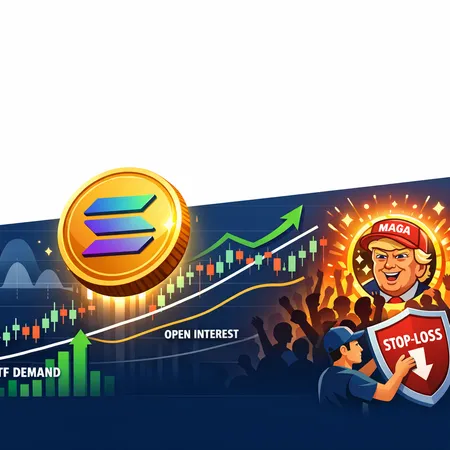
Solana (SOL) is carving out a high-stakes technical story: one narrative points to a breakout toward $100 as rising support and renewed buying stack up, while another points to a traditional head-and-shoulders reversal that could cap gains. That tug-of-war is playing out against a backdrop of rising ETF demand and higher open interest, plus event-driven memecoin activity — the TRUMP memecoin being the most visible recent example — which can both turbocharge and distort price moves.
This feature unpacks the technical picture, quantifies how ETF flows and derivatives open interest matter, explains the memecoin spillover mechanism, and gives practical risk-control rules for active traders and retail investors evaluating an event-driven breakout.
The technical setup: rising support vs head-and-shoulders
At a glance, SOL’s chart contains two competing patterns. On the bullish side there is a series of higher lows — a rising support line that suggests buyers are stepping in earlier after pullbacks. That pattern is attractive because it tightens risk-to-reward: stops can live below successive swing lows while upside targets push toward the $100 mark.
Countering that bullish read, a number of technicians have identified a classic head-and-shoulders formation with a potential neckline that, if broken, would invalidate the breakout thesis and imply a deeper retracement. The head-and-shoulders argument is not academic — it has reliable historical precedents and is precisely the sort of structure that attracts aggressive short sellers as price approaches perceived resistance. CoinPaper’s technical note contrasts these setups and lays out the $100 breakout path against the bearish pattern, which is useful for framing both scenarios (CoinPaper analysis).
How to reconcile? Treat the chart as a conditional model: bullish above the rising-support trendline and neckline confirmation; bearish if the neckline is pierced with conviction and volume.
How to read the patterns in real time
- Look for volume and momentum confirmation on a move above the short-term highs — not just a wick. Sustained volume that accompanies a breakout reduces the odds of a false break. Blockonomi’s coverage of SOL’s recent surge past $90 highlights how short-seller pain can accelerate moves when momentum aligns (Blockonomi report).
- Watch daily and 4-hour timeframes together. A bearish head-and-shoulders on daily with no 4-hour support zone increases risk.
- Measure risk using the distance between the breakout and the nearest meaningful swing low; size positions so a full stop loss equals a loss you can stomach.
Macro push: ETF demand and open interest dynamics
ETF flows and derivatives open interest are the macro levers that can convert a technical breakout into a sustained trend. Recent reporting suggests renewed institutional interest could be lifting SOL’s bid: higher open interest and ETF-related demand increase net leverage in the system, making squeezes more probable. Invezz’s analysis explores whether ETF-driven demand could help SOL clear $100 as open interest and product flows rise, a thesis that feels especially relevant in the current environment (Invezz analysis).
Open interest acts like stored pressure. When open interest grows faster than price, new money is coming in to bet on continuation — the market is primed for bigger moves. If that open interest is also skewed toward shorts, a breakout can create a short-squeeze cascade, amplifying the rally. Conversely, if open interest growth is driven by long liquidation flows or hedged positions, the same metric can mask fragility.
Practical read-throughs for traders:
- Monitor exchange-reported ETF flows and AUM deltas in Solana-focused products; persistent inflows materially change the fundaments around liquidity.
- Compare percentage change in open interest to price moves. A rising price with flat/declining open interest is weaker than a rising price with rising open interest.
Event-driven hype and memecoin spillover: the TRUMP case
Memecoin narratives are corrosive for pure technical trading — they add narrative volatility. The TRUMP memecoin episode, tied to a Mar-a-Lago event and social hype, illustrates how a token on Solana can suck on-chain activity into the broader SOL market. FXEmpire’s coverage tied TRUMP’s surge to event-driven momentum that can spill liquidity into the Solana ecosystem, increasing transactions, fees, and sometimes direct buying pressure for SOL when traders rebalance (FXEmpire forecast).
Mechanically, the spillover works in a few ways:
- Payment rails and gas fees: surges in memecoin trading increase SOL demand for fees, especially on Solana where many tokens and DEX activity are SOL-denominated.
- Speculative rotation: traders taking profits in a memecoin may reallocate into SOL, especially when SOL looks “cheap” on a technical breakout setup.
- Liquidity and exchange flows: heavy memecoin flows can deplete liquidity pools, creating temporary price slippage that ripples across correlated assets.
This isn’t an endorsement of memecoin-driven positions. Rather, memecoin surges create higher tail risk: fast, violent moves that can both propel a breakout and turn it into a flash crash if sentiment reverses.
For many traders, understanding memecoin spillovers is part of macro tape reading — keep an eye on emergent tokens and on-chain volumes. If you follow broader market narratives, you’ll notice how memecoin spikes often precede or coincide with sudden changes in SOL volatility. Retail platforms and tools like Bitlet.app may show these volume and token flows in real time; use them to sense-onchain crowd behavior.
Trading the breakout: risk controls and practical rules
Event-driven breakouts are high-reward but higher-risk. Mix technical discipline with event awareness.
Core rules:
- Layer entries: start with a partial position on the first clean breakout confirmation (volume + close above resistance) and add on sustained follow-through.
- Use time-based stops in addition to price stops. If a breakout stalls for X sessions (define X per your timeframe), trim exposure.
- Size for stress: assume a worst-case quick retracement to the rising-support line; set position sizes so that stop loss stays within your risk tolerance.
- Watch correlation: memecoin mania can spike correlation across Solana-linked tokens. If multiple tokens diverge, be wary of a chop-filled market.
- Hedge with options or inverse products if available, especially when open interest suggests crowded longs.
Stop placement examples (not financial advice):
- Swing trader: enter half size at a breakout close above resistance; stop below the most recent swing low — risk 2–3% of capital on the full-sized intended position.
- Short-term scalper: trade smaller size with tight intraday stops; avoid holding through major events tied to memecoin catalysts.
Scenario checklist and trade triggers
Bull case checklist (adds conviction toward $100):
- Daily close above the short-term resistance with rising volume and expanding open interest.
- Continued ETF inflows or fund flows into Solana products.
- Memecoin activity that increases on-chain demand without collapsing liquidity pools.
Bear case checklist (invalidates breakout):
- Clear daily break of the head-and-shoulders neckline with high volume.
- Divergence: price rising while open interest falls or funding rates flip negative.
- Rapid unwinding of memecoin positions that produces on-chain congestion and liquidity withdrawals.
Trade trigger examples:
- Long trigger: confirmed close + volume above resistance and OI up >5% week-over-week. Add on a successful retest of broken resistance as support.
- Defensive exit: if price returns below the rising-support trendline with volume, reduce or exit positions immediately.
Conclusion
Solana’s path to $100 is plausible but conditional. ETF demand and rising open interest provide the raw fuel; memecoin-driven event hype like TRUMP can act as the match that lights the fuse — or the spark that burns out quickly. For active traders, the winning approach is not to pick a narrative and cling to it, but to prepare conditional plans: define triggers, use layered sizing, and respect stop discipline. Clean risk controls will turn a noisy, event-driven environment from a threat into an opportunity.
Sources
- FXEmpire — TRUMP memecoin forecast and event hype
- CoinPaper — Solana head-and-shoulders vs $100 breakout setup
- Blockonomi — SOL price surges past $90 and short-seller liquidations
- Invezz — Is Solana the next crypto to break $100 after ETF demand?
For traders tracking on-chain flows and memecoin activity, tools and exchange data matter — and examples like Solana and DeFi narratives will continue to shape where price goes next.