XRP Derivatives Surge: How Ripple’s Australian AFSL Is Reshaping Options Flow and Price Targets
Summary
Executive snapshot: surge, license, and market mechanics
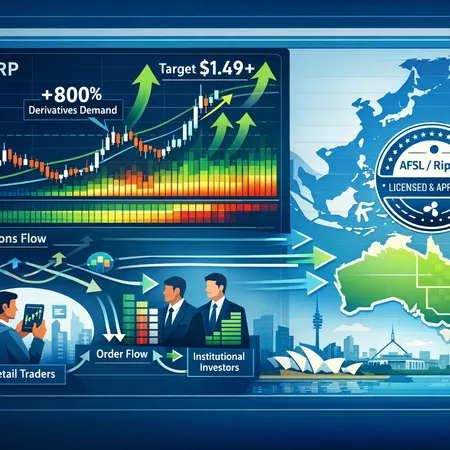
XRP has reappeared on many derivatives desks after an extraordinary spike in options and futures demand. Market monitors put the jump in derivatives activity at roughly 803% versus prior baselines, a number highlighted in market reporting and reflected in widened open interest and concentrated expiries. That flow is arriving as Ripple expands its regulated footprint in APAC by securing an Australian Financial Services License (AFSL) — a development that alters how exchanges, custodians and institutional desks price counterparty and regulatory risk.
This article unpacks what that derivatives surge actually means, who is driving it (retail vs institutional), how gamma and options flows can push spot price toward technical targets like $1.49+, and practical trade and risk-management ideas for derivatives users as market structure shifts.
What the 800% derivatives spike is — and what it isn’t
The headline figure (see reporting) points to a short, sharp increase in derivatives demand: call buying, futures volume, and new option expiries clustered around specific strikes and expiries. But the number by itself doesn't equal a sustained institutional tsunami. In practice you see three overlapping phenomena:
- Concentrated retail call-buying and directional bets around near‑term expiries, which produce high gamma for market makers and force delta-hedging flows into the spot market.
- Professional trading desks and boutique funds layering risk — directional plus volatility plays — that amplify flows but often use spread structures rather than naked exposure.
- Early institutional engagement tied to changing regulatory calculus, especially where licenses reduce listing friction and custody concerns.
CoinTribune reported the ~803% jump and documented how much of the activity is centered in derivatives markets rather than spot alone. That suggests a market moving on expectations as much as on fundamentals: options can create their own momentum through gamma hedging.
Gamma, options flow, and the mechanics that drive short-term rallies
When traders buy large volumes of out-of-the-money (OTM) calls, the dealers who sell them become net short gamma. To remain delta-neutral they buy the underlying as implied volatility moves or as time decays force re-hedging. This gamma-induced delta hedging can amplify upward moves — sometimes dramatically in thin liquidity windows.
Key reads on the recent flow:
- High concentration of OTM calls clustered near strikes just above $1.00–$1.50 on shorter-dated expiries.
- Skew leaning toward calls, which raises implied volatility on the upside and lowers the relative cost of downside protection.
- Expiration clustering that creates discrete squeeze risk around roll dates.
Retail accounts often trigger and feed these gamma squeezes; professional desks provide volume and structure. The result: a fast, self-reinforcing rally that can attract momentum players and create technical breakouts.
Why Ripple’s Australian AFSL matters to derivatives and listings
Regulatory clarity is not merely symbolic. An AFSL for payments and exchange services in Australia affects the derivatives ecosystem in several concrete ways:
- It reduces perceived legal tail risk for exchanges and custodians listing XRP or offering derivatives tied to it, which can translate into deeper liquidity and tighter spreads.
- Institutional counterparties and brokers are likelier to onboard assets that sit within a transparent regulatory framework, increasing the pool of buy-side flows in APAC.
- Payment licensing encourages commercial volume (on/off ramps) that supports spot liquidity and reduces slippage for large trades.
Blockonomi analyzed Ripple’s licensing move and its potential impact on XRP price structure, noting that regulatory acceptance in a major APAC jurisdiction materially shifts how market participants price uncertainty. Invezz has also reported on XRP reclaiming $1.40+ following the AFSL news, showing the immediate market reaction and technical follow-through in short-term trading ranges.
Technical bull case: mapping the path to $1.49+
From a technical standpoint the bull thesis is a layered one:
- Momentum: Options-driven rallies have pushed short-term moving averages higher, creating momentum that can draw momentum funds and CTA strategies into the space.
- Resistance and targets: A cluster of call interest has been targeting strikes in the $1.25–$1.60 band. Clearing those strikes on meaningful volume gives a clean technical path toward $1.49+ as both a psychological and data-driven target.
- Volume confirmation: Look for sustained spot volume above prior consolidation and widening of exchange liquidity across expiries.
This is not a guaranteed trajectory. Breakouts spawned by gamma squeezes can collapse if implied volatility normalizes quickly or if liquidity providers unwind hedges. Still, with APAC regulatory progress and concentrated options interest, the path to $1.49+ is plausible under a scenario of continued positive flow.
Who is driving the flow: retail, prop desks, or institutions?
- Retail: Quick to buy OTM calls and speculative structures. Their behavior is often visible through small-lot option trades aggregated into large order flow, which ignites gamma from market makers.
- Proprietary desks: They provide liquidity, trade spreads, and occasionally take directional risk. Often they buy calendar spreads or diagonal spreads to play a short-term skew.
- Institutions: Early-stage. The AFSL reduces barriers but large institutional allocations usually require custody, counterparty arrangements, and compliance comfort — processes that take time.
The current picture looks like retail and prop desks front-running a regulatory narrative that will, gradually, attract more institutional balance.
Trade ideas tied to the regulatory story (practical, with risk controls)
These ideas are illustrative, not financial advice. Adjust sizing, tenor, and collateralization to your risk profile and jurisdictional rules.
1) Bull call spread (defined risk) — near-term momentum play
- Rationale: Capture upside from gamma-driven rallies while limiting premium outlay and downside risk.
- Example: Buy the $1.10 call and sell the $1.50 call 30–60 days out if implied vol is rich on near-term calls.
- Risk control: Max loss = net premium. Roll out or widen the spread if momentum continues; close if IV collapses.
2) Long calendar (time premium) — play for sustained bid and lower short-dated IV
- Rationale: Buy longer-dated calls and sell shorter-dated calls to harvest theta while keeping upside optionality tied to regulatory wins.
- Structure: Long 90-day $1.25 call, short 30-day $1.25 call (size the short to avoid large gamma exposure).
- Risk control: Manage the short leg closely around expiries; if short-dated IV spikes, you may need to delta-hedge.
3) Protective put or collar — conservative exposure for spot holders
- Rationale: If you hold spot XRP, buy puts or sell covered calls to monetize premium and protect downside.
- Structure: Buy 60-day $0.90 put and/or sell 60-day $1.40 call to finance protection.
- Risk control: Collars cap upside but substantially reduce tail risk during regulatory reversals.
4) Short-dated long calls (high-risk, high-reward) — for speculators
- Rationale: If you believe a gamma squeeze or positive licensing rumor will push price sharply higher before expiry.
- Structure: Buy OTM calls 7–21 days out near the $1.20–$1.50 band, but keep position sizes small due to rapid theta decay.
- Risk control: Use tight position limits and pre-defined stop-loss on option premium (e.g., exit if premium halves or if delta fails to move within X days).
5) Put credit spread (income with directional bias)
- Rationale: If you expect regulatory progress to support a higher floor, sell a put spread to collect premium with limited downside.
- Structure: Sell $0.80 put, buy $0.60 put 30–60 days out.
- Risk control: Keep notional modest and ensure capital to cover assignment; avoid naked puts in low-liquidity moments.
Risk management: Greeks, liquidity, and expiry clustering
- Gamma awareness: Near-dated options create outsized gamma. If you're short gamma, be prepared for violent intraday moves and margin calls.
- Implied vol monitoring: A fast IV spike increases option premiums and dealer hedging; a fast IV collapse can leave long option buyers underwater despite spot gains.
- Position sizing: Cap exposure to a small percentage of portfolio (e.g., 1–3% notional for high-volatility trades). Use stress tests to simulate expiry squeezes.
- Ladder expiries: Avoid concentrating all exposure into a single expiry to reduce cliff risk on roll dates.
- Counterparty and custody: The AFSL reduces some risk in APAC, but confirm exchange credit, clearing arrangements, and settlement windows before placing large orders.
Market structure implications for APAC fintech strategists
For regional fintech players and exchanges, Ripple’s AFSL signals an operational pivot: easier payments integration, clearer compliance paths, and more predictable listing criteria. That reduces onboarding friction for spot and derivatives products and should, over time, increase institutional participation across APAC markets.
Fintech strategy considerations:
- Product design: Consider offering structured products and yield wrappers tied to XRP derivatives, but underpinned by robust collateral models.
- Compliance: Use the AFSL development as a template to engage local regulators and design rulebooks that pre-empt licensing queries.
- Liquidity provisioning: Prepare for bursty liquidity needs around options expiries and align market-making programs accordingly.
Bitlet.app and similar platforms that service derivatives or installment products should factor in evolving custody requirements and the potential for higher retail engagement triggered by headline volatility.
Checklist before executing XRP derivatives trades
- Verify exchange liquidity and spread depth for both options and futures.
- Check implied volatility curves and skew for the strike/tenor you're using.
- Confirm margin and collateral rules; ensure you can meet intraday calls.
- Size trades conservatively and set explicit stop-loss or rolling rules.
- Monitor regulatory headlines: APAC licensing and exchange listings can gap prices outside technical expectations.
Conclusion: a structural shift, not an overnight certainty
The derivatives surge around XRP — amplified by an AFSL win in Australia — is a classic example of regulation changing market economics. The spike in options demand can create rapid upside through gamma mechanics, and regulatory legitimacy makes the bull case more durable by lowering listing and custody friction. But gamma-driven rallies are ephemeral unless backed by sustained flow, liquidity, and institutional adoption.
For derivatives traders, the right approach is pragmatic: respect the mechanics of options markets, use defined-risk structures, and treat expiry clustering as a real source of event risk. For APAC fintech strategists, the AFSL is a prompt to redesign onboarding, custody and product menus to capture a gradually enlarging market.
Sources
- CoinTribune — XRP derivatives demand jump: https://www.cointribune.com/en/xrp-derivatives-explode-as-traders-seek-new-crypto-catalysts/?utm_source=snapi
- Blockonomi — XRP price outlook and Ripple AFSL analysis: https://blockonomi.com/xrp-price-outlook-as-ripple-secures-australia-afsl/
- Invezz — XRP reclaims $1.40+ after Australian license: https://invezz.com/news/2026/03/13/xrp-eyes-1-49-as-ripple-secures-an-australian-license-check-forecast/?utm_source=snapi
For context on on-chain narratives and broader market comparisons, consider how XRP derivatives flows contrast with other assets; and for cross-market implications, see trends in DeFi and liquidity provisioning.