Bitcoin at $70K: ETF Inflows, Rising Open Interest and a Brewing Supply Shock
Summary
Executive overview
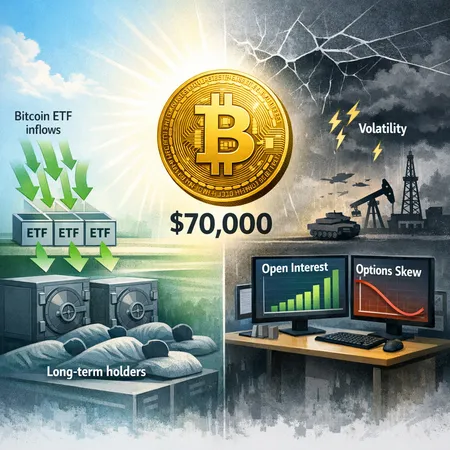
Bitcoin recently hovering near $70,000 is not the result of a single narrative. It’s the product of at least three moving parts: institutional ETF inflows providing steady, visible demand; a derivatives market showing rising open interest coupled with defensively skewed positioning; and on-chain dormancy among long-term holders that could create a latent supply shock. Add macro tail risks to the mix — think oil and geopolitical escalation — and you get a market that can flip quickly from constructive to fragile. This article walks through each element, links the data together, and offers a practical read for intermediate investors and analysts.
ETF inflows: scale, drivers and why they matter
Since spot ETFs launched, net inflows into BTC-focused products have been one of the clearest measurable sources of demand. Recent reporting shows steady net ETF inflows into Bitcoin (and Ethereum), a momentum that underpins the narrative of institutional adoption and demand aggregation. See reporting on net ETF flows for context here.
Why ETF inflows matter:
- They translate off-exchange institutional demand into spot-market buys, often executed via authorized participants and custodial channels rather than direct retail orders.
- Inflows are persistent and measurable; therefore they change the baseline supply/demand balance in a way that's easier to quantify than social sentiment or memecoin hype.
- The nature of ETF buying tends to be sticky: many allocations are strategic, meant for balance-sheet exposure rather than short-term trading.
Drivers behind current ETF flow strength include renewed institutional interest in BTC as a portfolio diversifier, tax-advantaged allocation structures in certain jurisdictions, and the narrative that Bitcoin could act as a partial inflation hedge. That said, ETF flows are not a perfect shield — they can slow, stop, or reverse if macro conditions or liquidity needs change.
For many traders, Bitcoin remains the primary market bellwether; ETF flows give that bell a louder ring, but they don’t remove other risk vectors.
Rising open interest and the derivatives puzzle
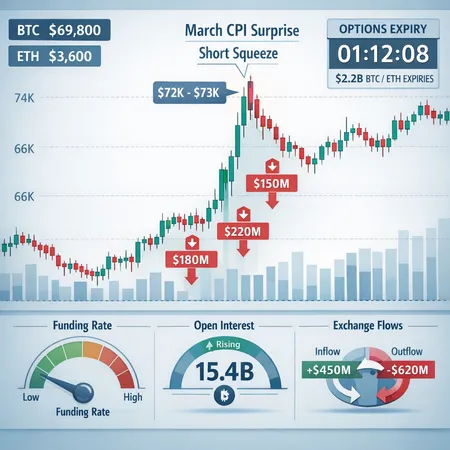
Open interest (OI) in BTC derivatives has climbed alongside price, signalling more capital and leverage are now exposed to the $70k area. CoinDesk noted that rising OI around $70,000 comes with a tone of cautious or even bearish positioning, suggesting many participants are using the derivatives market defensively rather than aggressively (e.g., long-dated protection, short-delta structures) — see the deeper market read here: Coindesk analysis.
How to interpret rising OI with defensive bias:
- Rising OI indicates more market exposure and thus increases potential volatility via liquidations and options gamma dynamics.
- Defensive positioning (put-heavy or short-gamma structures, widening skews) implies participants expect more downside or at least greater two-way risk. In that environment, a small spot move can provoke outsized implied-volatility moves as option sellers hedge.
- If ETFs continue to buy spot while derivatives players are hedging downside, the market can become fragile: buys are steady but hedges can flip quickly into transient selling pressure when realized volatility ticks up.
Put simply: rising OI amplifies the market’s sensitivity. A squeeze higher could be sharp if short-dated sellers are caught off-guard; a shock lower could also cascade quickly if protective hedges are executed in size.
Volatility mechanics to watch
- Funding rates and basis: persistently negative funding (or a premium/discount between futures and spot) will show where leverage is concentrated.
- Options skew and open put interest: growing put interest around $60–68k would confirm downside insurance is being bought.
- Short-term gamma exposure: option sellers short gamma will need to buy spot to hedge rising price and sell spot to hedge falling price — that dynamic amplifies short-term moves.
These dynamics mean rising OI is a two-edged sword: it makes breakouts more meaningful if structurally supported, but it also raises the probability of violent mean-reversion if a catalyst triggers hedging flows.
On-chain dormancy: is a supply shock brewing?
On-chain metrics show a notable trend: long-term holders (LTHs) have been largely inactive, and many large addresses are not rotating coins into circulation. Analysis arguing a brewing supply shock from this dormancy is worth taking seriously — see an on-chain discussion here: crypto.news supply shock piece.
Why dormant LTHs matter:
- When a large share of the circulating supply is effectively illiquid (sitting in LTH wallets), the available free float for active trading is smaller.
- If demand — from ETFs, miners, or retail — re-accelerates while the LTH cohort stays put, even moderate buys can create outsized price pressure.
- Conversely, if dormant whales suddenly decide to rebalance or realize gains, a supply flush can trigger rapid declines.
Key on-chain signals to monitor:
- Age distribution of UTXOs: rising coin-age and fewer older coins moving hints at increasing dormancy.
- Supply held by LTHs vs. exchange reserves: falling exchange reserves together with rising LTH share tightens on-exchange liquidity.
- Large transfers from cold wallets to exchanges: these are short-term actionable signs of potential selling.
The combination of ETF demand and an illiquid float is bullish in an idealized world — but only until derivatives hedging or macro shocks force latent supply to surface quickly.
Macro tail risks: how oil and war could flip the narrative
Macro environment remains the wildcard. FxEmpire’s analysis highlights a clear channel: an oil-price shock or geopolitical escalation that elevates inflation could change central bank calculus and market risk appetite. Read their outline here: fxempire macro analysis.
How that could play out for BTC:
- Inflation surprise from oil/war: higher inflation could hasten rate hikes or keep rates higher longer, pressuring risk assets including BTC in the near term.
- Alternatively, an extreme geopolitical event could drive a risk-off liquidity crunch: investors sell liquid assets (including BTC) to cover margin calls or fund safer havens.
- A Fed pivot (to ease quickly) triggered by a growth shock might restore risk-taking — but the transition is rarely smooth and usually accompanied by volatility spikes.
Macro risk complicates the ETF/derivatives/on-chain trifecta because macro shocks are often the catalysts that cause hedges to be executed and dormant coins to be moved.
Putting it together: breakout or fragile top?
Weighing the evidence:
- Positive: Net ETF inflows provide steady, measurable demand and are a structural tailwind. An illiquid float thanks to long-term holder dormancy could amplify price moves upward when demand outpaces the active supply.
- Cautionary: Rising open interest with defensive derivatives positioning increases the risk of sharp two-way moves; hedging flows can either accentuate a breakout (gamma buying) or contribute to fast selling when volatility spikes.
- Wildcard: Macro tail risks — notably an oil/war inflation shock — could force a rapid re-pricing, converting what looks like structural demand into a fragile top.
So, does current flow justify a sustainable breakout? The honest answer is: not yet unequivocally. ETF inflows materially improve the demand backdrop, but rising OI and defensive hedging plus broad on-chain dormancy create a regime where price action is fragile — capable of strong continuation but also of fast reversals. A sustainable breakout would likely need (a) persistent and accelerating net flows, (b) declining defensive skew and calmer OI structure, and (c) no immediate macro shock.
Practical signals and risk-management checklist for investors
Watch these data points in the coming weeks:
- Net ETF flows (direction and magnitude): sustained daily/weekly inflows matter more than headlines.
- Exchange reserve balances vs. LTH supply: falling exchange balances with rising LTH share tighten liquidity.
- Open interest and funding rates: divergent signals (OI up while funding neutral or negative) indicate leverage building in complex ways.
- Options skew and put-call ratios: growing put demand around lower strikes signals protective buying.
- Macro headlines: oil spikes, major geopolitical news, and central bank commentary all have outsized short-term impact.
Risk-management rules to consider:
- Position sizing: avoid over-leveraging into the $70k zone; size positions assuming higher-than-normal volatility.
- Use layered exits and stop frameworks: prevent single-point failures if hedges trigger cascading flows.
- Keep liquidity buffer: in a market with a potentially tight float, being forced to buy or sell at the wrong moment can be punishing.
Platforms tracking these flows — including custody and flow dashboards such as Bitlet.app — can help monitor ETF and on-chain activity in real time, but treat them as data inputs, not crystal balls.
Final read
ETF inflows are a real structural positive for BTC and are a major reason the market is testing the $70k area. However, the simultaneous rise in open interest with defensively skewed derivatives positioning and the on-chain dormancy of long-term holders create a market that is sensitive rather than decisively bullish. Add macro tail risks and you have a high-probability environment for episodic volatility.
For intermediate investors: the evidence supports cautious optimism, not complacent conviction. A sustainable breakout would require confirmation across flows, derivatives, and macro stability; without that, market participants should expect sharp moves in both directions and plan accordingly.
Sources
- Benzinga — reporting on net ETF inflows into Bitcoin and Ethereum: https://www.benzinga.com/crypto/cryptocurrency/26/03/51208682/bitcoin-at-70000-ethereum-xrp-dogecoin-go-sideways-on-etf-inflows?utm_source=benzinga_taxonomy&utm_medium=rss_feed_free&utm_content=taxonomy_rss&utm_campaign=channel&utm_source=snapi
- CoinDesk — rising open interest near $70k and cautious/bearish derivatives positioning: https://www.coindesk.com/markets/2026/03/12/bitcoin-steady-near-usd70-000-as-rising-open-interest-hints-at-cautious-bearish-positioning
- Crypto.News — on-chain argument that long-term holder inactivity could produce a supply shock: https://crypto.news/bitcoin-supply-shock-brewing-as-whales-stay-inactive/
- FXEmpire — macro outlook on how an oil/war shock could change BTC dynamics: https://www.fxempire.com/forecasts/article/bitcoin-price-outlook-what-200-oil-could-mean-for-btc-1584823