When Miners Become Cloud Builders: How BTC Sales to Fund AI Data Centers Reshape Supply, Energy and Geopolitics
Summary
Executive overview
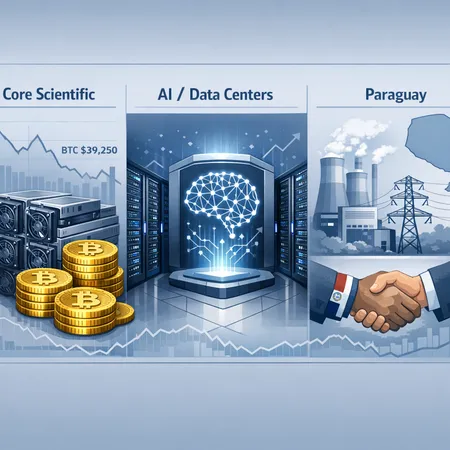
Bitcoin miners are no longer only in the business of producing BTC; a subset are reallocating capital into AI and data centers, power assets, and broader infrastructure. Core Scientific — reportedly considering a sale of roughly 2,500 BTC to fund AI-related expansion — is the clearest corporate-level signal that miners may monetize treasury holdings to buy compute and real estate rather than additional ASICs. At the same time, institutional allocators such as the firm profiled by Cointelegraph show that equity plays in power, data centers and bitcoin miners are converging into a single infrastructure thesis. Meanwhile, national-level actors like Paraguay’s state utility exploring mining cooperation illustrate how mining can be embedded in sovereign energy strategy.
This piece unpacks three linked questions for institutional investors and energy strategists: (1) how miner BTC sales to fund AI/data-center moves affect BTC supply dynamics and market functioning, (2) how this capital redeployment shifts energy demand and grid economics, and (3) what the implications are for miner valuations and the geopolitical map of mining.
The emerging playbook: miners as infrastructure allocators
Historically miners used cashflow and debt to buy ASICs, sign hosting contracts, or secure power. Today there is a broader set of deployment options: in-house AI data centers, colocation deals, direct investment in generation and transmission, and M&A into existing cloud assets. Core Scientific’s reported plan to sell 2,500 BTC specifically to fund AI expansion is an emblematic decision: instead of recycling mined coin into more hashing, management is converting movement in digital asset form into long-lived physical infrastructure. See the ZyCrypto report for details on that contemplated sale.
Institutional investors are already treating this as an investible infrastructure category. As Cointelegraph describes, funds like Situational Awareness LP are increasing equity exposure across power, data centers and mining — essentially underwriting the full stack from electrons to compute. That means miner strategy is beginning to look like a traditional energy or real-estate developer: capex-heavy, non-cyclical contract revenues (if structured right), and longer-term, asset-backed valuations.
How BTC treasury sales change supply dynamics
At scale, miners’ treasury behavior matters to market liquidity. There are three simple scenarios when miners sell BTC to fund AI/data centers:
- Immediate lump-sum sales into spot markets — creates clear, near-term upward supply pressure and potential downward price impact.
- Phased sales via OTC desks or algorithmic execution — spreads market impact but still increases net circulating supply over a multi-week/month horizon.
- Structured conversions (e.g., swaps, forwards, or using BTC as collateral for credit lines) — may avoid immediate spot sales but still materialize supply if counterparties close positions.
Core Scientific’s potential sale of ~2,500 BTC is non-trivial in absolute terms but modest relative to global daily volumes. What matters is the pattern if this behavior scales across multiple large miners simultaneously. If several large operators decide to monetize treasuries for infrastructure pivots, cumulative net selling could push more supply into markets during windows of lower liquidity, amplifying volatility. For more context on institutional-scale reallocations into mining and infrastructure, see the Cointelegraph profile.
Crucially, miners have playbooks to reduce market impact: using OTC desks, selling into futures markets (basis trades), or laddering sales across time. Many mining treasuries will adopt a hybrid: keep a portion of BTC as a strategic reserve while liquidating just enough to meet capex and debt covenants. That said, any public guidance that a miner intends to reallocate sizeable BTC holdings will be interpreted by markets and could change price expectations even before execution.
Energy markets: from variable demand to dual-use infrastructure
When miners redeploy capital into AI/data centers or power assets, the energy demand picture changes in several ways:
Base-load vs flexible demand: Traditional miners offered near-continuous, interruptible demand that could be throttled to support grid balance. AI data centers require stable, low-latency power and often higher PUE (power usage effectiveness) considerations. Redeployment toward AI can increase base-load contracted demand and reduce the grid-flexibility benefit miners previously supplied.
New contracting frameworks: Power purchase agreements (PPAs) tied to data centers differ from hosting contracts. Miners deploying or buying generation will negotiate long-term PPAs, potentially removing surplus renewable energy from merchant markets and altering price curves.
Transmission and congestion: Large-scale data center or co-located mining + AI campuses may require transmission upgrades. That creates opportunity for utility partnerships but also political friction where local communities or neighboring markets see price or reliability impacts.
Asset synergies and stranded equipment: ASIC-based mining assets are specialized and depreciate quickly; repurposing sites for data centers reduces stranded-asset risk but requires significant capex per megawatt.
From an energy-strategy view, the shift implies that host jurisdictions that previously benefited from flexible, interruptible data-center load may now face increased firm demand. That affects capacity planning and may accelerate investments in generation and transmission — or provoke regulatory responses to protect domestic consumers.
Geopolitical implications: where mining meets state policy
Paraguay’s state utility exploring mining cooperation is an early example of how mining can be folded into national energy policy. When a host state actively partners with miners, several dynamics follow:
Energy diplomacy: Countries with abundant, low-cost renewables (hydro in Paraguay) can monetize generation via mining and related compute projects, turning electricity exports into strategic revenue streams.
Sovereign risk reorientation: Host nations may extract more favorable terms (tax, ownership stakes, local content) in exchange for cheap power and permitting, shifting the profitability calculus for miners.
Geopolitical concentration: If miners’ capital increasingly targets jurisdictions with both cheap energy and favorable regulatory regimes, we could see renewed concentration risk — the very outcome the Bitcoin community has feared post-2021. Governments with strategic control of power can use mining as leverage, from negotiating foreign investment to setting cross-border transmission conditions.
Paraguay’s exploration of state-run mining underscores how mineral-scale energy policy can become a national economic tool. Read the Bitcoinist coverage for the case study.
Miner balance-sheet strategies and timing of BTC sales
How miners choose to fund AI/data-center capex is a critical modeling input for investors. Common strategies include:
- Treasury liquidation: Sell BTC reserves to raise equity-free cash. Timing often follows capex milestones, lender tranches, or favorable market windows.
- Debt financing: Use BTC or future cashflows as collateral to obtain low-cost loans; this delays sales but introduces counterparty risk and margin calls.
- Equity raises or asset sales: Issue equity or sell non-core assets to fund the pivot, which dilutes shareholders but avoids direct BTC sales.
- Structured deals: Partner with data-center operators or energy firms in joint ventures where capital is contributed in fiat or equity rather than BTC.
Market timing will be driven by three inputs: the miner’s cash runway and covenant deadlines; the BTC price (higher prices encourage selling smaller volumes); and prevailing credit conditions. Firms with urgent capex needs tend to accept more market impact to secure timely financing. Those with longer horizons will stagger sales or use hedges.
Execution mechanics are central to minimizing market disruption. Large miners prefer OTC liquidity providers, block trades, and programmatic execution; they may also use derivatives to convert economic exposure without immediate spot sales. From a market-maker perspective, anticipating miner selling windows can be profitable but also adds short-term volatility.
Valuation and investor implications: miners vs infrastructure operators
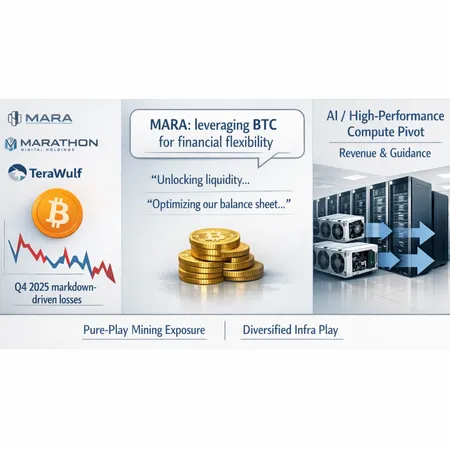
Investor perception will bifurcate along two axes: pure-play miners and diversified infrastructure operators.
Pure-play miners: Valuations remain tightly correlated with BTC price and hashprice. Large-scale treasury sales that reduce coin holdings can mute the leverage between mined coins and market upside — potentially lowering multiples for pure miners.
Diversified operators (AI/data centers + power): These firms may trade at a premium to pure miners if they can demonstrate predictable contract revenues, long-term PPAs, or capacity bookings. The shift toward AI workloads can justify higher enterprise multiples if revenue is sticky and margin profiles are attractive.
However, this re-rating is conditional. Investors will value the new business only if the company provides clarity on unit economics (capex per MW, expected utilization, PUE for AI workloads), contractual tenure (term length of PPAs or compute contracts), and the path to becoming a cash-generative operator. The market will discount announcements that lack execution detail or increase sovereign exposure without compensating returns.
For energy-sector strategists, miners-turned-cloud-builders can become strategic partners: offering load flexibility, investing in generation, or co-financing transmission upgrades. For institutional investors, the key diligence items include counterparty risk, regulatory exposure (e.g., permitting, environmental approvals), and the company’s treasury and hedging policies — particularly around miner BTC sales. Platforms such as Bitlet.app illustrate how the crypto ecosystem continues to create specialized trading and financing pathways that investors should monitor.
Ecosystem effects: suppliers, hosting providers and the secondary market
A capital shift toward AI/data centers will ripple through the supply chain:
- ASIC OEMs may see slower replacement cycles if firms pivot away from heavy hashing ROI models.
- Hosting providers can benefit from diversified workloads, but must invest in connectivity and cooling to support AI hardware (GPUs/accelerators) versus ASICs.
- Secondary markets for used ASICs may grow as firms repurpose sites — increasing availability of low-cost ASICs for smaller miners or hobbyists.
This evolution could also accelerate consolidation: traditional mining operators may sell to opportunistic buyers focused on pure hashing, while larger diversified players scale via M&A.
Practical checklist for institutional investors and energy strategists
- Model multiple treasury-sale scenarios (immediate lump-sum, phased OTC, structured debt) and stress-test BTC price impacts.
- Require transparency: insist miners disclose treasury policy, hedging program and capex milestones tied to planned sales.
- Assess jurisdictional risk: quantify geopolitical concentration and potential for sovereign renegotiation (e.g., Paraguay-style deals).
- Evaluate P&L and cashflow under an AI-data-center model: capex/MW, operating margin, PUE and contractual tenure.
- Monitor energy-market implications: PPAs, transmission needs and the loss of grid-flexible load if interrupted mining demand is replaced by firm data center consumption.
Conclusions: a new infrastructure narrative with trade-offs
Miners reallocating capital to AI/data centers or power is a logical extension of their asset-heavy business model. It offers the promise of smoother, contractable revenue and closer alignment with traditional infrastructure investors. But the transition is not neutral for markets: concentrated BTC sales used to fund capex can increase spot supply and volatility; energy systems will face a shift from flexible to more base-load demand; and host states — exemplified by Paraguay — will gain leverage in negotiations.
Institutional investors and energy strategists should treat this development as an opportunity to re-evaluate exposures: miners can become infrastructure companies worthy of different valuation paradigms, but only if they demonstrate credible execution, transparent treasury management and prudent handling of geopolitical risk.
Sources
- ZyCrypto — Core Scientific mulls 2,500 BTC sale to fund AI expansion: https://zycrypto.com/core-scientific-mulls-2500-bitcoin-sale-to-fund-ai-expansion/
- Cointelegraph — Situational Awareness LP scales equity exposure across power, data centers and Bitcoin miners: https://cointelegraph.com/news/situational-awareness-aschenbrenner-13f-ai-infrastructure-power-core-scientific?utm_source=rss_feed&utm_medium=rss&utm_campaign=rss_partner_inbound
- Bitcoinist — Paraguay first state-run Bitcoin mining exploration: https://bitcoinist.com/paraguay-first-state-run-bitcoin-mining/
For context on market structure and long-term implications, also watch developments in Bitcoin narratives and trading behavior.