How Mining Difficulty, Miner Monetization and Yield-Seeking Will Shape BTC Supply in 2026
Summary
Executive snapshot
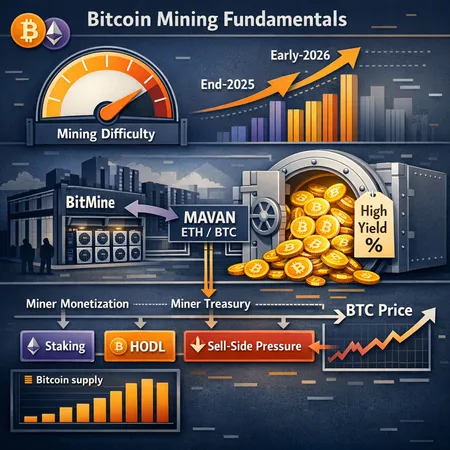
By the end of 2025 Bitcoin mining difficulty settled at ~148.2 trillion, a notable milestone that marks both technological progress and mounting cost pressure across the miner cohort. Higher difficulty means fewer coins mined per unit of hash power and, if BTC price and fees don't compensate, greater incentives to monetize holdings differently. This report ties that difficulty reading into two corporate stories — BitMine’s MAVAN pivot and Metaplanet’s yield tactics — and draws out practical scenarios for supply‑side behavior into 2026.
What the end‑of‑2025 difficulty number actually means
The headline figure — difficulty ≈ 148.2T — signals more total network hash power securing Bitcoin than most prior periods. TheNewsCrypto summarizes the closing 2025 reading and consensus forecasts that difficulty will remain elevated into 2026 (TheNewsCrypto difficulty report). Elevated difficulty has three immediate effects:
- Per‑block miner revenue pressure. If BTC price and fee income do not rise proportionally, miners’ BTC per TH/s falls, squeezing margins.
- Higher capital intensity. Smaller, older operations either upgrade or face attrition, concentrating hash with larger players.
- Reduced instantaneous supply growth. All else equal, more difficulty slows the rate at which each unit of deployed hash converts to liquid BTC on the market.
That last point is subtle: difficulty doesn't change the nominal block subsidy — 6.25 BTC per block post‑halving adjustments — but effective supply outflow depends on how many miners choose to sell vs hold. When miners earn less BTC per dollar of expense, their behavior (sell to cover costs, or tap treasury reserves) becomes the key determinant of available supply.
Early‑2026 difficulty scenarios
Forecasting the next few difficulty adjustments is part art, part instrumentation. Consider three plausible paths:
- Baseline (moderate upward drift, +5–15%). Continued ASIC deployments and institutional scale‑ups keep hash rate rising slowly. Miners invest to maintain margins; difficulty inches higher.
- Capitulation shock (flat or dropping difficulty). A sharp BTC price correction or power/capex shock forces mid‑tail operators offline; hash rate retreats and difficulty dips, temporarily increasing per‑hash rewards for survivors.
- Step‑function jump. Large corporate entrants or migrations of cloud/mining capacity (e.g., co‑location expansions) push difficulty up sharply, exacerbating short‑term revenue pressure for smaller miners.
Whichever path unfolds, the practical implication is this: miner monetization strategy becomes the lever that translates difficulty and hash rate into real BTC sold into spot markets.
Miner monetization: beyond spot sales
Historically, miners convert a large portion of their mined BTC into fiat shortly after receipt to cover operating costs. But two macro trends are changing the playbook:
- Treasury diversification and yield-seeking. Large operations are moving portions of their BTC into yield strategies or other protocols to generate operating cash without immediate spot sales.
- Product diversification (staking/validation). We're seeing miners morph into broader digital-asset infrastructure firms: running validators, offering custodial yield products, or even underwriting tokenized services.
BitMine's MAVAN and what validator products signal
BitMine's move to launch MAVAN, a validator/staking product backed by a multi‑billion dollar ETH treasury, is a striking example of miner diversification (BitMine MAVAN plan). Key takeaways for supply-side analysts:
- Cross‑protocol revenue smoothing. Staking ETH or running validators produces a relatively steady yield stream (denominated in ETH), which miners can convert to operational fiat or use to rebalance treasury exposures without selling BTC mined that week.
- Reduced mechanical sell pressure on BTC. If significant operating capital can be sourced from ETH yields, miners can afford to hold more mined BTC, at least temporarily, reducing immediate spot sell volumes.
- New liquidity vectors. Converting staking returns to fiat often requires swapping across assets (ETH → stablecoins → fiat) — that creates cross‑asset flow that may indirectly affect BTC liquidity through hedging, arbitrage, or paired OTC trades.
A subtle strategic effect: miners with large ETH treasuries can design their cash flow. They can sell ETH into BTC rallies, or cash out ETH yields when BTC is weak, thereby decoupling the weekly mined‑BTC → fiat pipeline that used to be the dominant supply pressure on BTC markets.
Metaplanet: outsized BTC yield and corporate treasury tactics
Metaplanet’s 2025 reporting shows aggressive yield-seeking on BTC holdings and a treasury approach that behaves more like a trading desk than a commodity operation (BeInCrypto on Metaplanet yield; The Block on Q4 holdings). What matters here:
- Yield as timing control. Corporates extracting yield from BTC (or from secondary activities) can delay spot sales because they can finance operations from yield streams, reducing the urgency to liquidate mined coins.
- Active rebalancing. Treasury teams may opportunistically convert yield into hedges or buybacks, creating episodic sell orders or buy orders that are not tied to mined output but to P&L management.
- Visibility and counterparty concentration. Public disclosures by corporates seed market expectations; large, coordinated treasury moves (e.g., selling BTC to raise cash for capex) can create outsized short‑term pressure.
Metaplanet’s example shows how a corporate miner with scale can act as a macro actor in BTC markets: not just a source of supply but an asset manager that times flows, hedges, and uses returns to engineer balance‑sheet outcomes.
Network health, centralization risk and fee dynamics
Rising difficulty and corporate concentration affect security and market mechanics:
- Security vs centralization. A higher hash rate generally improves security, but if hash consolidates into a few large players, the network’s political and operational risks shift. Researchers should watch regional concentration, miner ownership disclosures, and hosting profiles.
- Fee market implications. If miners hold more newly minted BTC and short‑term liquidity becomes scarce, transaction fee dynamics could tighten: fee volatility tends to increase during periods when block rewards are hoarded or when mempool congestion meets an active fee market.
- Capex cycles and orphan risk. Rapid hardware rollouts can create temporary orphan rates and unstable block propagation; these are short‑term health indicators worth tracking.
What this means for BTC supply and pricing pressure
Synthesizing the above, here are the practical supply‑side implications heading into 2026:
- Lower mechanical supply growth into spot is possible. If major miners finance operations via diversified yields (ETH staking, BTC yield strategies) they can reduce routine spot sales.
- Supply becomes more episodic and concentrated. Instead of steady daily miner selling, expect larger, less frequent institutional sales tied to treasury rebalancing, hedging events, or corporate liquidity needs.
- Cross‑asset flows will matter more. ETH denominated revenues (as with MAVAN) mean ETH market conditions can indirectly govern BTC sell behavior. Watch bridging, swaps, and OTC desks.
Practical signals and on‑chain metrics for analysts
If you’re assessing how miner behavior will actually translate to BTC liquidity, monitor these items closely:
- Miner coinbase spends and cluster flows. Aggregate coinbase outputs and the timing of spends, with attention to known corporate clusters.
- Exchange balances and inflows. Rising exchange BTC balances still correlate with sell pressure; diverging patterns between miner flows and exchange inflows are revealing.
- Hash rate and difficulty adjustments. Sharp falls in hash rate followed by difficulty drops point to capitulation and potential temporary supply surges as marginal operators liquidate.
- Treasury disclosures and on‑chain treasury movements. Large movements from cold storage to OTC counterparties or stablecoin rails are red flags for upcoming liquidity events.
- OTC and derivative volumes. Increased OTC desk activity and open interest in BTC futures/forwards often precede large treasury hedges or unwind events.
Use tools that combine on‑chain clustering with public corporate disclosures to map miner addresses and estimate how much mined BTC is sold vs re‑treasured. For retail and smaller institutions looking to dollar‑cost into BTC or access yield, platforms like Bitlet.app illustrate the growing ecosystem of services around installment and managed exposure — a reminder that market structure is evolving beyond simple spot flows.
Conclusion — scenarios and recommended watchlist
Higher difficulty and corporate-level yield strategies are reshaping miner economics. The net effect for BTC supply in early 2026 likely looks like less steady daily miner selling but larger, more concentrated liquidity events. Whether that supports price stability or increases volatility depends on: BTC spot price action, institutional treasury decisions, and how quickly miners convert non‑BTC yields into fiat.
Top items to watch this quarter:
- Coinbase spend rates for known miner clusters
- Exchange BTC balance trends vs miner sell volumes
- Announcements or SEC/regulatory filings from large miners
- Hash rate volatility around major difficulty adjustments
- Cross‑asset flows (ETH staking yields converted to fiat or BTC)
For on‑chain researchers, the actionable objective is to convert raw telemetry (spends, balances, difficulty) into probability‑weighted forecasts of supply events. Record the cadence and counterparty of large sells, and treat corporate miner disclosures as leading indicators rather than just PR.
Sources
- TheNewsCrypto — Bitcoin mining difficulty ends 2025 at 148.2 trillion: https://thenewscrypto.com/bitcoin-mining-difficulty-ends-2025-at-148-2-trillion/?utm_source=snapi
- TheNewsCrypto — BitMine to launch MAVAN backed by 12B Ethereum treasury: https://thenewscrypto.com/bitmine-to-launch-mavan-backed-by-12b-ethereum-treasury/?utm_source=snapi
- BeInCrypto — Metaplanet BTC yield record 2025: https://beincrypto.com/metaplanet-btc-yield-record-2025/
- The Block — Metaplanet Bitcoin Q4 2025 reporting: https://theblock.co/post/383950/metaplanet-bitcoin-q4-2025
For many traders, Bitcoin remains the primary bellwether but these supply dynamics mean the next moves may be driven as much by treasury engineers as by retail flows. For cross‑protocol context on staking and yield, see early narratives around DeFi.