Curve Finance Sees Record $29B Volume in Q3: Here's Why
Summary
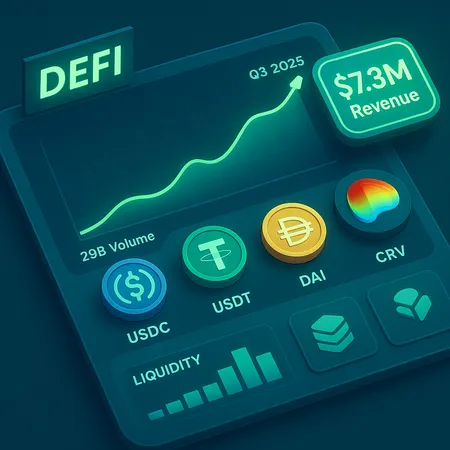
Curve Finance closed Q3 2025 with a striking performance: $29B in trading volume and a $7.3M revenue increase. That combination — heavy stablecoin flows plus deeper liquidity — underpinned Curve’s strongest quarter in recent memory. Market participants and liquidity providers are watching closely: higher fee income improves incentives, while the surge highlights Curve’s central role in low-slippage stablecoin swaps that power much of decentralized finance.
Market overview and context
Curve’s Q3 figures reflect both on-chain activity and real-world demand for stablecoin rails. The protocol has long been a go-to for traders and algorithms seeking minimized slippage between USD-pegged assets; in Q3 that use-case intensified. Arbitrage windows tightened, automated market makers routed larger trades to Curve pools, and aggregate liquidity increased enough to sustain bigger order flow without dramatic price impact. For token observers, the uptick in fee income also sends a signal about the health of the platform’s economic model.
Key drivers behind the volume surge
Several factors combined to push volume and revenue upward. First, renewed demand for stablecoins — both for on-chain settlements and DeFi yield — created persistent swap flow. Second, Curve’s expanding set of metapools and integrations with lending and yield protocols funneled more TVL into Curve-specific strategies. Third, macro conditions that encouraged on-chain capital rotation increased arbitrage and treasury management activity. Put simply: more capital chasing stable returns, plus deeper pools, equals higher throughput and fee capture.
What this means for CRV holders and the DeFi ecosystem
Stronger revenue translates into practical benefits for Curve stakeholders. Higher fees mean improved earnings for liquidity providers, which can reduce impermanent loss pressure and attract more TVL. For CRV tokenomics, rising protocol revenues and network activity can bolster governance relevance and long-term value propositions — though token price moves remain subject to broader market sentiment. The development also matters for the wider DeFi stack: efficient stablecoin rails on Curve help lending platforms, DEX aggregators, and yield strategies operate more smoothly, reinforcing composability across the blockchain ecosystem.
Risks and competitive outlook
Growth is positive, but competition and concentration risks persist. Other AMMs and stable-swap-focused protocols continue innovating on fee models and incentives, and regulatory scrutiny around stablecoins could influence future volumes. Additionally, if fees rise too far, trading behavior might migrate to lower-cost alternatives. Market participants should weigh these dynamics when considering exposure to CRV or when directing liquidity.
Takeaway
Curve’s Q3 performance — $29B in volume and $7.3M in revenue — reaffirms the protocol’s importance as a backbone for stablecoin liquidity in the crypto market. For traders, LPs, and governance voters, the result underscores why Curve remains central to many on-chain strategies. Platforms like Bitlet.app, which interact with DeFi rails and stablecoin flows, will likely benefit from the improved efficiency and depth that Curve provides as the ecosystem evolves.