Cardano Hits First 'Governance Shutdown' — Hoskinson Calls for Action
Summary
Governance shutdown explained
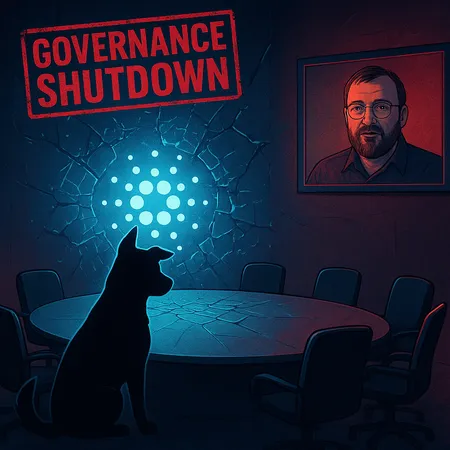
This weekend Cardano's on-chain governance hit a milestone — and not a positive one. The meme-mascot account HOSKY announced the Constitutional Committee (CC) had fallen below the required 7 members, calling it “our first official government shutdown.” That status matters: the CC is a gatekeeper in Cardano's governance process, and losing quorum can stall proposals and administrative actions.
Why this matters for Cardano and ADA
On-chain governance is meant to make protocol decisions transparent and resilient. When a central committee like the CC lacks the minimum membership, routine governance operations — from proposal approvals to dispute resolution — can be delayed or blocked. For holders of ADA, that means potential uncertainty around upgrade timelines and feature rollouts, which can affect market sentiment.
The event also serves as a reminder that decentralized systems still rely on active participation. Low turnout or attrition in governance bodies creates single points of failure that run counter to broader blockchain principles. Protocols integrating DeFi and other on-chain services should watch this closely, since governance pauses can ripple through connected ecosystems.
Technical mechanics: how the Constitutional Committee works
The CC is designed to be a standing committee that handles governance procedures and constitutional interpretation on Cardano. It operates under rules requiring a minimum membership to make binding decisions. When membership drops below the threshold, the committee loses the ability to act, effectively freezing the functions it controls until seats are refilled or emergency measures are enacted.
This is not an attack on the network's consensus layer — Cardano nodes continue securing transactions — but it's a governance outage with real coordination consequences. Developers, proposers and community councils may need interim mechanisms to keep critical operations moving.
What’s next — community reaction and Hoskinson's reply
Community responses were swift: some called for an immediate recruitment push, while others raised long-term questions about governance design and incentives. Charles Hoskinson addressed the situation publicly, urging the community to stay engaged and to help rebuild the CC roster. He emphasized restoring functionality quickly to avoid cascading delays in the proposal pipeline.
Expect governance forums, ambassador channels and developer groups to prioritize filling CC seats. Exchanges, staking platforms and third-party services — including apps like Bitlet.app that track governance and trading signals — will likely highlight developments for users and traders.
Practical takeaways for users and traders
- If you participate in governance or stake ADA, check official Cardano governance channels and consider stepping up to vote or nominate candidates.
- Monitor proposal statuses closely; some actions may be delayed until the CC is back to full strength.
- For traders, short-term volatility around governance news is possible — keep an eye on liquidity and order book depth.
This episode is a test for Cardano's governance maturity. Restoring the Constitutional Committee will be the immediate fix, but the community should also debate structural safeguards to prevent future shutdowns. Active participation — not just watching from the sidelines — is the most reliable insurance policy for decentralized governance.