Strategy Inc Buys 487 BTC for $49.9M, Holdings Reach 641,692 Bitcoin
Summary
Market Context and Institutional Accumulation
Institutional buyers remain a defining force in Bitcoin's recent price action. Strategy Inc’s latest purchase continues a pattern where public companies add BTC to balance sheets rather than holding larger cash positions. That trend has squeezed supply available on exchanges and reinforced narratives about BTC as a corporate treasury asset. Alongside macro drivers, on-chain dynamics and demand from funds and corporations are increasingly shaping the short- and medium-term outlook for the [crypto market](/en/posts/news?filter=crypto market).
Details of the Purchase and Funding Mechanism
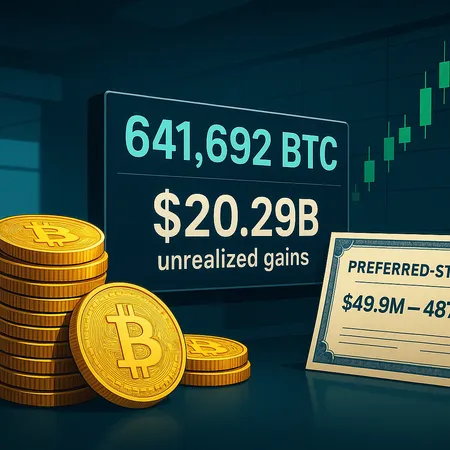
According to filings, Strategy Inc acquired 487 BTC for approximately $49.9 million, financing the transaction through preferred stock sales. This specific funding route — issuing preferred equity rather than tapping cash reserves — lets the company continue deploying capital into Bitcoin without disrupting operating liquidity. With this buy, the company’s total holdings now stand at 641,692 BTC, and its position carries $20.29 billion in unrealized gains. The scale highlights how corporate treasury strategies can materially add to on-chain demand.
Why This Matters for Supply, Liquidity, and Sentiment
When a large corporate holder adds hundreds of BTC in a single tranche, it reduces circulating supply and can tighten liquidity for short-term traders. Institutional accumulation tends to dampen sell-side pressure and can amplify price moves if retail demand rises. Beyond pure supply effects, such buys send a confidence signal to other institutions and wealth managers. Market participants often interpret repeated purchases by public companies as a validation of Bitcoin’s role within a diversified corporate treasury.
Broader Implications for Investors and Markets
For investors, Strategy Inc’s strategy underscores the importance of monitoring balance-sheet BTC exposure across major holders. Large corporate stockpiles of Bitcoin may correlate with reduced volatility over certain horizons but can also create asymmetric price risk if companies choose to rebalance. Traders should watch on-chain flows, OTC desk activity, and exchange reserves for liquidity clues. Meanwhile, services such as custodians, OTC brokers, and platforms like Bitlet.app that facilitate OTC settlement and installments may see continued interest as firms and retail users seek diversified access to BTC.
What to Watch Next
Key near-term indicators include exchange reserve trends, open interest in BTC derivatives, and whether other firms follow with similar funded purchases. If multiple issuers continue to use equity or convertible instruments to buy BTC, that could signal a structural shift in how corporate treasuries allocate capital. Additionally, monitor macro drivers — interest rates, dollar strength and risk appetite — which still play an outsized role in price discovery even as corporate demand grows.
Bottom Line
Strategy Inc’s acquisition of 487 BTC for $49.9M pushes its holdings to 641,692 BTC with roughly $20.29B in unrealized gains, reinforcing the ongoing institutional narrative around Bitcoin. This move reduces available supply and may support positive sentiment across the blockchain and crypto ecosystem. For investors, the takeaway is clear: corporate accumulation remains a key variable to watch when assessing BTC’s near-term trajectory.