Bitcoin Positioning: Options Traders Eye $80K as ETFs Flow — Balancing Bitwise Bulls with Cycle Risk
Summary
Executive snapshot
The options market, spot ETF flows, and institutional research are telling a story that feels both familiar and fraught: many market participants are pricing in a path higher, even as cycle indicators and macro noise warn that mean reversion remains a live risk. For active traders and options-focused investors, understanding how these forces interact is essential for sizing, hedging, and execution.
For many desks, Bitcoin is now moving at the intersection of capital flows (spot ETFs), derivatives positioning (options skew and OI), and macro/cycle signals that can accelerate either direction.
Evidence from the options market: upside skew toward $80K
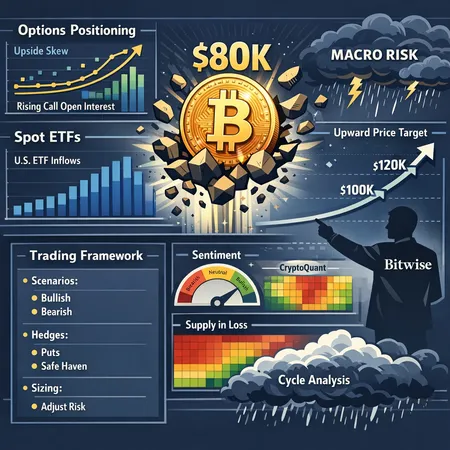
Recent options flow shows a persistent tilt toward calls and structures that pay off on a decisive move higher. Public reporting and market commentary highlight traders buying call spreads and directional calls struck well above current levels, a behavior often seen ahead of large breakouts or short squeezes. Analysis that tracks positioning suggests an increased willingness to pay for upside convexity around the $80K area rather than buying symmetric volatility protection.
Coinspeaker summarized how options traders are positioning for a break above $80,000, pointing to skew and concentrated open interest in higher strikes. That positioning manifests in a few repeatable patterns: elevated call open interest, risk reversals that favor calls over puts, and seller‑financed call spreads where traders sell nearer‑dated options to fund longer‑dated upside exposure. These actions reduce outright vega exposure while preserving upside participation — attractive when dealers hedge by buying spot BTC and delta-hedging into the move.
Key takeaways for traders:
- Look at call OI concentrations across expiries. Clusters near $80K–$100K signal collective upside bets. Prioritize expiries 1–3 months for breakout plays and 3–9 months for conviction views.
- Compare risk reversals: when the implied price for calls is higher than puts at similar deltas, the market is paying up for upside. That’s an actionable cue for synthetic bullish structures.
- Watch implied vs realized volatility. If IV across calls is rich relative to realized moves, selling premium via defined‑risk spreads may be better than buying naked calls.
Spot ETF inflows: the structural bid
US spot ETF inflows have become a dominant narrative for price support. Institutional demand via ETFs creates a mechanical need to purchase BTC on creation days, effectively converting dollar inflows into long‑dated physical demand. Industry reporting highlights consistent inflows into US spot ETFs, which buoy long‑term liquidity and limit available sell pressure from some market segments.
Cointelegraph recently covered how ETF inflows are shaping market dynamics and contributing to a supportive price backdrop. The practical effect is straightforward: ETFs compress free float and create a predictable demand profile that can fuel momentum if sentiment and derivatives positioning align.
Why this matters for options traders:
- Dealer hedging of ETF-driven buys can add delta into the market, amplifying upside when options positioning is already skewed to calls.
- ETF bids tend to be persistent, not flash‑in‑the‑pan; they change the supply/demand matrix and therefore option premia across maturities.
The Bitwise long‑term thesis: institutional adoption and a path higher
Bitwise and other institutional managers articulate a multi‑decade bull case rooted in scarcity, adoption, and portfolio allocation. Bitwise’s commentary on Bitcoin’s trajectory outlines how incremental institutional adoption, combined with capped supply and product innovation (like spot ETFs), can compound into significantly higher long‑term price levels.
The practical implication is a risk‑on scenario where ETFs, corporate treasuries, and sovereign allocations reduce market float and push valuation multiples higher over years. Bitwise frames the “path” as gradual but accelerating: steady inflows, rising treasury and corporate adoption, and greater retail access via regulated products. This structural narrative supports the rationale for buying convex upside exposure with longer‑dated options.
See Bitwise’s perspective on the long‑term path and institutional view for more detail.
Cycle and macro counterarguments: why caution still fits
Not all signals are aligned with the bullish story. Cycle analysts and on‑chain metrics flag distribution risk, rising supply in loss positions, and a “frustrating” phase where price grinds and fails to trend sustainably. CryptoQuant’s analysis described the current cycle phase as particularly frustrating, highlighting stress points that often precede larger drawdowns.
Specific concerns worth weighing:
- Rising supply in loss positions: when a larger share of holders are underwater, selling pressure can spike if macro conditions deteriorate or if long-term holders capitulate.
- Cycle friction points: historical cycles show periods where momentum stalls despite positive fundamentals; those phases can last months and erode leverage-driven bullish positions.
- Macro environment: rates, liquidity conditions, and risk appetite still matter. A hawkish surprise from global central banks can suck risk premia out of speculative assets quickly.
These elements argue for protecting upside exposure with hedges and for avoiding oversized directional bets that assume a smooth ascent to new highs.
A balanced trading framework: scenarios, hedges, and sizing
Below is a pragmatic framework tailored to options‑savvy investors evaluating risk/reward around a potential BTC breakout.
Scenario A — Breakout and sustained leg‑up (bull case)
Indicative view: Price convincingly clears $80K with follow‑through into $90K–$100K within 1–3 months. Drivers: ETF flows, short gamma in derivatives, positive macro surprise.
Tactics:
- Core trade: buy a vertical call spread (e.g., 80K–100K) 2–4 months out to cap cost while keeping upside convexity.
- Leverage: consider buying 1/2 to 2/3 of your intended exposure in a longer-dated call spread and layering nearer‑dated call spreads to capture momentum.
- Funding: sell shorter‑dated OTM calls or call calendars to reduce premium if you expect a measured rally.
Sizing: keep bullish option exposure to a limited fraction of portfolio risk capital (e.g., 2–5%), increasing only with realized breakout confirmation.
Scenario B — Fakeout and mean reversion (bearish/mean case)
Indicative view: Price spikes above $80K but fails to hold, reverting to $60K–$70K amid profit‑taking and volatility. Drivers: liquidation induced squeeze, capitulation by retail or macro shock.
Tactics:
- Hedging: buy protective puts (60K–70K strikes) when initiating or scaling bullish positions. A cheaper alternative is to buy a put spread to limit cost.
- Volatility play: if IV pops on the fakeout, sell premium via iron condors or put spreads below support levels.
Sizing: maintain put hedge size at 25–50% of your bullish option delta exposure to avoid margin stress while keeping downside protection.
Scenario C — Grind sideways (low conviction)
Indicative view: BTC trades rangebound between 65K–80K for months. Drivers: mixed flow, macro uncertainty, distribution.
Tactics:
- Income strategies: sell covered calls or short iron condors around range extremes, being mindful of tail risk.
- Collars: pair long spot or long-dated calls with short‑dated calls to fund protective puts.
Sizing: prioritize capital preservation; treat income strategies as yield enhancement on a core HODL or long‑dated options position.
Practical execution checklist for options traders
- Strike selection: anchor to key technical levels and option skew clusters (e.g., $80K). Avoid picks purely on round numbers without volume.
- Expiry laddering: stagger expiries to avoid placing all vega risk into one calendar point; use 1–3mo for tactical, 6–12mo for conviction.
- Hedging cadence: enter protective hedges when implied volatility cheapens relative to realized volatility; scale hedges into adverse moves rather than timing tops.
- Position sizing: cap directional option exposure to a small share of liquid net worth; consider notional equivalence (futures) when translating option delta into portfolio risk.
- Liquidity and execution: use limit orders for large blocks, prefer exchange‑listed options where available, and monitor dealer flows that can widen spreads during high volatility.
Platforms that combine derivatives execution with OTC and P2P options settlement (such as those in the Bitlet.app ecosystem) can help with granular sizing and hedging strategies, but execution costs and counterparty terms should be checked.
Conclusion — weigh flow, not just thesis
The current market shows a meaningful tilt toward upside: options positioning signals, coupled with steady spot ETF inflows, create an environment where a vigorous breakout is a credible scenario. Yet cycle analysis and macro fragility are real and historically capable of turning an orderly rally into a sharp unwind. For active investors and options traders, the right posture is neither full‑on risk nor blanket pessimism — it is scenario planning, disciplined sizing, and dynamic hedging.
If you expect a sustained regime change, buy convexity with defined risk (call spreads, long‑dated calls). If you respect the cycle warnings, prioritize hedges and income strategies that protect capital while letting a winning breakout be monetized. Either way, let flows (ETF creations, options skew, dealer hedging) guide execution — they are the practical engine of short‑term BTC moves.
Sources
- Analysis of Bitcoin options traders positioning for a break above $80,000 — Coinspeaker
- US spot Bitcoin ETF inflows and market impact — Cointelegraph
- Bitwise commentary on Bitcoin's long‑term path to $1 million — Bitcoinist
- CryptoQuant analysis calling Bitcoin's current phase 'most frustrating' — U.Today