USSD and the New Era of On‑Chain Stablecoins: A Treasury Playbook
Summary
Why USSD matters for treasuries and builders
Sonic Labs’ announcement of USSD — described as a permissionless, dollar‑pegged token built on Frax infrastructure and backed by BlackRock and Frax infrastructure — has set off fresh debate about where the next wave of on‑chain dollars will come from and who should use them. The launch signals two converging trends: incumbent institutional interest in programmable dollars, and a proliferation of protocol‑native designs that aim to be more composable within DeFi stacks. See the original launch reporting for the details on the partnership and design choices: Sonic Labs launches USSD.
For corporate treasurers and DeFi builders, the question is not only whether USSD is credible, but how its design differs from established choices such as USDC and FRAX — and what that means for settlement, on‑chain liquidity, and risk management. The broader market context matters: institutional adoption of on‑chain dollars continues to accelerate, with analysts pointing to expanding payments and enterprise use cases as drivers of demand for programmable USD rails (see Bernstein’s analysis of Circle/USDC adoption trends and institutional momentum: Bernstein sees 70% upside for Circle as stablecoin adoption expands).
Core design tradeoffs: permissionless vs. custodial issuance
Permissionless, protocol‑native stablecoins (the USSD pitch) and custodial issuer models (USDC) trade off different risks.
Issuer/custody risk: USDC is issued by Circle (a centralized issuer) with established banking and reserve reporting. That creates an identifiable counterparty and off‑chain redemption path. By contrast, permissionless minting models move counterparty risk on‑chain — typically to collateral pools, algorithmic mechanisms, or a decentralized collateral manager. That reduces reliance on a single banking counterparty but introduces protocol and oracle risks.
Regulatory posture: Centralized issuers can more easily offer compliance controls and KYC'd redemptions, which matters when treasuries need fiat settlement. Permissionless designs can be harder to reconcile with enterprise KYC/AML workflows, though hybrid approaches (on‑chain settlement + off‑chain fiat rails) may emerge.
Liquidity and settlement speed: Centralized stablecoins benefit from wide exchange and fiat on‑ramp coverage; permissionless tokens can settle on‑chain instantly and composably but may require additional steps (bridges, liquidity pools) for fiat off‑ramp.
For treasuries that require predictable fiat redemption, the tradeoff often leans toward assets with explicit, auditable reserve and redemption mechanisms. For DeFi builders prioritizing composability, permissionless on‑chain stablecoins reduce friction and allow native integration into lending, AMMs, and automated treasury strategies.
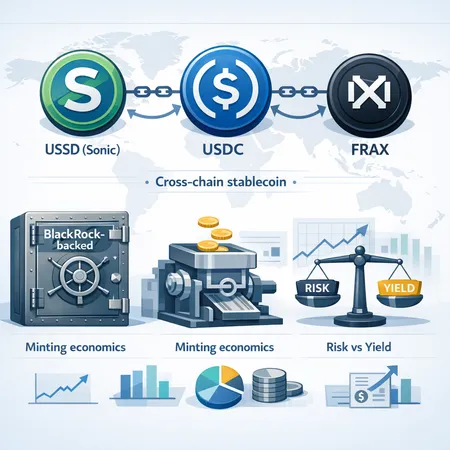
Minting economics and seigniorage: what changes with USSD
How a stablecoin is minted matters for who captures value, how supply grows, and how peg stability is maintained.
Fee capture and seigniorage: Protocol designs can route minting/burning fees to a governance token (e.g., an S token) or to a protocol treasury. That matters for token economics: if seigniorage accrues to holders or the protocol, there is an incentive to bootstrap liquidity and reward market makers. Treasuries should ask: who benefits from issuance fees and does that create conflicts with my objective of capital preservation?
Collateral composition and haircuts: Permissionless systems often accept a mix of on‑chain collateral (other stablecoins, tokenized assets) with algorithmic mechanisms to manage haircuts. Collateral concentration risk — for example heavy reliance on FRAX or another single protocol — increases protocol contagion risk.
Slippage and mint/burn friction: On busy chains, mint/burn transactions can be expensive due to gas and liquidity depth. Compare that to custodial redemptions on centralized rails where off‑chain settlement costs may be lower per unit despite banking fees.
Sonic's use of Frax infrastructure suggests it will inherit some composability and minting primitives similar to FRAX, but treasuries must validate the exact mechanics (collateral types, mint fees, redemption rights) in technical and legal diligence before any allocation.
Network compatibility and cross‑chain access: fragmentation vs. reach
Cross‑chain access is a double‑edged sword: more chains = more utility, but also more fragmentation and bridging risk.
Native multi‑chain deployment: If USSD launches across several L1s/L2s, treasuries gain flexibility to settle where their counterparties prefer. However, liquidity will likely be concentrated on a few hub chains initially, and on‑chain depth can vary wildly.
Bridging and canonical vs. wrapped assets: Bridged or wrapped versions of the same USD token introduce trust layers (bridge custodians or smart‑contract guarantees). For settlement, a canonical token on a target chain is preferable; for cross‑chain liquidity, reliable bridges and liquidity providers matter. Treasuries should require clear documentation on canonicality and bridge security.
UX and gas economics: The real cost of using a stablecoin across chains includes gas, bridge fees, and DEX slippage. For high‑frequency settlement use cases, those costs can outweigh token level price stability.
DeFi builders will appreciate permissionless, chain‑native stablecoins for composability. Treasuries often need to balance that with the predictability and fiat rails that centralized issuers provide — a hybrid model, keeping on‑chain settlement assets and reserving a larger fiat buffer off‑chain, is common.
Comparing USSD, USDC, and FRAX in practical terms
- USDC: Deep liquidity, predictable fiat on‑ramp/off‑ramp, strong institutional adoption and compliance features. Preferred for corporate settlement and large redemptions where bank rails matter.
- FRAX: Protocol‑native approach with algorithmic/over‑collateralized mechanics. Highly composable in DeFi, with distinct collateral dynamics and governance‑driven incentives.
- USSD (Sonic): A hybrid promise — permissionless on‑chain minting and Frax composability combined with reported backing/support from an institutional partner like BlackRock. If the backing includes infrastructure or liquidity commitments (as reported), USSD could occupy a middle ground: more enterprise confidence than purely algorithmic tokens, and greater on‑chain openness than custodial issuers. Verify the nature of any “backing” in legal terms before relying on it.
Operational checklist for treasury managers (step‑by‑step)
- Legal & Compliance Review: Confirm whether the token’s minting/redemption process is compatible with KYC, AML, and your jurisdictional limits. Ask legal to interpret any “backing” claims.
- Reserve and Audit Transparency: Require audited reserve attestations and real‑time reporting where possible. Compare frequency and scope against Circle/USDC disclosures.
- Redemption Testing: Do a staged redemption test — small amounts first, multiple times, across rails and chains you intend to use.
- Custody & Access Controls: Use segregated custodial controls and multisig for hot wallets holding new stablecoins. Ensure Bitlet.app or other platform integrations are vetted for custody practices.
- Integration Sandbox: Integrate in a sandbox environment, test peg behavior under stress (e.g., DEX drains, bridging outages) and measure slippage and settlement times.
- Exposure Limits: Set hard exposure limits by counterparty, protocol, and chain. Consider time‑based caps for new token allocations (e.g., pilot 1–3 months before increasing exposure).
- Monitoring & Oracles: Deploy real‑time monitoring, price oracles, and on‑chain dashboards to detect peg deviation, reserve drops, or unusual minting/burning activity.
- Contingency Plan: Document exit and escalation procedures for prolonged peg divergence or bridge failures — include fiat settlement fallbacks.
A pragmatic allocation framework
For treasuries that need both operational fiat rails and on‑chain utility, consider a layered approach:
- Core reserve (settlement backbone): 60–80% in a large, regulated issuer (USDC or equivalent) for predictable off‑chain redemption.
- Operational liquidity: 10–30% in permissionless, highly composable stablecoins (FRAX, USSD pilot) used for programmatic payouts, AMM liquidity provisioning, and on‑chain settlements.
- Experimental bucket: 0–10% in newly launched tokens to evaluate integration and opportunities; rotate exposure based on audits, maturity, and proofs of backing.
Adjust weights for treasury size, jurisdictional constraints, and counterparty limits. Small treasuries may prefer heavier USDC allocations until new entrants demonstrate sustainment and audit transparency.
Final considerations and next steps
New entrants like USSD change the calculus by promising the best of both worlds: composability and institutional support. But the devil is in the details — the exact legal backing, mint/burn mechanics, reserve composition, and bridge architecture determine whether a token is suitable for corporate treasuries.
Before integrating USSD or similar tokens, insist on clear documentation, frequent attestations, and operational testing. DeFi builders should map liquidity paths and router implications; treasurers should prioritize redemption certainty and regulatory alignment. As the market evolves, platforms such as Bitlet.app that integrate multiple USD tokens can help treasuries route settlement to the most efficient rail, but internal controls and legal review remain the gatekeepers.
Sources
- Sonic Labs launches USSD: a network‑native USD stablecoin backed by BlackRock and Frax infrastructure — https://blockonomi.com/sonic-labs-launches-ussd-a-network-native-usd-stablecoin-backed-by-blackrock-and-frax-infrastructure/
- Bernstein sees 70% upside for Circle as stablecoin adoption expands across payments and AI — https://www.theblock.co/post/392962/bernstein-sees-70-upside-for-circle-as-stablecoin-adoption-expands-across-payments-and-ai
For further reading on how protocol design impacts treasury integration, see discussions in DeFi and the broader literature on Stablecoin.