STRC Explained: How Strategy’s Record Equity Issuance and Omnibus Sales Change Bitcoin Treasury Risk
Summary
Quick primer: what is STRC and why it matters now
STRC is Strategy’s tracking-equity vehicle designed to give public investors a security whose economics are tied to the company’s Bitcoin exposure without changing the parent company’s capital structure in the same way as direct share dilution. In plain terms, STRC allows investors to express a view on Strategy’s BTC-centric treasury strategy through a designated equity instrument. That design makes STRC a market-facing lever on top of an already large corporate BTC stash — and with Strategy reporting record STRC issuance, the lever just got visibly heavier. For many traders, Bitcoin remains the primary market bellwether, and any corporate instrument that amplifies flows into or out of a concentrated BTC treasury deserves careful scrutiny because corporate flows can be large relative to regular spot market liquidity.
How STRC mechanics work (high level, with legal and market contours)
STRC functions as a tracking stock: its economic performance is linked to a defined asset or business segment — in this case, Strategy’s BTC-related economics. Unlike a direct claim on BTC, holders of STRC own equity whose value is intended to move with the underlying exposure but is governed by corporate charters and disclosure rather than by custodial ownership of specific coins. That distinction matters: rights on a balance-sheet line item or a tracking equity are legally different from ownership of the private keys.
From a market mechanics perspective, when Strategy issues STRC shares, it increases the supply of publicly tradable instruments tied to its BTC exposure. Issuance proceeds can be used for corporate purposes (including, theoretically, to buy more BTC) or for general corporate financing. Whether issuance is dilutive to legacy shareholders or neutral depends on the instrument design, the parent’s accounting and the use of proceeds — but in every case, issuance increases the potential channels for investor flows to interact with the company’s underlying BTC position.
The Omnibus Sales Agreement change: multiple agents now permitted
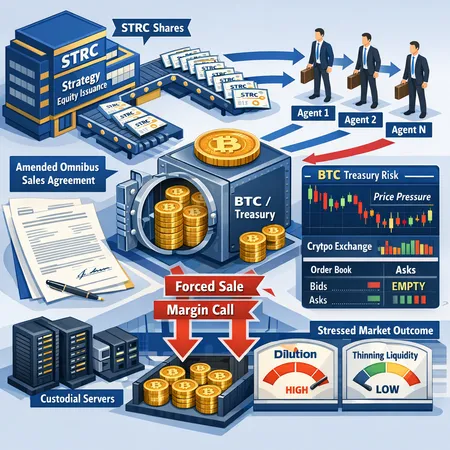
A recent filing shows Strategy amended its Omnibus Sales Agreement to allow multiple agents to sell STRC in the secondary market, and the company logged record STRC issuance on that same day. Allowing multiple selling agents is operationally significant: instead of a single broker-dealer coordinating placements and block trades, multiple agents can offer inventory and execute sales concurrently. That typically increases available distribution capacity and can speed execution during high-demand windows.
Faster, broader sell-side capacity is a double-edged sword. On the one hand, multiple agents improve liquidity and price discovery — retail and institutional buyers can more readily find counterparties, which can tighten spreads and reduce execution friction. On the other hand, in a stressed market, having many agents authorized to sell can multiply the channels through which a liquidity cascade propagates: coordinated or simultaneous selling—whether driven by hedgers, short-covering, or market makers adjusting inventory—can move STRC prices materially in compressed timeframes.
Why record STRC issuance now changes the math
Issuance matters in three linked ways: supply-side pressure, potential use of proceeds, and signaling. First, record issuance clearly enlarges the floating supply of STRC, which can depress the security’s price if demand doesn’t keep pace. Second, the way Strategy uses proceeds matters for BTC exposure: proceeds might be used to buy BTC (increasing the treasury), to repay debt, or to fund operations — each path shifts counterparty risk and balance-sheet leverage differently. Third, large, rapid issuance is a signal to markets about management’s financing preferences and appetite for expanding market-facing instruments tied to BTC.
Reports noting Strategy’s continued BTC purchases alongside financing and new issuance underscore the interplay between corporate accumulation and financing instruments. As coverage in the media has put it, these actions aren’t happening in isolation — issuance and financing flow into one another, changing the company’s risk profile in aggregate. See recent reporting for contemporaneous context on issuance and corporate accumulation trends, which matter when sizing potential market impact under stress.
How multiple-agent selling changes liquidity and dilution dynamics
Practically, multiple-agent selling alters two core dynamics:
Execution velocity: More agents mean a higher aggregate capacity to sell large blocks quickly. During normal markets this helps absorb demand; during tight markets it can exacerbate downward pressure as orders disperse across desks that may be independently managing inventory or hedges.
Market microstructure and hedging: Market makers and institutional desks often hedge STRC exposure by trading BTC or BTC derivatives. If several agents flood the market, hedging flows (selling spot BTC, increasing short futures exposure) can be larger and faster. That hedging creates a transmission channel from STRC equity stress into spot and derivative BTC markets.
Dilution dynamics are subtler. Issuing new STRC shares increases the pool of claims that track BTC economics; whether that dilutes existing STRC holders depends on whether the instrument includes rebalancing or conversion features, which are governed by corporate documents. But dilution for legacy Strategy common shareholders can be more direct if STRC issuance reallocates economic exposure away from the parent or funds treasury operations in ways that change ownership economics.
Forced-sale pathways: how a hit to STRC could reach Strategy’s BTC treasury
This is the heart of the current debate. Skeptics like Peter Schiff argue that STRC could create a vulnerability that leads to forced BTC liquidations. That outcome is possible in specific configurations where financing and collateral arrangements tie Strategy’s BTC holdings to market or balance-sheet metrics that move sharply during STRC stress.
Mechanically, a few plausible chains can link an STRC price collapse to BTC sales:
Counterparty margin and covenant cascades: If Strategy or a financing lender uses the parent’s equity value or related metrics as covenant triggers (for loans taken to buy BTC), a severe drop in market appetite for STRC could be reflected in consolidated equity metrics. That in turn could trigger covenants, forcing the company to sell assets — including BTC — to restore ratios or repay loans.
Hedging-induced feedback loops: Market makers or authorized agents hedging STRC exposure might sell spot BTC or increase short futures positions. If these hedging flows are large relative to liquidity, they push BTC prices down, inflicting mark-to-market losses on Strategy’s BTC holdings and possibly triggering margin calls on any leveraged positions.
Direct secured financing tied to STRC inventory: If Strategy or affiliates pledge STRC or related receivables as collateral for financing, a rapid price decline could cause lenders to demand additional collateral or liquidate pledged securities, further driving downside.
Each path is conditional. The link from STRC price movement to forced sale is not automatic; it requires specific contractual linkages, leverage, or reliance on short-term funding that demands rapid balance-sheet repair. Critics emphasize those conditionalities, and the market should treat the scenario seriously while also mapping the exact contractual contours before declaring inevitability. For an example of the criticism and the forced-sale argument, see this commentary.
Custodial and market outcomes under stress: scenarios to model
When stress hits, custody arrangements and market depth become central. Consider three stylized scenarios:
Mild stress: STRC price falls modestly, authorized agents step in to provide liquidity, hedging flows are absorbed by derivatives markets, and Strategy’s BTC position remains intact. Market makers widen spreads, but there’s no material corporate sell-off.
Severe but orderly stress: Rapid STRC issuance and multi-agent selling cause significant downstream hedging in derivatives markets. BTC price falls materially; Strategy posts collateral or taps liquidity facilities to meet shortfalls. The company reduces noncritical spending and may pause further BTC purchases while avoiding fire sales by negotiating amendments with lenders.
Disorderly cascade: STRC suffers a steep price collapse, multiple agents sell concurrently, and hedging flows overwhelm market depth. Mark-to-market losses on Strategy’s BTC holdings trigger covenant breaches or margin calls. If lenders insist on remediation and the company lacks enough cash or unencumbered assets, Strategy could be pushed into selling spot BTC into thin markets, amplifying losses and producing a self-reinforcing loop.
Custodial arrangements matter in the severe scenarios. If BTC is held under standard custody with no immediate contractual right for custodians to liquidate in a parent’s financing distress, forced sales would come from Strategy’s own executed sell orders or from lenders who hold liquidation rights over pledged assets. If, however, some BTC is used as direct collateral under agreements with recall or sale rights for counterparties, the probability of forced liquidation increases. Public filings and collateral schedules are therefore critical documents to audit.
What to watch next — practical indicators for analysts and risk managers
To assess near-term tail risk and ongoing exposure, analysts should track:
Issuance cadence and agent appointments: More frequent or larger STRC issuances and the roster of selling agents are leading indicators of distribution pressure.
Use-of-proceeds disclosures: Are proceeds funding new BTC buys, paying debt, or general corporate purposes? The choice changes the balance-sheet leverage picture.
Financing covenants and collateral schedules in lending agreements: These determine whether equity moves can mechanically force asset sales.
Hedging flows and derivatives positioning: Look for spikes in futures open interest, basis moves, or large options flows that correlate with STRC moves.
Custody terms and pledge arrangements: Publicly disclosed custody and any asset-back pledge details reveal whether custodians or lenders have rights that could accelerate liquidation.
Tracking these variables — plus basic market liquidity metrics for BTC at common execution sizes — will let investors convert conjecture into quantified scenarios.
Balancing critique and probability: Peter Schiff’s warning in context
Peter Schiff’s critique is a valuable stress-test: it highlights a non-obvious transmission channel from equity-derivative instruments to corporate treasury dynamics. The scenario he describes is plausible under specific contractual and leverage conditions. But plausibility is not inevitability. The likelihood of a forced-sale cascade depends on the concrete legal rights embedded in Strategy’s financing, the scale and speed of STRC selling, and whether counterparties rigidly enforce remedial actions or prefer negotiated cures.
Investors should treat the critique as a prompt to examine filings and counterparties, not as a binary prediction. In other words: map the contract chains, model the balance-sheet elasticity, and stress test with realistic market-impact assumptions rather than assuming an immediate collapse.
Risk mitigation and how Strategy (and investors) can reduce tail risk
Several practical steps can reduce systemic vulnerability:
Conservatively structured financing: Avoid short-term covenants tied tightly to market prices of related tracking securities.
Transparent collateral reporting: Clear disclosure of which assets are unencumbered helps markets price the company’s stress resilience.
Staged issuance and lockups: Limiting how many STRC can be sold immediately or staggering agent sell windows reduces execution velocity risk.
Active hedging and liquidity buffers: Keeping committed liquidity lines or stablecoin buffers can help bridge shortfalls without forcing spot BTC sales.
These are standard balance-sheet hygiene items, and their presence or absence will materially change the odds of a forced-sale outcome.
Conclusion — how investors should think about STRC, issuance, and BTC treasury risk
STRC introduces new plumbing between public markets and a large corporate BTC treasury. The recent record issuance and the amended Omnibus Sales Agreement that permits multiple selling agents materially change execution and distribution dynamics: they can improve liquidity in ordinary times but also open more rapid channels for stress to travel from equity desks into spot and derivatives markets.
The forced-sale scenarios critics warn about are real possibilities in particular contractual and leverage configurations, but they are not automatic. The right way to respond as an analyst is to move from narrative to contract-level analysis: read the financing covenants, inspect custody and pledge language, model market-impact for plausible sell programs, and monitor agent behavior and hedging flows in real time. That approach turns alarm into actionable risk assessment.
For practitioners who monitor corporate treasury strategies across blockchains and public markets, this episode is a reminder that corporate innovation in the crypto era — whether tracking stocks, convertible instruments, or tokenized receipts — changes not only balance sheets but market microstructure. Platforms and services such as Bitlet.app follow these developments because corporate flows increasingly matter to on-chain and off-chain liquidity alike.
Sources
Strategy logs record STRC equity issuance and amended Omnibus Sales Agreement: Coindesk coverage of record STRC issuance and amended Omnibus Sales Agreement
Critical commentary arguing STRC could create a vulnerability and possibly trigger forced BTC liquidations: U.Today commentary on Peter Schiff’s forced-sale thesis
Context on Strategy’s continued BTC purchases and how corporate accumulation interacts with financing instruments: Invezz analysis of Bitcoin price movement and Strategy purchases