Ripple's AFSL Play: How the BC Payments Deal Could Supercharge XRP Adoption Across APAC
Summary
Executive summary
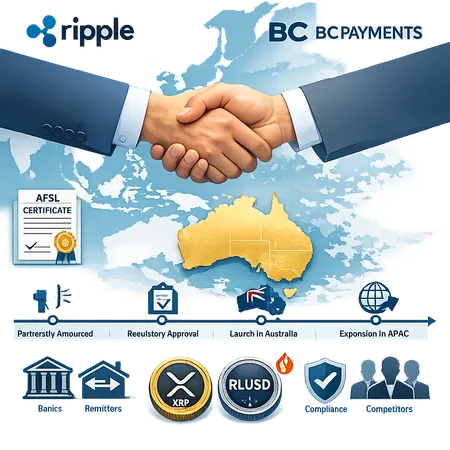
Ripple's announcement that it intends to obtain an Australian Financial Services License through the proposed acquisition of BC Payments Australia is more than a regional expansion — it is a calculated regulatory play to make XRP and Ripple's payments stack more palatable to banks and regulated remitters across APAC. The deal short‑circuits some of the legal and compliance questions counterparties raise, and could unlock on‑ramps, custody and fiat rails that have been bottlenecks for tokenized cross‑border payments. At the same time, active RLUSD management (including a recent 10,000,000‑coin burn) shows Ripple is tightening control over stablecoin liquidity as it scales.
The BC Payments acquisition: mechanics and timeline
Ripple disclosed its intention to acquire BC Payments Australia in March 2026, a transaction framed explicitly as a route to secure an AFSL and speed regulatory approvals in the region (Cryptonomist announcement). Reporting suggests the move is part of a broader licensing push across APAC — a pattern Ripple has followed elsewhere by partnering with or acquiring locally licensed entities to provide regulated rails more quickly (ZyCrypto coverage; TheNewsCrypto overview).
Operationally, the acquisition would transfer BC Payments’ existing corporate structure, banking relationships and regulatory filings to Ripple’s controlled entity, followed by a period of integration and ASIC (Australian Securities & Investments Commission) review. Realistically, expect a 6–12 month window for transactional close, regulatory notifications and implementation of compliance frameworks — shorter if regulators treat the deal as a change‑of‑control for an already‑licensed business, longer if significant remediation or capital adequacy work is required.
Why Australia matters for Ripple’s APAC roadmap
Australia is more than a large economy; it is a regional payments hub with strong correspondent banking links, stable financial infrastructure and clear regulator dialog. Securing an AFSL establishes a credible onshore presence that serves three strategic purposes:
- Regulatory certainty: An AFSL offers a recognized compliance framework under ASIC that banks and licensed remitters can evaluate more easily than an offshore or unlicensed provider. That credibility reduces legal and counterparty risk assessments.
- Market access: From Sydney or Melbourne, Ripple can service flows to Southeast Asia, New Zealand and Pacific Island remittance corridors with local banking partners and fiat on‑ramps.
- Commercial signaling: Having an AFSL can be a persuasive commercial argument when negotiating bilateral integrations with banks, PSPs and government treasuries seeking accountable providers.
In short, Australia functions as a gateway to APAC corridors where legacy correspondent networks have become costly or slow — a place where tokenized rails can demonstrate time‑to‑settlement and FX efficiencies.
How an AFSL changes compliance and on‑ramps for banks and remitters
An AFSL will not magically eliminate due diligence, but it reshapes the compliance conversation:
- Easier counterparty underwriting: Banks and remitters can rely on ASIC‑licensed oversight, making contractual and operational risk models easier to reconcile.
- Clearer custody and safekeeping treatments: An AFSL enables onshore governance around custody, segregated client accounts and auditability — elements essential for institutional acceptance.
- Improved AML/KYC posture: ASIC oversight means Ripple would operate to locally accepted AML/CTF standards, simplifying integration for remitters who must meet the same rules.
- Enhanced fiat settlement options: With a licensed Australian vehicle and existing banking relationships, Ripple can offer more predictable fiat rails and settlement windows, which matters for treasury and liquidity managers.
For payments executives, the practical upshot is this: partnering with a licensed Ripple entity reduces legal friction and accelerates pilot timetables because counterparties can map Ripple’s controls to their own regulatory obligations.
Competitive responses: incumbents and other crypto firms
Expect three broad reactions from incumbents and crypto competitors:
- Defensive partnerships and lobbying. Large Australian banks and payments incumbents may accelerate partnerships with regulated crypto firms or lobby for tightened rules that raise barriers to entry. That could slow or shape rollout timelines.
- License chasing. Competitors (global exchanges, stablecoin issuers and other blockchain payments firms) may pursue similar acquisitions or local licenses to maintain commercial parity. The public reporting around Ripple’s move suggests such a pattern (TheNewsCrypto analysis).
- Product differentiation. Firms will emphasize privacy, liquidity or integration breadth — for example, broad stablecoin pools vs. single‑ledger rails. Some players will double down on SWIFT gpi integrations or card rails as hybrid alternatives to tokenized settlement.
For traditional PSPs and banks, the near‑term choice is whether to partner, build or block. Partnering with licensed crypto rails can be the fastest route to product differentiation; building an in‑house rail is costlier and slower.
Implications for XRP utility and RLUSD management
The proposal has two direct token implications:
XRP utility: If AFSL status reduces integration friction, demand for XRP as a settlement asset in corridors could rise. Banks and remitters often choose rails they can operationalize rapidly; an AFSL makes XRP more operationally credible as a settlement bridge currency. For treasury teams evaluating token rails, XRP therefore becomes a practical, not merely theoretical, option.
RLUSD dynamics: Ripple’s recent record burn of 10,000,000 RLUSD tokens signals active peg and liquidity management (U.Today coverage of RLUSD burn). Burning stablecoin supply can tighten liquidity to support a peg when on‑chain demand spikes, or it can be a balance‑sheet step during program recalibration. For payments businesses, two points matter: (1) a smaller, actively managed RLUSD supply can improve confidence in peg maintenance if backed by credible reserves and transparency; (2) tight liquidity during sudden demand surges may require fallback rails (e.g., fiat settlement or alternative stablecoins).
Ripple’s ability to combine an AFSL with active RLUSD management could make a package attractive: regulated corporate entity + predictable stablecoin settlement. But the model requires visible reserve attestations, robust redemption pathways and contingency plans in partnership contracts.
Go‑to‑market considerations for payments executives
If you run payments, treasury or a remittance flow in APAC, treat Ripple’s AFSL play as a signal and an opportunity:
- Reassess corridor pilots. Prioritize corridors with high FX friction and daily remittance volumes where faster settlement materially reduces float and FX exposure.
- Contractual controls. Require contractual SLAs for settlement finality, proof of reserves for any stablecoins used, and explicit AML/KYC mapping to local rules.
- Multi‑rail strategy. Keep fallback rails: fiat settlement lines and alternate stablecoins for continuity.
- Partner diligence. Evaluate not only the parent firm but the licensed subsidiary’s banking relationships and governance. In this respect, licensed status shortens legal timelines but does not eliminate operational diligence.
Bitlet.app users and other treasury teams should view the AFSL move as part of an industry shift toward regulated token rails — worthy of integration pilots, but executed with conservative risk controls.
Conclusion
The BC Payments acquisition and the path to an AFSL is a pragmatic growth tactic for Ripple: it mitigates counterparty risk, provides a local regulatory foothold in a strategic market, and helps position XRP and RLUSD as operationally credible instruments for APAC payments. The commercial payoff depends on execution: ASIC approval timelines, banking partnerships, and transparent stablecoin governance will determine whether this becomes a watershed moment for tokenized cross‑border settlement or simply another licensing milestone in a crowded field.
Sources
- Announcement and details on the AFSL plan via BC Payments acquisition: Cryptonomist
- Reporting on Ripple’s Australia/APAC licensing acceleration: ZyCrypto
- Overview of the BC Payments acquisition and Ripple’s global licensing footprint: TheNewsCrypto
- Coverage of Ripple’s record RLUSD burn: U.Today