Why TRON DAO’s Board Seat in the Agentic AI Foundation Matters for Blockchain–AI Integration
Summary
What the Agentic AI Foundation is building—and why it matters
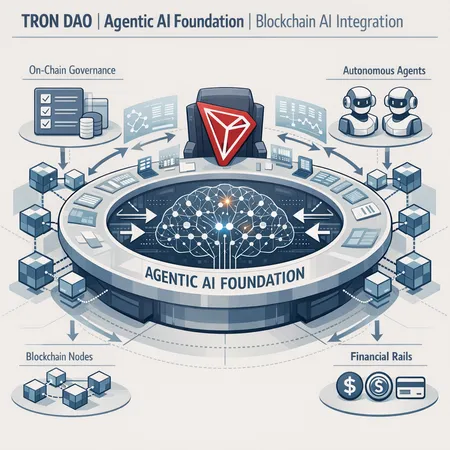
The Linux Foundation’s Agentic AI Foundation is assembling industry players to define how autonomous, agentic AI systems will interoperate, scale, and be governed. Its work focuses on standards for agent orchestration, safety controls, shared tooling, and infrastructure that lets agents act across services and environments. That ambition matters to blockchain developers because agentic AI—systems that plan, adapt, and take multi-step actions—will need deterministic, auditable, and permissioned pathways to interact with smart contracts, oracles, identity layers, and payment rails.
TRON DAO’s recent moves—announced as a partnership and a governing/member role—signal that a major blockchain ecosystem wants a seat at the table where those cross-domain specs are defined. Coverage of these developments highlights both partnership-level collaboration and TRON securing formal board-level influence: see the announcement and reporting on TRON DAO’s governing membership and board position for context (Tron DAO partners with Agentic AI initiative, Tron DAO becomes governing member, TRON secures board position).
For architects and builders, the open question is not whether AI will touch blockchains—the answer is clearly yes—but how: through off-chain agents writing transactions, on-chain policy engines directing execution, or hybrid approaches that keep sensitive models off-chain while exposing verifiable outputs on-chain. The Agentic AI Foundation aims to make those patterns predictable and interoperable across vendors and ledgers.
Why TRON DAO’s board seat changes the interoperability equation
A governing seat gives TRON DAO influence over specification design, membership criteria, and governance mechanics inside the Foundation. Practically, that matters in three ways:
- Standard shaping: TRON can steer protocol-level decisions about message formats, agent-to-ledger APIs, and cryptographic attestation schemes—elements that determine how easily an agent can sign and submit transactions on any chain.
- Reference implementations and incentives: With voice in the Foundation, TRON can help ensure that reference SDKs, test suites, and integration patterns support TRON-specific RPCs, transaction models, or identity primitives—lowering integration friction for developers who target TRON’s throughput and cost profile.
- Network effect and credibility: Board-level participation signals to enterprise users and developer communities that TRON wants to be a first-class participant in AI-native stacks. For many decision-makers, a presence in the Agentic AI Foundation is a credibility multiplier.
This is not purely liturgical: by joining the Foundation’s governance, TRON positions TRX and its governance apparatus to be part of the normative plumbing that connects agentic AI with on-chain effects—what I’ll call blockchain–AI integration.
Practical use cases: how blockchain and agentic AI can combine
Below are three high-impact, realistic use cases where TRON’s involvement could be material. I sketch the pattern, why interoperability matters, and technical considerations for builders.
On-chain governance augmented by agentic AI
Pattern: Autonomous agents analyze proposals, model economic impacts, simulate outcomes across market conditions, and either recommend votes or execute delegated votes under predefined guardrails.
Why it needs standards: Agents must reliably fetch snapshot state, interpret on-chain data, and create authenticated transactions. Standard APis and attestation flows let external AI systems prove their computations and authority when interacting with governance contracts.
Developer notes: Implementations will likely combine off-chain compute (for heavy ML workloads) with on-chain attestations (for auditability). Approaches include MPC-signed delegation, threshold wallets, and verifiable off-chain execution with cryptographic receipts. TRON’s low-fee environment could make frequent governance microtransactions economically viable.
Autonomous agents that interact with smart contracts
Pattern: Agents act as persistent actors that monitor market signals, rebalance portfolios, execute arbitrage, or liquidate positions across chains based on objectives and constraints.
Why it needs standards: Inter-agent messaging, secure identity, and cross-environment safety constraints (kill-switches, budget limits) require shared semantics—without them, agents can’t trustably coordinate with on-chain actors or other agents.
Developer notes: Builders will combine on-chain triggers (events or oracles) with off-chain decision logic. Critical infra includes robust oracles, signed action bundles, and replay-protection for multi-step agent flows. The Agentic AI Foundation’s work on orchestration protocols could standardize the “action bundle” format and error semantics, lowering integration risk.
AI-native financial infrastructure
Pattern: Risk-scoring oracles that feed lending protocols, AI-managed AMMs that rebalance liquidity pools, or automated credit desks that underwrite and execute loans programmatically.
Why it needs standards: Financial systems require high integrity for input data, explainability of decisions, and clear dispute resolution paths. Standardized attestation and audit trails let regulators and counterparties evaluate model behavior and trace decisions back to inputs.
Developer notes: To reduce systemic risk, teams should design dual-track flows: AI proposes and simulates on a sandbox, and only when checks pass are transactions committed on-chain. Combining TRON’s throughput with interoperable agent protocols could make frequent settlement cycles feasible for novel financial instruments. AI-native primitives have the potential to reshape DeFi UX by automating complex strategies for end users.
Strategic implications for TRX and developer adoption
TRON’s board seat is likely to influence both macro and micro adoption drivers.
- Token utility and demand: If agentic AI systems use TRX for transaction fees, staking, or governance delegation, demand could increase in proportion to agent activity. Frequent microtransactions executed by agents (governance votes, market operations) create a baseline utility for TRX.
- Developer incentives: Standards that include TRON-specific tooling reduce integration cost and accelerate time-to-market for AI-native dApps. Reference SDKs, CI test suites, and documentation generated under Foundation auspices make it easier for ML engineers to adapt models into agentic agents that work with TRON.
- Enterprise adoption: Many enterprises value predictable fees and throughput for AI-driven automation. A credible presence in the Agentic AI Foundation reduces perceived integration risk, making TRON more attractive to corporate pilots and proofs-of-concept.
That said, the net effect depends on how open and competitive implementations are. Widespread developer adoption favors openness and multi-vendor tooling; proprietary or tightly coupled stacks may shrink the potential ecosystem.
Risks: centralization, standards capture, and regulatory exposure
Board-level access carries responsibility—and risk. Here are the main pitfalls to watch for.
- Standards capture: If a small cohort of large vendors (including any single chain ecosystem) dominates specification drafting, the resulting standards may favor particular architectures or APIs, creating vendor lock-in. This can stunt cross-chain competition and limit choice for developers.
- Governance centralization: When a DAO or ecosystem influences agentic rules, there’s a risk decisions reflect the interests of a few stakeholders—especially if on-chain governance mechanisms are weighted toward large token holders or centralized validators.
- Concentration of power and attack surface: Agentic AI + smart contracts introduces novel failure modes. Compromised agents could execute large-scale automated transactions; weak interoperability assumptions could allow cascading failures across protocols.
- Regulatory scrutiny: Agentic systems that autonomously trade, lend, or manage assets will attract regulatory attention. Ecosystems seen as enabling automated market manipulation or opaque decision-making may face faster regulatory headwinds.
Mitigations include multi-stakeholder governance in the Foundation, transparent reference implementations, open-source SDKs, independent audits, and adoption of anti-capture governance patterns (time delays, multi-sig, and stake decentralization). Developers should design failure-handling and human-in-the-loop safety gates from day one.
A practical decision framework for builders and architects
If you’re deciding whether to build AI-native applications on TRON, ask these questions:
- Does your agent workload require high-frequency, low-cost on-chain interactions that favor TRON’s fee and throughput profile?
- Do the Foundation’s emerging standards include the APIs and attestation primitives you need (or are they likely to, given TRON’s role)?
- Can you design an architecture that minimizes sensitive model exposure (keep models off-chain, provide verifiable outputs on-chain)?
- How will you handle fail-safe behaviors, human overrides, and audit trails for automated actions?
- Are you prepared for potential vendor lock-in risks—what’s your exit plan if standards consolidate around other stacks?
If the answers skew positive and you value predictable costs and strong governance hooks into the Agentic AI standards process, TRON becomes an attractive option. If you need maximal neutrality and cross-chain portability today, plan for abstraction layers that decouple your agent logic from chain-specific SDKs.
Final takeaways
TRON DAO’s governing seat in the Agentic AI Foundation is a consequential move: it lets an ecosystem with a history of low-cost transactions and high throughput help shape the protocols that will enable agentic AI to operate safely and predictably with blockchains. For Web3 strategists, enterprise architects, and developers, this opens pathways to richer on-chain automation—especially in governance, autonomous agents, and AI-native financial infrastructure.
But influence is a double-edged sword. The upside is faster integrations, better tooling, and potential TRX utility growth. The downside is the risk of standards capture and centralization, which can reduce competition and invite scrutiny. Smart builders will engage with the Foundation’s standards work, design for portability, and bake in transparency and safety primitives from the start.
For teams building payment rails, P2P exchanges, or automated financial services, platforms such as Bitlet.app illustrate how payments and trust rails can be integrated into broader stacks—agents will be the next layer to consider. If you’re evaluating a TRON-first approach for AI-native dApps, weigh immediate operational advantages against long-term governance and portability requirements.