Why Ethereum Adoption Is Booming While Price Lags: Negative Funding, Rollups, and a Trader Playbook
Summary
The divergence: booming on‑chain adoption vs. muted price action
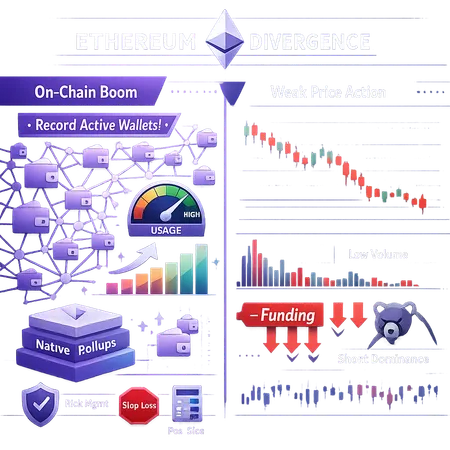
Ethereum's narrative is oddly bifurcated right now. On one hand, multiple on‑chain indicators—active wallets, transactions, and other usage metrics—are printing at or near record levels, a sign of genuine network adoption. On the other hand, ETH’s price has failed to follow, and derivatives markets are showing negative USD perpetual funding, which signals short dominance and puts a lid on rallies in the near term.
This combination creates a tricky environment for intermediate traders and investors: fundamentals (real usage) are improving, but market microstructure and macro forces are still suppressing price. Understanding the mechanics behind both sides is essential to building a coherent trading and risk strategy.
What the data is actually saying about network adoption
Multiple data points converge on the same conclusion: more people and protocols are using Ethereum. Santiment highlighted a surge in active users and growth in nonzero addresses, pointing to rising engagement on the network (Santiment data report). Complementary reporting shows record highs in overall network activity even while ETH price lags behind that user growth (CoinSpeaker coverage).
Why does this matter? Rising active wallets and transactions indicate expanding product-market fit: more wallets mean more potential fee flow, more DeFi primitives interacting, and a larger addressable user base. It’s not the same as price appreciation, but adoption is a leading fundamental that typically precedes long-term price revaluation.
Why fundamentals aren’t translating to price (yet)
There are several, often overlapping, explanations for ETH’s price lag despite stronger on‑chain metrics:
1) Liquidity and supply dynamics
High on‑chain activity can coexist with muted price moves when liquidity is fragmented. If large holders (exchanges, staking pools, or whales) are willing to supply ETH into buy/sell walls or distribute into new entrants, the net price impact is reduced. Also, staking and L2 custody patterns can lock ETH in ways that change available float but don’t immediately compress sell pressure.
2) Macro backdrop and risk‑off flows
Macro sentiment—rates, inflation signals, and risk appetite—still flows through crypto. Risk‑off episodes or tighter global liquidity can mute upside even if network usage improves. Traders often reduce gross exposure across risky assets, and crypto is still sensitive to those shifts.
3) Derivatives positioning and funding rate mechanics
Derivatives markets can temporarily dominate cash price direction. Recently, ETH’s USD perpetual funding moved negative, meaning shorts are paying longs (or more accurately, short sellers receive funding while longs pay, depending on convention), and that dynamic can cap price rallies as short liquidity absorbs buying pressure. CryptoNews analyzed the funding move and concluded bears regained control in USD‑denominated perpetuals (CryptoNews report).
4) Sentiment and narrative timing
Sentiment-driven markets move faster than fundamentals. Adoption tends to be a slow burn. If the market expects faster upside (or is anchored to past narratives like “the halving” for other assets), the gap between real fundamentals and price expectations widens until catalysts align.
Reading the negative USD perpetual funding rate correctly
A negative USD perpetual funding rate for ETH is an important signal, but it’s not a binary trade trigger.
- At face value, negative funding often suggests short dominance: more market participants are short ETH on perpetuals (or shorts are receiving funding), and that imbalance can suppress upward price moves. CryptoNews describes this shift as bears regaining short‑term control.
- Funding is a cost or income stream for levered positions. When funding is negative, being long is more expensive (or less rewarded), reducing leverage appetite for longs and making squeezes less likely unless spot buyers step in.
- However, funding rates are dynamic. Large, coordinated spot buying or a sudden liquidity withdrawal from shorts can flip funding quickly. Funding helps you read sentiment and positioning, not predict direction with certainty.
For traders, the actionable interpretation is: negative funding increases the probability of short‑dominated price action in the near term but also raises the asymmetric squeeze risk should spot buyers or on‑chain events remove liquidity from shorts.
How native rollups and roadmap catalysts could change the picture
Technical progress matters for longer-term fundamentals. Researchers recently demoed a proof‑of‑concept for native rollups, which could simplify Layer‑2 verification and reduce the overhead of interacting with L2s (The Block coverage).
Native rollups promise to streamline developer and user UX across scaling layers, lowering friction and possibly increasing throughput and composability. If they deliver, expect several medium-term effects:
- Improved developer velocity and cheaper UX for end users, boosting on‑chain demand.
- A healthier L2 ecosystem with reduced friction for asset movement and lower cumulative fees.
- An eventual narrative pivot where adoption improvements translate more directly into economic value capture on the Ethereum base layer.
That said, protocol upgrades work on timelines. Native rollups are a structural positive, but market participants will price in technical certainty gradually as implementations, audits, and live deployments materialize.
Practical trade ideas and risk management for intermediate traders
Below are tactical and structural considerations that connect on‑chain adoption, derivatives sentiment, and roadmap catalysts:
Tactical (weeks to months)
- Respect Funding: If USD perpetual funding is persistently negative, avoid aggressive long leverage. Consider trading range strategies (shorter time frame) or use smaller position sizes.
- Volatility‑aware entries: Use limit orders and laddered entries rather than slamming market buys into short liquidity.
- Watch liquidation clusters: Monitor exchange order books and open interest—clusters of long liquidations can amplify down moves.
Structural (months)
- Horizon alignment: If you’re buying based on adoption and roadmap (e.g., native rollups), size positions for multi‑month conviction and tolerate interim drawdowns.
- Hedging: Consider partial hedges (inverse ETFs, index shorts, options collars) to protect against macro or derivatives‑driven squeezes.
- On‑chain overlays: Use on‑chain signals (active wallet growth, L2 inflows) as confirmation before scaling into positions. Bitlet.app users, for example, can combine installment strategies with on‑chain monitoring to dollar‑cost into a thesis more prudently.
Stop logic and scenario planning
- Define stop levels relative to long‑term support, not only recent swings.
- Plan for a funding flip: If funding turns positive and open interest collapses on the short side, be ready for short squeezes that can create rapid upside.
Putting it together: strategy checklist
- Confirm adoption: Are active wallets, L2 activity, and protocol TVL moving in tandem? (On‑chain confirmation reduces false positives.)
- Measure derivatives sentiment: Funding, skew, and OI tell you how levered the market is.
- Time horizon: Short traders follow funding and liquidity; long investors price in roadmap catalysts like native rollups.
- Risk size: Limit leverage when derivatives skew against you; use collars or hedges if conviction is long but near‑term sentiment is hostile.
Conclusion
Ethereum’s current divergence—booming on‑chain activity versus muted price and negative USD perpetual funding—is a classic example of fundamentals and market microstructure moving on different timelines. On‑chain adoption is a positive leading indicator, but funding rates and macro liquidity determine how that adoption translates into price in the short run. Native rollups and other roadmap improvements are structural tailwinds that could compress this gap over time, but traders should align sizing, horizon, and hedges to navigate a market where derivatives sentiment still holds sway.
Sources